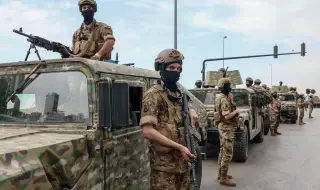
The agreement announced in Washington between Lebanon and Israel includes for the first time the idea of creating “pilot zones“, in which the Lebanese army would deploy in the southern part of Lebanon, after it had partially withdrawn from there at the beginning of the war in March, writes BTA, citing AFP.
The implementation of the text, however, requires the approval of the pro-Iranian organization “Hezbollah“, which rejected its conditions and insisted on the withdrawal of Israeli forces from Lebanon.
What are the practical dimensions of this measure and how feasible is it in a region like southern Lebanon, which has been filled with tension and conflict for decades?
Safe corridor
“The ceasefire is tied to a complete cessation of shelling by “Hezbollah“, says the text, announced after talks under the auspices of Washington between Lebanon and Israel, which do not maintain diplomatic relations.
The document provides for “withdrawal of all “Hezbollah“ members from the area south of the Litani River“, which is located about 30 kilometers from the border with Israel.
According to the ceasefire agreement that ended the previous war between “Hezbollah“ and Israel in November 2024, the pro-Iranian group's military infrastructure was to be dismantled by the Lebanese army in the area between the border and the Litani.
The army announced in January that it had completed this task. But a “Hezbollah“ representative admitted to Agence France-Presse that the organization had sent "reinforcements" in this part of southern Lebanon when it launched its war in support of Iran on March 2.
According to the Israeli ambassador to Washington, Yechiel Leiter, who was involved in drafting the agreement, the first step is for "the Hezbollah fighters who recently arrived in the south of the country to return to the north." He estimated their number at over 2,000.
"We will guarantee them safe passage" within a period of time "which will not be very long," he added, without giving further details.
A plan riddled with obstacles
The agreement provides for the "establishment of pilot zones" in which the Lebanese armed forces will exercise exclusive control over territory“ – first step towards a “comprehensive peace and security agreement“.
Lebanese Prime Minister Nawaf Salam announced that troops would begin deploying in these areas, large parts of which are currently occupied by the Israeli army since the start of the war on March 2.
“This is a plan riddled with obstacles, with many potential problems and uncertainties“, said Michael Young, an analyst at the “Carnegie” Center for Near East Studies.“.
“Nevertheless, this is the first plan that seriously addresses the issue of disarming “Hezbollah”, he told Agence France-Presse.
No direct confrontation
According to the analyst, if the army takes control of areas from which "If Hezbollah withdraws, the two sides will not find themselves facing each other, which would reduce the risk of a direct clash."
The plan "implies a tacit recognition by the Americans that the Lebanese army is unable to disarm Hezbollah by force," he added.
The Lebanese authorities, under pressure from Israel and the United States to disarm the group, declared its military activity illegal at the beginning of the conflict. However, this measure did not lead to any real results.
The government did not take further action, as in the event of a clash with the powerful pro-Iranian organization it feared for the unity of the country's fragile army, numbering about 80,000 soldiers of all faiths.
“The army "It will not fight against any Lebanese group in the country. It does not want to provoke a civil war," said retired General Khalil Gemayel, who once commanded the area south of the Litani. "Disarming Hezbollah requires a political solution," he added, "as has happened with the disarmament of other militias in Lebanon's history."