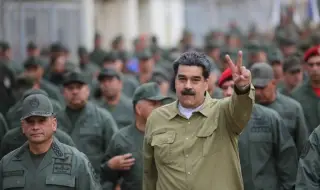
US President Donald Trump is having a hard time convincing businesses to return to Venezuela after he ousted its authoritarian leader in January. And Cuba may prove to be an even tougher task, Daniel Desrochers and Nahal Toussi write for "Politico".
The Trump administration continues to increase economic pressure on Cuban President Miguel Diaz-Canel through sanctions and an energy blockade, gradually moving closer to military action in an attempt to weaken or even topple the regime there.
But to help "build a better future" for Cuba — as Secretary of State Marco Rubio said in a video message to the Cuban people last week - it will require massive private sector investment on the communist-controlled island. But American business is wary. And without it, Cuba could become a dangerously impoverished and ungovernable country of about 10 million people, located just 90 miles south of Florida.
"We are talking about a country that has to be rebuilt from scratch," said Horacio Garcia Jr. "a Cuban-American business leader in Miami who is affiliated with the Cuban Freedom Council, an organization that advocates for democracy in Cuba. "There is no infrastructure for anything - water, electricity, nothing, nothing. There is no truly fair banking system. Everything has to be built from the ground up. We are talking about a country in ruins. Unlike Venezuela, whose oil sector is the main engine of the economy, Cuba does not have a single dominant industry that Trump could target, although American companies in the fields of agriculture and tourism have previously shown interest. The long rule of the communist regime in Havana has also resulted in a much more stunted private sector, as well as a crumbling public infrastructure. Any attempt to open up Cuba also carries the heavy burden of history - from the émigré community seeking to reclaim confiscated property to the layers of American politics that must be dismantled to encourage business development. That includes lifting decades of US sanctions - a process that will likely require congressional approval. Adding to the complexity is a Supreme Court case over the right of companies to sue for assets confiscated by the Cuban government in the 1960s — something the U.S. Chamber of Commerce has warned could expose American companies to lawsuits.
"Cuba is a complex and multifaceted place," said Mark Entwhistle, a former Canadian ambassador to Cuba. "Every aspect of it has its own long history and countless labyrinths".
A person familiar with the Trump administration's discussions on Cuba said the administration is in contact with business leaders about potential future investment in the island. The source declined to provide details of the talks, but insisted that the administration is "talking to people.".
There are already American companies — mainly in agriculture and motorcycle manufacturing — that are exporting to the island. Tourism companies, such as hotels and cruise lines, showed immediate interest in investing during the temporary thaw in relations with former President Barack Obama’s diplomatic opening to Cuba in 2015. Companies from countries such as Spain and Canada have also invested in the island, albeit on a limited basis.
Last week, President Donald Trump cited the Cuban-American community as a key resource for the country’s recovery. “They want to come back, they want to invest in their homeland and see if they can revive it,” he said.
But Trump’s team understands that Cuba needs serious political and economic changes before American companies will even consider serious investment, said the source familiar with the discussions.
“I’ve been building businesses my whole life, I’ve been investing my whole life,” said Sen. Rick Scott, a Republican from Florida. “Nobody is going to invest in risk unless they’re a fool. So you need a clear democracy, a clear rule of law. Otherwise, no one is going to take any money out. At least not in any significant amount."
Scott compared the reluctance to invest in Cuba to the similar hesitation of American companies to invest in Venezuela, even after the Trump administration succeeded in capturing autocrat Nicolas Maduro and installing his deputy, Delcy Rodriguez, who is actively working with the administration.
But as Entwistle notes: "there is no Cuban Delcy in Cuba."
"Unless there is a real war, sooner or later you will have to work with the Cuban government," he said. And according to Entwhistle, it has proven to be much more cohesive and unified than in Venezuela, where Rodriguez has collaborated with the White House.
"Venezuela worked because it was so weakened. I think Cuba is weakened too, but people deeply misunderstand Cuba and Cuba's extraterritorial influence," said a trade association representative, who was granted anonymity to share the business perspective. This includes Cuba's ties with countries like China and Russia, its passionate expatriate community in the United States, and ongoing litigation over assets confiscated by the Cuban government.
Investments by American companies in Cuba carry additional risk, for example, because of a 1996 U.S. law that allows people and companies whose assets were confiscated after the Cuban Revolution to sue any company that profits from that property. American Airlines and a Spanish hotel chain recently reached out-of-court settlements in lawsuits brought by Cuban-Americans who inherited confiscated properties.
Last week, the Supreme Court ruled that a U.S. port off the Cuban coast has the right to sue four cruise lines that used the docks between 2016 and 2019 under the law. The court is also considering another case in which energy company Exxon Mobil wants to sue over confiscated oil and gas assets.
Trade groups say businesses are not publicly discussing any interest in investing in Cuba, partly out of fear that broken promises in an uncertain economic environment could provoke Trump’s wrath.
“Everyone is quietly waiting,” said John Kavulich, chairman of the U.S.-Cuba Economic and Trade Council. "This means that companies that are already doing business with Cuba where they are allowed to do so are simply continuing their business but not talking about it. And those that are interested and waiting are gathering information and observing without advertising it because the risk is too great".
While companies are waiting, the United States is ramping up the pressure. Last week, the Justice Department indicted former Cuban President Raul Castro in connection with the 1996 killing of four people involved in civilian rescue flights - a political escalation amid the country's ongoing massive power outages.
"This is a failed state, everyone knows it. They have no electricity, they have no money, they have almost nothing," Trump said on Thursday. "We will help them".
The first thing Cuba needs from the United States is food.
Paul Johnson, chairman of the American Farm Coalition for Cuba, said the island would be in immediate need of food aid because the country's hog and poultry herds have been drastically reduced and a large-scale food crisis is already looming.
"I hope at least someone in this circle around the White House is talking about agriculture, because from both an industrial and a humanitarian perspective there is an obvious food crisis that nobody wants," Johnson said.
Currently, American companies export chicken, rice and beef to Cuba. Johnson said those exports could increase. If the United States lifts the embargo on the island, Americans could also start buying more Cuban agricultural products — from coffee and charcoal to tropical fruits and winter vegetables, as well as Cuba's famous cigars.
Repairing Cuba's crumbling infrastructure will be another urgent investment need. Entwistle said billions will be needed to modernize the island's infrastructure - from water and electricity to improving internet access - after decades of neglect.
Despite the huge obstacles, American businesses still see potential in Cuba - at least when it comes to tourists looking to visit a country known for its beautiful beaches and rich history.
Kavulich compared business interest in Cuba to an electrocardiogram, which shows peaks and valleys as it tracks the heart's activity.
"We are at a peak in terms of interest right now, but in a valley in terms of action," he explained. "There is a huge amount of knowledge, attention and interest in what will happen to Cuba, but because the question is precisely "what will happen?", no one is doing anything".