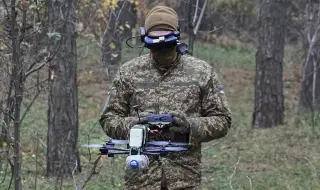
In the war with Russia, Ukrainians are developing innovations in the field of drones and combat technologies based on artificial intelligence at an incredible speed. Ukraine has turned its expertise into a product for global export.
Ukraine recently created an online portal in which it gave allied countries and defense companies access to two million hours of footage from drones used in the war with Russia - this is equivalent to 228 years. Every day, five new terabytes of material are added to this database. No other country has done anything like this before.
The Ukrainians’ motivation is this: they share data with their allies, helping them develop autonomous weapons, and in return, they get faster and smarter AI tools to use on the front lines. But the portal with the huge amount of data is just the tip of the iceberg. Beneath it lies four years of efforts on and off the battlefield, turning Ukraine’s expertise into a product for global export.
Ukraine used to have 7 drone manufacturers. Today, there are 500.
Part of it is a new software developed by a Ukrainian startup called KordycepsOS. It is named after the zombie virus from the video game adapted into the successful series The Last of Us. This Ukrainian cordyceps is a small black box that attaches to drones and allows engineers to change their functionality remotely. The biggest innovation is that everything you need is now in one box - previously, each different functionality required separate ones, which is difficult to achieve due to the size of the drones.
Olexander Bakmakh, who is the creator of this innovation, says he came to it out of necessity. "At the beginning of the war, we used FPV (first person View) drones to direct strikes. However, this technology also has its drawbacks - for example, it requires a constant connection between the drone operator and the drone itself," explains Bakmakh. This is a problem because the Russian army blocks the signal with radio waves. And if you lose the connection, the drones fall.
At the beginning of the full-scale invasion, Ukraine could not afford to lose drones - there were only seven manufacturers in the country. Today, there are over 500. Most of them are startups. One of the important such companies - BRAVE1, connects startups, front-line units and the government. The company's CEO Andriy Khristeniuk says that Ukraine is clear that it cannot compete with Russia in terms of resources. That is why an asymmetric approach is needed. "You need to give freedom to Ukrainian companies, and then they will sprout like mushrooms after the rain." The role of soldiers on the front is very important - they do not just use the products of these companies. They give them clear indications of what works and what does not, as well as what they need in the future.
On the front, drones with implemented artificial intelligence are very popular. "With a regular drone, the pilot can miss the target, but with this one, the computer takes over. It passes through the areas where the signal is blocked and does not drop, and when it is on the other side, the pilot regains control, "explains a soldier codenamed "Montero".
Artificial intelligence is also used for other purposes - another company is developing software that analyzes photos and videos from security cameras to independently indicate targets - this saves hours of work. The developers explain that the decision to carry out a strike is still made by a person, but the machine indicates possible targets. "There is a big difference between using artificial intelligence to get a recommendation and using it to carry out strikes independently," explains Danilo Zvok, CEO of the company A1.
In Ukraine, AI does not decide on its own. The person has the final say.
The Ukrainian army insists that drone operators in their army do not let artificial intelligence decide on its own what to strike. There is already evidence that this is not the case elsewhere, such as in Gaza. Human rights groups and the United Nations have expressed concern over revelations that Israel has used artificial intelligence to strike targets in the Gaza Strip. International organizations are now trying to regulate the use of artificial intelligence in warfare.
Ukraine has been warning the world for years that it should prepare to wage war primarily with drones powered by artificial intelligence. When the war in Iran began in late February this year, the Gulf states found themselves in exactly that situation - attacked by the same "Shahed" drones that Russia has been using to bomb Ukraine since 2022. Ukrainian President Volodymyr Zelensky has sent specialists to Saudi Arabia, the UAE and Qatar to share their experience. Ukraine's foreign minister has begun negotiating the sale of Ukraine's innovative interceptor drones.
This is an incredible success for a country that until recently begged its allies for military support - now Ukraine is not only selling its weapons, but also transferring its expertise elsewhere in the world.
In April, Germany became the first country to officially conclude an agreement to use Ukraine's vast database of drone footage from the front. Other countries are expected to follow. "This is an arms race. If a country doesn't participate, it is lagging behind and in danger," says one of the Ukrainian developers.
According to Andriy Khristeniuk, artificial intelligence could become the equivalent of nuclear weapons. "But our goal should be to develop artificial intelligence at a level that would allow us to deter new wars," he says.