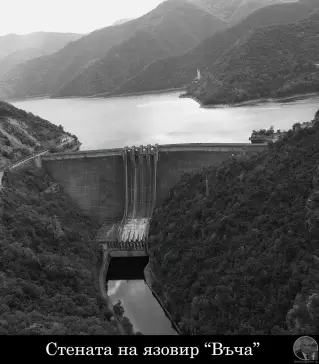
Have you seen the wall of the Vacha Dam? Years ago, traveling to Devin, I had this opportunity and was stunned. A 144.5-meter-high concrete pile, an engineering marvel, erected in the strength of the Rhodope Mountains, with a crown length of 420 meters.
This is what Rosen Petrov wrote on "Facebook".
A knowledgeable local man with obvious technical knowledge explained to me that the spillway consisted of four 8-meter spans and could "release" 2,060 cubic meters of water per second. In fact, whenever I have faced such structures – or even one of the old and rusty, and many of them already cut up industrial giants - I have felt a certain awe. Maybe because as a child I lived for a long time in a military factory (my mother, my grandmother and grandfather worked there and we lived in an apartment in the factory) and yet I have seen what kind of work was going on there. And maybe because I am trying to realize with what effort and sweat these "things" were built. Bloody sweat and a lot of calluses. But here I am talking about the dams, because many of the factories went for scrap, and some were clearly built in the wrong places and with the wrong strategy - or at least that is today's story. And look, the dams are still standing. And I imagine what an even greater water shortage there would be if they and what our fathers and grandfathers built were not there.
Only for the decade between 1960 and 1970 in Bulgaria 95 large dams were built. The "Vucha" in question was built from 1968 to 1975. The world statistics of ICOLD (International Commission on Large Dams) - a serious organization - says something interesting: in terms of the pace and intensity of dam construction in relation to territory and population, Bulgaria then ranked third in the world. After industrial and technological giants such as the USA and Japan.
Why am I telling you this? Not to mourn the past. But because it is curious how in those times, 200 large dams were built in 40 years, of which 52 are defined as "strategic", and in the last 37 years we have completed only... 11. And while today we argue about every repair, these 52 "veterans" continue to keep us afloat. Literally. In fact The comparison is far more startling, because 8 of these 11 "new" dams were simply completed in the early 1990s, and only two were actually built entirely after 1989 - "Plovdivtsi" and "Tsankov Kamak".
But let's get down from the high walls and look at something that is talked about less often - the cost of this concrete in human sweat. Because these walls did not appear with a magic wand.
Thousands of builders and laborers were mobilized just for the construction of the "Iskar" dam. They did not have modern laser levels or computer-controlled excavators. They had shovels, picks, and endless perseverance. They worked in three shifts, 365 days a year, in winter temperatures of -20°C in the mountains. Do you know how much concrete was poured into the wall of “Iskar“ alone? Over 180,000 cubic meters. Now imagine that every cartload of this concrete went through a human hand. This was “labor enthusiasm“, often underpaid or “free”, but backed up by strong, harsh discipline. Young people aged 18-20 who spent their youth in tunnels full of dust and groundwater. During the construction of the “Belmeken-Sestrimo“ cascade alone, over 100 kilometers of diversion tunnels were dug high in the mountains. Bulgaria was among the leaders in digging hydrotechnical tunnels in difficult rock conditions.
And here it gets even more interesting, because Bulgarians build complex hydrotechnical facilities not only in our country, but also around the world. Let's take as an example Morocco. There, the Bulgarians are building the Mansur Eddabi Dam - a key facility that is transforming agriculture in the region. Or Syria, where our specialists are designing and building quite a few small and large dams, including the huge Rastan hydroelectric power plant. I love these kinds of jobs.
And when you pass by one of these dams in our country today, remember not only the millions of cubic meters of water, but also those guys who built them. And if you accidentally touch the cold concrete, you can feel a little warmth in it - whether because it is heated by the warm sun, or because the hot blood of an entire generation has frozen in it. Let us remember.