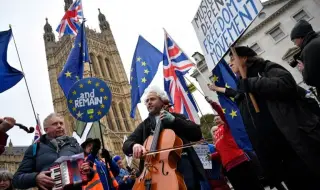
London is the largest financial and commercial center on the island. Before leaving the EU, the two opposing camps - supporters and opponents of Brexit - drew the most dramatic scenarios. Which turned out to be true.
Ten years ago, 60% of Londoners wanted their country to remain in the European Union. And this is more than logical - London is the largest commercial, financial and tourist hub on the island.
A new analysis by the authorities in the capital, quoted by the BBC, concludes that "Brexit has limited London's potential to create jobs, increase productivity and improve living standards", although it acknowledges that other factors have also contributed to these results.
London's economy is 30 billion poorer
"Locals constantly complain about absurdly high food bills and chronic staff shortages," journalist Vasil Hristov, who has lived in London for six years, told DW. "Business people say that because of the new customs bureaucracy they have simply thrown up their hands and stopped trading with the continent."
Mayor Sadiq Khan, who came to power in the 2016 referendum, has insisted that the next Labour leader must promise to work towards re-joining the EU. "Studies show that London's economy is £30 billion smaller than it would otherwise be. The average Londoner is £3,400 poorer. As a result of Brexit, we are seeing less investment and less trade," Khan argued.
During the campaign before the Brexit referendum, both sides drew dramatic scenarios. Supporters of leaving the EU said it would free up businesses, free them from regulation and allow London to become a second Singapore. According to the other camp, Britain outside the EU also means a loss of workforce, businesses and potential.
London - still important, but with more limited potential
Neither scenario has fully materialized, notes “Politico”. London remains Europe's main financial center, occupying a leading position in currency, securities and commodities trading, as well as in cross-border banking. In addition, the city remains the European center for insurance and financial technology.
At the same time, however, London has lost its momentum, its share of global markets has fallen, and Britain's economic engine has slowed down much of its energy. “London remains a global colossus and is quickly filling the gaps with staff from Asia and Africa, but the feeling is that it is a cosmopolitan city that looks back with nostalgia on Europe”, commented Vasil Hristov.
After the UK left the EU, other cities in Europe such as Paris, Frankfurt, Milan and Amsterdam tried to attract those businesses that wanted to operate on EU territory. Banks, insurance companies and other investors opened offices there to continue doing their business. And these new offices brought with them jobs and cash receipts.
Rob Rooney, who in 2016 headed the London office of the investment bank “Morgan Stanley”, tells “Le Monde” how a legal structure was immediately created in Frankfurt and asset management was moved to Dublin. In addition, offices in Paris, Milan and Madrid were expanded. According to a 2021 report by the think tank “New Financial”, the American bank has moved between 400 and 500 employees and assets worth 90 billion British pounds to the continent.
The big winner is New York
In the first two years after leaving the European Union, assets worth about 1 trillion British pounds of about 440 financial companies were transferred to continental Europe. Dublin attracted the most companies, followed by Paris and Luxembourg.
But although it has lost some of the investment, London remains a leading financial sector, and some areas such as the insurance business have seen significant growth in recent years. However, the British capital lags far behind New York. The big winner from Brexit in this regard is the United States, which has attracted much of the investment, notes „Politico".
Investment in technology in the United States, the dominant position of New York and the loosening of regulations, especially by Donald Trump, are crucial. „The United States is the largest market and the gap is widening. The EU is growing slower," Miles Selick of the lobby group TheCityUK told „Politico".
The tough game ahead of the future prime minister
All eyes are now on Andy Burnham, the frontrunner to replace Starmer. “Sadiq Khan's call for a swift return to the EU has become a real stress test for the next leader of “Downing Street”, commented Hristov. “Burnam has quickly decided to bypass this political minefield - although he had previously admitted that he wanted to see Britain back in the EU “within his lifetime”, today he categorically refuses to reopen “Pandora's box” with a new referendum. The reason is the so-called “Red Wall” - that traditional chain of industrial and working-class constituencies in Northern England and the Midlands, which historically vote for Labour, but in 2016 massively supported Brexit", explains the journalist.
London today is still a magnet for investment and a global economic center, but far from the scale it could be, experts are convinced. And while returning to the EU is a taboo topic for those in power, the other camp is not asleep. “Nigel Farage is already rubbing his hands and lurking in ambush, ready to brand any economic rapprochement with Brussels as a “quiet betrayal of Brexit" in order to steal valuable votes", summarizes Vasil Hristov. “Burnham will have to balance on the razor's edge - to make it easier for business without giving Farage new electoral ammunition."