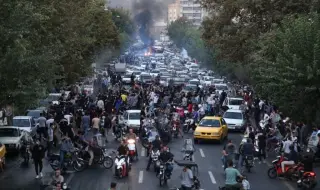
"The resilience of Iranian society should not be underestimated," experts warn. Despite the economic burden and the blows of the war, opposition to the regime and its repression has not subsided.
Amid ongoing negotiations between Washington and Tehran, the United States has lifted the ban on trade in Iranian oil until August 21.
The US Treasury Department has issued a temporary license that allows the production, supply and sale of Iranian crude oil. The suspension of sanctions is a central element of the framework agreement that the two countries signed last week.
Billions for Iran
In parallel, the United States and Qatar are negotiating the release of about six billion US dollars in frozen Iranian oil revenues intended for humanitarian purposes. "The funds released will be used to purchase food products. They will be purchased only by our farmers in the United States," the US president said on Monday.
Iran continues to urgently need additional financial assistance. According to preliminary estimates by the Iranian government, the damage from the war amounts to about 229 billion euros. It is not known whether or when the $300 billion fund for the recovery of the Iranian economy, envisaged in the preliminary agreement, will be created.
Inflation will continue to rise
According to Iranian Minister of Economy and Finance Seyyed Ali Madanizadeh, in addition to the existing budget deficit, the government has been forced to borrow billions more from the Central Bank to cover war-related costs. These loans are likely to significantly fuel inflation in the coming months.
"A deal with the US will not fully normalize the Iranian economy," warned the minister, who is a graduate of the University of Chicago. "The significant inflationary effects of the new debt will soon be felt."
Economist Ahmad Alavi also does not expect tangible improvements in the short term. In an interview with DW, he points to the experience with the 2015 nuclear deal: While higher oil revenues and less foreign policy pressure could provide the economy with a kind of "artificial respiration", without deep structural reforms, the effect will be limited and unsustainable, he warns.
For years, Iran has been in a severe economic crisis caused by sanctions, mismanagement and corruption. The war, as well as the blockade of Iranian ports by the US in response to the temporary closure of the Strait of Hormuz, have further worsened the situation.
Food prices have risen significantly in a short time. This is particularly noticeable for eggs - the price of a pack of 15 eggs has risen from around 70,000 tomans to over 200,000 tomans within a year, which is almost a three-fold increase. Other basic food products such as oil and imported rice have also risen significantly.
"Prices are rising literally every day", says a 28-year-old woman from Iran. "My husband and I both work and have a small child. However, we have to do without a lot of things. I don't believe prices will fall again."
The exchange rate has recently fallen slightly - according to the news portal "Tabnak", the dollar has fallen from around 1:190,000 to around 1:150,000 tomans. However, the situation remains difficult for consumers. Rising rents are forcing more and more people to move into smaller apartments or live with relatives.
"Many Iranians want change"
The authorities fear social discontent. According to the Social Affairs Organization of the Ministry of Interior, a large part of the population is experiencing financial difficulties. The head of the organization, Mohammad Batei, cites official surveys that show that about 60 percent of people can no longer bear the economic burden. The share of Iranians who are pessimistic about the future is also high.
Iranian President Masoud Pezeshkian also expresses concern. He fears that economic problems could lead to protests. "Discontent could once again spill over into the streets," he warns.
"Do not underestimate the resilience of Iranian society"
In an interview with DW, sociologist Merdad Darvishpour described the current situation in Iran as "an unstable order." The political system is currently struggling to survive. The war has not only caused enormous economic damage, but has also left deep social and psychological scars.
However, the professor at Mörlardalen University in Sweden remains cautiously optimistic: "The main question is whether this society can reorganize itself after defeats, repressions and collective traumas. My answer is "yes". The resilience of Iranian society should not be underestimated."
The political system will not be able to erase all the changes - for example, the growing resistance to the mandatory wearing of the hijab. The "Women, Life, Freedom" movement has already permanently changed social relations. Even in conditions of severe repression, women continue to go out on the streets without the hijab.