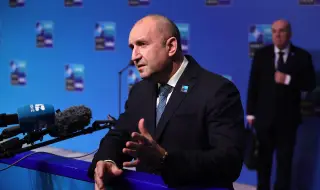
Daniel Smilov's comment:
What is the Bulgarian national interest? "Russian", some ill-intentioned observer of the efforts of Rumen Radev's government to conduct a "sovereign" foreign policy would probably say. The latest cabinet decisions suggest that it is in Bulgaria's interest to remove Patriarch Kirill (an apologist for aggression in Ukraine) and two oligarchs from Vladimir Putin's entourage from the EU sanctions list, as well as for the country to refuse to provide unilateral aid to Ukraine (due to lack of funds and capabilities) and to reject the invitation to join the coalition of countries creating ballistic defense for Europe and Ukraine.
Bulgaria's place and the Kiev Declaration
Radev himself announced in Paris, where he was kindly invited by Macron to the July 14 celebrations, that Bulgaria's place is not in this coalition. But on July 15, the website of the Ukrainian presidency published information according to which the Minister of Foreign Affairs of Bulgaria Velislava Petrova-Chamova had also adopted a 21-point declaration in Kiev supporting the territorial integrity of Ukraine, the just defense cause of this country, as well as the efforts of the so-called "Coalition of the Willing" to support it. In this regard, a discussion arose in Bulgaria as to whether the declaration had actually been signed or not. Today, the Minister herself, as well as Prime Minister Radev, announced that no signature had been placed. Petrova-Chamova emphasized: "Nobody has signed any declaration. Such declarations are not signed. Declarations of this type are constantly adopted in different formats. Our position remains exactly the same as before: Bulgaria defends its interests, but does not prevent its allies and other partners from defending theirs and participating along the line they want, so in this case absolutely no commitment has been made for Bulgaria's participation in the "Coalition of the Willing" or in any other type of format, and it is high time to stop this speculation".
Some analysts and observers see "strategic ambiguity" in this policy of Bulgaria. In the sense that there is ambiguity, but no strategy. Others explain the Prime Minister's behavior with a desire to please the pro-Russian part of his electorate. Both so that they are satisfied and so that Bulgaria does not interfere too much with Europe. Still others hope that with this policy Bulgaria insures itself against a Russian attack (conventional or nuclear) in the event of a possible escalation of the conflict.
In fact, all three explanations are wrong. If "strategic ambiguity" means waiting to see who wins before taking a stand, this policy is a sure path to contempt from everyone: from Europe and Russia. Radev's electorate will at some point listen to Kostadinov's accusations that behind the anti-European facade of the "new policy" there is actually nothing new in essence. And whether Gundyaev or Alekperov are on the EU sanctions list will not be a consideration for Putin when deciding whether and how to escalate the war.
Ultimately, the big problem with Bulgaria's "new sovereign policy", with which it supposedly defends its national interest and shows that it can say "no" to Europe, is the following: there is nothing new in it, nor sovereign, and even less defending the national interest. This policy also confirms the old maxim that those who talk the most about defending the national interest usually do nothing substantial about it.
Don't others in Europe want peace?
In his statement on Facebook today, Radev once again recalled: "I said years ago that if the military actions are not stopped, the war will expand its spatial scope". But in fact, the insistence on resolving the conflict diplomatically is empty of content. Because no one in the world is against resolving the conflict diplomatically. The whole point is that Russia does not want to stop the war and sit at the negotiating table if Ukraine does not cede four of its regions to it or at least withdraw its troops from Donbas. These regions are not occupied in their entirety by Russia and it is not clear whether it will ever be able to completely occupy them. The Ukrainian position is for freezing the conflict along the front line and starting negotiations immediately afterwards. Which of the two positions does Bulgaria support? Or maybe some third position is being considered? Until there is clarity on these issues, the Bulgarian position is actually hollow and offensive to its EU partners. As if others in Europe do not want peace, but only Bulgaria. As if the Bulgarian Prime Minister is a peacemaker and the others are not. For internal use, this may still pass, but no one who closely follows international politics would have any doubt about the emptiness of the Bulgarian statements made at the highest level.
A lot has been written about the "stopping" of aid to Ukraine. But you can't stop something that hasn't been given for years - like unilateral military aid from our military warehouses. Also, Bulgaria does not claim (thank God) that aid to Ukraine from Europe should be stopped: if that happens, Ukraine will probably have to surrender. In this sense, Bulgaria continues to participate in collective forms of support for Ukraine, which are the most important at the moment. So, if we remove the rhetoric on the issue, there will be no very significant change in the Bulgarian position on it.
And finally, we come to Bulgarian support for Patriarch Kirill, Alekperov and the third oligarch we protect. When people socialized in late socialism start defending Orthodoxy, it is probably clear to everyone that it is not about religion. What else it is about is not very clear, but it is certain that it is not about religion. The defense of Alekperov and the other Putin ally has absolutely nothing to do with the national interests of Bulgaria. Why then does Bulgaria decide to take this step? One thing is clear: that "Neftokhim" Burgas and the Sofia metro are as much connected to the topic of personal sanctions against Alekperov and Makhmudov as a former KGB agent may be connected to Orthodoxy.
Foreign policy is a delicate matter, requiring aerobatics. The loopings of our doves of peace so far cause more wonder than admiration. Bulgaria is a country with weight in international relations, which historically has played an important role in Europe. But experience shows us that the desire to derive benefits without contributing to the common cause ends in failure. Bulgaria's privileged position today stems from its membership in the EU. A strong EU is of exceptional Bulgarian national interest. Even Eurosceptics have clearly understood this and voted en masse not for radicals like Kostadinov, but for "Progressive Bulgaria", despite its unclear positions.
Today we support Ukraine and the Europeans declaratively, we do not wish to be legally bound by anything. We want peace, but we do not stand against the aggressor and we do not want him to be held legally responsible. We want to be strong and independent, but if possible, someone else should pay for the common defense and protection. To some, this behavior may seem cunning in the sense of Hitar Petar and Nastradin Hodja. But their tricks are for talk, not foreign policy.
If there is a principled consideration that explains Bulgaria's reluctant Europeanization regarding the war in Ukraine, it is perhaps Prime Minister Radev's conviction that there is no way a nuclear power can lose a war. It has been said that there are actually no historical arguments for such a conviction, because nuclear states have quite often lost military conflicts. The question is different, however, and it is whether everything a nuclear state asks for should be given to it? Ukraine is ready to negotiate based on the current state of the front. However, Russia wants more than that. With its behavior, Bulgaria creates the impression that it is ready to recognize these Russian claims. In fact, Putin has said something else: that he wants NATO to return to its 1997 borders. And are we willing to discuss this?
The strength of medium-sized and small countries internationally lies in their ability to defend a principled position together with other like-minded countries. It is time to reflect on the principled position we stand for and who our partners are. Since the answers to both questions are clear, there is no need for "strategic ambiguity" in our positioning.