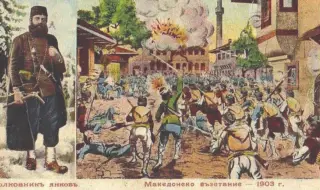
Despite the countless historical testimonies of the Bulgarian origin of the majority of the population of Macedonia, including Vardar, and without a single serious historical document attesting to the existence of a Macedonian people and language, the Serbomaniacs of Skopje have pierced the ears of the European headquarters that the Bulgarians are encroaching on their Macedonian identity. Of course, they can be crushed to dust for their unprecedented impudence, as long as adequate and responsible politicians who know how to protect the interests of their country come out to meet them in Bulgaria.
This is what is written for "Trud" Assoc. Prof. Dr. Yordan Velichkov.
I have repeatedly stated and maintain the thesis that with the Skopje Serbo-Romani group, any talks about overcoming differences and common positions concerning our past are impossible. The false thesis, replacing the national consciousness of the Bulgarians with the Macedonianism fabricated by the Serbian nationalists, must be a transitional act towards the Serbianization of this indigenous Bulgarian land and population. And it can only be established in conditions of extremely deteriorated relations between Sofia and Skopje, of frantic confrontation and propaganda demonizing Bulgaria and everything Bulgarian.
This is the reality that the Bulgarian political stratum, both the one in power and the one in opposition, failed to understand.
And the only approach of the Bulgarian side to the extremely hostile and arrogant policy and propaganda is a scientifically organized, uncompromising and consistent exposure of the criminal essence of Macedonianism.
Currently, 123 years are being marked since the Ilinden-Preobrazhensko Uprising - the first significant event of the 20th century. In the then emerging pre-war situation in Europe and the world, it became one of the central news stories of the European and American press. In 1,700 articles of leading American newspapers and magazines, the most detailed information is given about the causes, goals, tasks of the uprising, the heroism of the insurgent people and its brutal suppression. The New York Times alone, the most widely circulated newspaper in the world, published over 350 articles covering this event.
The press of European countries, especially the large ones, covered the uprising in 6,500 printed materials.
All European publications, except for some German and Austro-Hungarian ones, wrote about the just cause of the insurgents. In addition to the heroism and self-sacrifice in all the materials, the correspondents repeatedly, in tens of thousands of places, emphasized that the uprising was the work exclusively and only of the Bulgarian population. There is no article, comment or correspondence from the scene of the event that does not mention the self-sacrifice of the insurgents, the massacred Bulgarian women and children, the destroyed and burned dozens of Bulgarian settlements.
In the entire American and European press, there is not even a single sentence that mentions that another ethnic group participated in the uprising. This fact alone is a sufficient argument, revealing the boundless impudence, the ruthless and brazen falsification of indisputable historical evidence. Moreover, it shows that Bulgaria is facing not normal partners, but ruthless political charlatans, for whom the seizure of foreign lands and the assimilation of foreign populations is the meaning of their lives.
The Bulgarian archives have all the information materials concerning the uprising.
All of them are in the language of the country whose correspondents covered the event. And this is a ready-made authentic historical document, crushingly exposing Macedonianism. All that is needed is the goodwill and sense of responsibility for the fate of Bulgaria from the leading management teams to make this information accessible to all European capitals, and also outside Europe. Such a move will undoubtedly expose the falsification of an ancient Macedonian people and language.
In two years, 125 years will have passed since the Ilinden-Preobrazhenie Uprising. It is time for the two organizations, the VMRO and the Thracian Societies, to traditionally celebrate the anniversaries of the uprising, which is an honor for them, and for state institutions to also get involved in this event. This is one of the largest uprisings of the Bulgarians during the Ottoman rule. Therefore, we have no right to treat it with disdain.
But it seems that our state's attitude towards the history and fate of Bulgarians outside Bulgaria is becoming a practice.
For example, this year in April it was 185 years since the Niš Uprising (1841) - the second in number of rebels - over 20 thousand.
In addition to the Bulgarians from Niš who participated, it included a number of villages from other Bulgarian regions - Leskovac, Pirot and Vidin. After its defeat, Serbia closed its border to the defeated rebel detachments, abandoning them to the mercy of the Turkish enslavers. And why? - Because they were Bulgarians.
Along with the rebels, another group of 10 thousand peaceful villagers were saved from the raging hordes thanks to the energetic intervention of Russia in Serbia, forcing it to allow them into Serbian territory. And as is known, Serbia received autonomy thanks to the Russian ultimatum to the Sublime Porte.
Why are we not mentioning these compatriots of ours, who raised the uprising in order to live freely as Bulgarians?
At the same time, there are still villages in the districts of Niš, Vranja, Leskovac and Pirot, in which the Bulgarian dialect language has been preserved. There is even a curious anecdote in this regard, which the Serbs themselves tell in Belgrade:
A Serb from Belgrade and a Niš resident are traveling on the Belgrade - Niš train. The Serb asks the passenger in the compartment where he is from. The answer is: “From Niš.“ The Serb reacts: “Ah, you are from Niš.“ The Niš resident, irritated, answers bluntly: “Well, I know better where I am from. I am not “from Niš“, I am from Niš.“ Obviously, the Serbian case form is not used in the places mentioned.
Undoubtedly, the expression of interest in the fate of several hundred thousand Bulgarians who fell within the borders of the Serbian state during the Russo-Turkish War of Liberation (1877-1878) will reveal the crude denationalization methods of our western neighbor.
However, they are already part of the Serbian nation. And the fact that a significant number of them have Bulgarian blood is a serious reason to suppress the hostility and anti-Bulgarian policy and propaganda of Belgrade, and for both sides to use this fact as a uniting, rather than a dividing factor, between Bulgaria and Serbia.