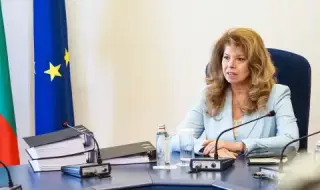
Will Iliyana Yotova repeat the trajectory of Zhelyu Zhelev and Georgi Parvanov or will she lose in a runoff? It all depends on what phase Rumen Radev's administration is actually in.
Iliyana Yotova could have announced her candidacy for president at the last minute because she has the strategic comfort of an incumbent president. She does not need to enter a campaign, because the post permanently provides her with one, as well as a rating that starts at a very high level - about half of the voters evaluate her work positively according to sociological surveys. The lowest level of approval for a president was at the end of Rosen Plevneliev's term - 21%.
Yotova tactically entered the race just when the ruling party seriously angered its voters with the American tanker planes in Bezmer. Radev as president had pumped up expectations that Radev as prime minister would not allow such things at all - not only at Sofia airport, but in the country in general. Just as he had pumped up expectations with the referendum on the euro - he was caressing the ear of both those who were afraid of its introduction and those who did not want it at all. With her application for the presidential race, Yotova was supposed to ease the tension as the main contender, who was also the first to announce her application, as well as consolidate the rule of her former boss.
She even consolidated it by dispelling the not very well-founded suspicions that Radev might choose another candidate or juggle with two until the very end.
Initiative committees have become the norm
Since the first direct presidential elections in January 1992, the nomination of presidential candidate pairs with initiative committees has begun, and to this day this is more the rule than the exception. It creates the illusion that the candidacy is almost a civil one, while in fact the initiative committee is more of a legal procedure and an opportunity for the candidate to be decorated at the start with authoritative names from various professional fields who are not party members.
In the 2016 presidential elections, Rumen Radev was first nominated by the BSP, which the then party leader Kornelia Ninova recently described as her biggest mistake, and then the BSP also announced that it was nominating him with an initiative committee, headed by Stefan Danailov, then deputy chairman of the party. Now Iliyana Yotova has also announced her candidacy through an initiative committee, but was immediately supported by the BSP, and after her by "Progressive Bulgaria".
An initiative committee must also nominate the candidacy of Andrey Gyurov, indicated as the candidate of the democratic community, the party leaders of which expect him to first give his consent to enter the race. Daniel Valchev, who also has not yet said definitively whether he will participate, verbally decided for himself to remove the civic mask of the initiative committee on the party anthropology of presidential nominations. He would be a purely civic candidate and would not even hold talks with parties for support, although prominent GERB party members such as Vladislav Goranov in a personal non-partisan capacity promised him such.
Everyone who wins the first round wins the second round
The presidential elections pose the question, for which the initiative committees are only a wish - how to overcome narrow-party support, in a particularly categorical manner. Because in the conditions of party-political pluralism, the direct election for president is highly polarizing. It is no coincidence that in the seven direct elections since 1992, we have not had a president elected in the first round. And the second round is practically a completely new choice, when the opportunity opens up for a broader consolidation within the polarization between the remaining two contenders.
However, our history of the presidential vote shows that in the seven presidential votes so far, the winner of the first round has always been the winner of the second. But mobilizations, as a result of the expansion of the electorate, have occurred in both the gold and silver medalists. In 2001, Georgi Parvanov emerged from the first round with a very fragile lead over Petar Stoyanov, but in the second it became categorical - the red candidate added 1 million votes, and the blue - 740,000. The incumbent president lost. In 2011, Rosen Plevneliev had a clear lead over Ivaylo Kalfin in the first round, but it eroded significantly in the second, when Kalfin increased his votes almost twice as much as Plevneliev managed, but this did not help him defeat the candidate of the ruling GERB.
The presidential vote follows other political dynamics
Large mobilizations for the presidential vote are usually the result of a radical change that has already occurred. Petar Stoyanov, for example, lost after Ivan Kostov lost the parliamentary vote to Simeon Saxe-Coburg-Gotha months earlier. And they are almost absent as a safeguard vote when a threat looms - as when in 2006, on the eve of our European membership, it was threatened by nationalism and anti-Europeanism with the exit of Volen Siderov from the "Attack" in the runoff. On the other hand, in 2002, the French massively stood behind the right-wing Jacques Chirac in the second round in the face of the danger of the nationalist Jean-Marie Le Pen coming to power and Chirac beating him 5:1.
A third option for over-mobilization is for such a majoritarian supra-party player to emerge who, with irresistible authority and charisma, can erase party divisions. We have never had such a stunning case before and we can hardly expect a similar one in the fall, because it would already be recognizable, even though we currently have an incomplete line-up of contenders.
Will the voter put all their eggs in one basket?
Then for October-November 2026, the question remains what phase of support the new government is in and whether it will reconfirm it in the presidential vote through Iliana Yotova, or whether voters will prefer not to put all their eggs in one basket, as the democratic opposition hopes.
The seven presidential votes so far indicate that the voter almost always prefers an opposition president. He is in power only when he wins a second presidential term - like Parvanov in 2011 and Zhelev in 1992. The only exception is Plevneliev in 2016, who was a candidate for the ruling party.
What phase is Radev's government in?
Yotova is currently in a position similar to Zhelev - a president incumbent, but not quite directly elected, but as Radev's runner-up. Will she repeat the trajectory of Zhelev and Parvanov a la a second term, which according to the President of the Constitutional Court Pavlina Panova will be her first, or will she lose in a runoff? It all depends on what phase Rumen Radev's government is actually in - stable like the SDS in 1992 and the GERB in 2016, or already eroded despite its very early stage. And whether voters, who are generally inclined to support an oppositionist, have started to dislike the current rulers more than the previous ones, so as not to prefer Yotova. However, an opposition presidential candidate has never faced a ruling party with a one-party absolute majority, except for the BSP in 1996, which had already collapsed the country with hyperinflation.
So the key to the vote in the fall will be who will go to the second round and whether there are prerequisites, but also a person who can unite the votes not only of the former "assembly workers", but also of the voters disappointed with Radev. Or will the second round actually turn out to be a one-horse election with lower voter turnout than the first - as has always happened so far. There are two exceptions: 2001 when Parvanov won over Stoyanov and barely noticeable in the first elections in 1992 when Zhelev won over Velko Valkanov, but with the unthinkable turnout of over 75% in the votes after that. After the turbulent political upheavals in the last 5 years and the unprecedented majority of 131 deputies, political time is very compressed. So it is not at all excluded that the remaining 3 months until the vote will again lead to a sharp turn.
This text expresses the opinion of the author and may not coincide with the positions of the Bulgarian editorial office and the State Gazette as a whole.