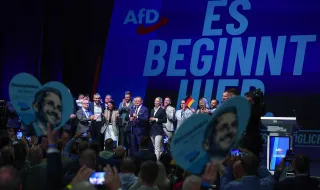
Three votes. That's all the "Alternative for Germany" needs to elect the first far-right state premier in the Federal Republic since World War II.
If it gets them, it will put an end to the so-called cordon sanitaire - a coalition against the far right similar to the one in France, which has been blocked on its way to the Elysee Palace for decades.
However, another country close to Germany has long since broken it. As early as 2000, the Austrian People's Party allowed the Freedom Party (FPO) to come to power in Vienna. A decision that shocked Europe at the time and whose consequences are particularly relevant today.
Former Nazis remain in politics after the war
The Freedom Party of Austria was founded in 1956, and its first leader, Anton Reinthaler, was a former Nazi general. Former representatives of the Nazi regime joined the party, many of whom were banned from the two "big" forces - the conservative Austrian People's Party and the Social Democratic Party.
In the following decades, it was a marginal force, but had permanent representation in parliament. At that time, however, the Freedom Party presented itself as a moderate national-liberal party that distanced itself from far-right ideologies. It even supported Social Democratic governments several times in the 1980s.
Until the arrival of Jörg Haider, who became leader in 1986. Haider took the turn that turned the SPD into what it is today - a Eurosceptic, anti-immigrant and far-right force that opposes the social contract in Austria and key aspects of liberal democracy.
Haider's behavior and the xenophobic and anti-Semitic statements of the SPD leaders once again made any partnership with his party taboo. Until 2000.
When the Grand Coalition is exhausted
Like Germany, in Austria since World War II there have been two parties that dominate politics and always send the chancellor. However, the need to form a Grand Coalition, which has been in power since 1987, began to affect the election results.
In 1999, the Austrian People's Party became the third force for the first time in its history. The Social Democrats came first with 33.15%, and the Austrian Freedom Party came second with a historic result of 26.91%.
The leader of the conservatives, Wolfgang Schüssel, made a decision that shocked Austria and Europe. He offered a partnership to the far right on the condition that he be chancellor in the cabinet. The European partners reacted sharply - Vienna was placed under diplomatic isolation. But Schüssel had a plan.
"Taming the Far Right"
In government, the far right did not become less radical. But it failed to keep its promises. Most of the key messages from the campaign never became a reality. At the same time, tensions grew between the different wings of the party. The coalition was dissolved, and in 2002 Austria went to early elections. Schüssel's conservatives won with 42.30%, while the far-right collapsed to 10%.
A new government was formed, but corruption scandals and personality clashes within the Freedom Party led to a split, after which Jörg Haider founded a new party - the Alliance for the Future of Austria.
In the next elections in 2006, the APS and the Greens shared third place - they received an equal number of mandates. After that, Austria returned to the old formula of the Grand Coalition. Until 2017, when Sebastian Kurz broke the taboo again.
The entry of the Austrian Freedom Party into government this time did not provoke the sharp reaction of 2000. The diplomatic isolation 17 years ago did not lead to the desired result, so dialogue is sought. But history repeats itself. The "Ibiza" scandal reveals a corruption affair, in which Vice Chancellor Heinz-Christian Strache is ready to enter, as well as a number of confessions about the vicious practices in the far-right party. Early elections are held in 2019, and the Freedom Party collapses again.
What are the lessons
The decisions of Schüssel and Kurz lead to a short-term positive effect for their own party - after the coalition with the Freedom Party, the vote for the traditional right is growing. Apparently, the strategy is exactly that, and a number of political observers comment that coming to power actually shows the voters of the far-right the bankruptcy of their promises.
However, the electoral failures do not lead to a softening of positions. On the contrary: nine years after the "Ibiza" scandal and another failure of the far-right to participate in government, the Austrian Freedom Party is leading in the polls - with a record nearly 39%. And its current leader Herbert Kickl is considered even more radical than Heinz-Christian Strache and Jörg Haider.
Author: Alexander Detev