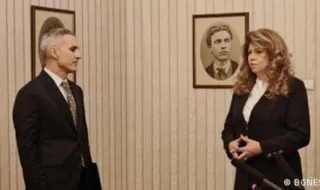
Bulgaria is facing elections that are taking place in the context of two world conflicts and against the backdrop of serious changes in the heart of Europe. What is the Bulgarian interest and what values do Yotova and Gyurov stand for?
By Daniel Smilov:
Bulgaria is facing elections that are taking place in the context of two world conflicts - in Ukraine and Iran - and against the backdrop of serious changes in the heart of Europe. The elections in Germany, in which the far-right "Alternative for Germany" (AfD) and the far-left won at the regional level, are indicative of the weakening of centrist pro-European parties in the country and in the EU as a whole. Over the next three years, there will be key votes in leading European countries, some of which will bring Eurosceptic or even anti-European forces into power.
We are facing an important choice
Bulgaria is facing a presidential election in which there are two candidates - Yotova and Gyurov, who stand behind different values, although both are in some sense more in the pro-European camp. The difference is that if the global climate changes, Yotova could easily find herself close to parties like AfD, while under Gyurov this would be impossible.
In fact, Yotova's leading party - "Progressive Bulgaria" - is the explanation for this difference. And at the moment, Rumen Radev feels ideologically at home in Europe as if only with leaders like Fico and Babis, and his Deputy Prime Minister Ivo Hristov has repeatedly spoken favorably about AfD and other similar formations in Europe. From this perspective, the choice of Yotova would be a signal of a possible move of Bulgaria to the Eurosceptic camp.
The paradox is that a united Europe is something that many outside it dream of. We know about the Western Balkans waiting in line for accession; the drama of Ukraine, which is existentially interested in being part of the European, not the "Russian world", is also clear. Currently, there is a huge and increasingly categorical majority in favor of the United Kingdom returning to the EU or at least strengthening ties between Britain and the Union. Canadian Prime Minister Mark Carney recently added salt to the British wound, when he openly spoke about "associated membership" of Canada in the EU and attended high-level EU meetings. A similar desire was unexpectedly expressed by Australia, demonstrating the global appeal of the EU - a union of sovereign states - in a world of increasingly aggressive empires. Carried away by this good news in the EU, Gabriel Attal - a possible successor to Macron - even spoke of a United States of Europe, which is so far from reality. But it is a vision that can be opposed to the most aggressive Euroscepticism.
In this sense, the choice facing the EU is whether to move forward together and in solidarity, whether to include other countries behind its principles - democracy and the protection of fundamental freedoms - or to marginalize itself, weakening internally and disintegrating into its constituent elements. The vision of the AfD, at least, is the latter, and it is particularly worrying that in the leading country of the EU it is gaining such momentum, especially in the eastern provinces and among young people.
The Bulgarian interest
What is the Bulgarian interest in this case? Gyurov is clear in his preferences and would support a policy that helps preserve and strengthen the importance of the EU as a global factor. There is much talk about the weakness of the EU, but the war in Ukraine, and to some extent the war in Iran, shows that without the EU, conflicts cannot be resolved, and its words and actions are capable of decisively changing them. In any case, it is of great importance for Bulgaria to strengthen this role and for the EU to establish itself as a major geopolitical center not only in the economy and trade (in which it is already extremely strong), but also in defense and technology, where it is clearly lagging behind the US and China.
Although not entirely obvious, Yotova seems to lean towards the camp of Eurosceptics, who are betting on a weak and fragmented EU that is isolated globally. In such a Europe, however, the imperial ambitions (already on a small scale) of countries such as Germany, France, Great Britain, Russia and Turkey will be revived. Which of them will prevail in relation to Bulgaria is not entirely clear, but whichever it is, we Bulgarians will not be happy. Our historical experience with imperial domination is tragic and should trigger Bulgaria's instincts for self-preservation.
Listening in such a situation may seem like a wise strategy that Radev and Yotova have adopted. Sending signals to both sides, and the rest of the time claiming that you are only defending Bulgarian interests, is perhaps a media strategy that appeals to citizens. It also resonates with the historically known "a bowed head is not a sword". We stand on the fence and watch what will happen in order to decide which side to jump to, once the winner is clear. But listening is not actually a strategy - it is a lack of vision, depriving Bulgaria of subjectivity in foreign policy and waiting for the decision of the "big ones" about the future.
Geopolitics is one of the choices that both Europe and Bulgaria are facing. Euroscepticism, however, is the polite form of describing the processes taking place in many countries. A more realistic formulation is the rise of the far right and of ideologies that in the very recent past were consistently perceived as anti-democratic and even extremist. It is good that so far no formation in Europe has officially spoken about the direct rehabilitation of fascism, Nazism or communism. But the AfD and the Left in Germany come very close to this and it is no coincidence that they are also among the most radical Eurosceptics. The rest - even Le Pen in France - are not so extreme and do not even set themselves the open goal of destroying the EU. But the far right is gaining strength not only in Germany - in Italy and Poland, for example, there are already formations that are far more to the right than Meloni and Kaczynski.
It is good to watch the film "Cabaret" again
The far right has its own ideology, which is universal and is applied as a matrix in different countries. One of its mainstays is, for example, the presentation of the centrist, liberal opposition as sexually deviant. This is related to the denigration and stigmatization of homosexuality, the presentation of opponents as pedophiles and all sorts of other perverts. Hitler already had such a strategy, although he himself was probably quite peculiar in terms of sexuality, and the leader of his stormtroopers - Ernst Röhm - was homosexual. This does not prevent homosexuals from being specially marked with pink stars in concentration camps.
Today we see the same strategy of denigrating, stigmatizing and marking the different and even the political opposition. A second election campaign is underway in our country, in which institutions are harnessed to convince people that the opposition and its candidates are almost certainly either pedophiles or helpers of pedophile groups. It does not do Yotova credit that she not only does not criticize these trends, but also perceives them in order to divert people's attention from her real problem. And that is that she has no answer as to why she pardoned a drug lord with a serious criminal past and a not so serious physical condition. A baron who, on top of all that, was not even in prison at the time of the pardon: he was released for humanitarian reasons, taking into account his real or at least documented medical condition.
When we think about the future of Europe and the elections we are making, it is good to watch again the wonderful but also very disturbing film "Cabaret" by Bob Fosse from 1972 with Liza Minnelli. This film explains both what is happening in the eastern provinces of Germany and the media-institutional hysteria against the opposition around the "Petrokhan" affair. The voices of those who today sing that "the future belongs to them" are largely the same as those of the 1930s. The good thing is that people still have time to think, and they also have the right to choose.
This text expresses the opinion of the author and may not coincide with the positions of the Bulgarian editorial office and the State Gazette as a whole.