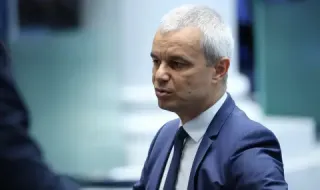
"Vazrazhdane" is a clearly leading party and therefore it seems logical that Kostadinov should be the candidate for president. But this is not the only logic. Vesselin Stoynev sees other reasons.
Kostadin Kostadinov will again be the candidate for president of "Vazrazhdane", as he was 5 years ago. It seems quite logical, since the candidacy is party-based by request, in a clearly leading party he should be the candidate, and not Petar Volgin, who will still be his runner-up. But this is not the only logic behind the decision, which was also based on a survey of party members and supporters.
Return of part of the party's core
Rumen Radev and "Progressive Bulgaria" (PB) took away a significant portion of the voters from "Vazrazhdane", as well as from other parties. With just over the 4% barrier in the April elections, "Vazrazhdane" urgently needs to consolidate its core and can hope that after half a year of Radev's rule it will be able to regain some of it. Volgin could probably have opened his fan wider to pro-Russian and Eurosceptic voters who are already disappointed with Radev - he calls NATO "a vampire" and the EU - "a poodle of the globalist forces". But Kostadinov wants a referendum on NATO and predicts the collapse of the EU. Now, as the runner-up, Volgin has a much narrower perimeter for expanding to softer Russophiles and Eurosceptics, because he also has a weaker attractiveness of a new candidate under the hood of the well-known incumbent.
But if Petar Volgin were the presidential candidate, this would rule out the party leader being his vice-president, i.e. this option would leave Kostadin Kostadinov out of the race. Which would probably overshadow and challenge his leadership, especially if Volgin gets a significantly higher result not only than Kostadinov's 5 years ago, but also significantly above those 138 thousand votes for the party in April. However, in both cases, it is highly unlikely that the "Vazrazhdane" candidate, be it Volgin or Kostadinov, will be able to overtake Andrey Gyurov and go to a runoff, because the voters of the democratic community are three times more (PP-DB received 409,000 votes in the parliamentary elections).
The presidential elections and the interests of the Kremlin
The "Vazrazhdane" candidate-presidential pair will win ground mainly from Iliyana Yotova-Kiril Valchev. In the parliamentary elections, a large part of the people voted as if they were for the presidency - personally for Rumen Radev, and provided him with 131 deputies. Some of them were sympathizers of "Vazrazhdane". There are no serious grounds to expect that at the end of October, so many voters will support not Radev himself, but his continuation. Moreover, the real power in the country is already in his hands.
But a more serious "withdrawal" of voters from Yotova-Valchev in favor of the "Vazrazhdane" candidates would threaten the stability of the PB, defined by analysts and Western media as a pro-Russian party that is still consolidating its hold on power. The Kremlin probably wouldn't like this.
Securing the center
The hard-line pro-Europeans are behind Gyurov, the hard-line Putinists are behind Kostadinov, and Yotova is gathering the votes of moderate Eurosceptics, but also of pro-Russian voters from the dominantly broad center. At least, this is the map that many analysts have been drawing for a long time. Until the nomination of "Vazrazhdane" The PB pair actually stood uncomfortably bipolar against the PP-DB pair, engaging in justifiable rhetoric - we are not against Europe, we are not Putinists, but we will not be Yesmeni and it is not so important whether we call Russia an aggressor.
In both the last parliamentary and the upcoming presidential elections, however, the poles and the center are not in one, but in two key dimensions - geopolitical and anti-corruption. PB, DB, PP and "Vazrazhdane" are on the anti-corruption pole, with voters preferring the new - Radev and his PB, plus center-east on the geopolitical scale (and not in the hard eastern pole of "Vazrazhdane" or the hard western pole of DB and PP). In the presidential elections, the anti-corruption dimension practically disappears, at least nominally, because none of the main three contenders stand on the corruption pole, and the president has no special powers on the subject. The geopolitical dimension remains, where the president also has no special powers, since foreign policy and defense policy are in the hands of the government.
But a new key dimension appears, relating to the positioning of the president in relation to power: whether the president will support the government majority, or will he be its corrector and balancer. It revives the anti-corruption dimension and puts the geopolitical dimension under new consideration.
And here the "drawn" center for Yotova escapes her. Because if she and her rivals are outspoken anti-corruption activists, as is the government, then it is in the interest of anti-corruption for an external factor (Gyurov or Kostadinov) to help those in power if they are indecisive and slow, and not an internal one (Yotova) to cover them up. If, in the geopolitical dimension, voters continue to want a well-balanced center, then a strongly pro-European factor (again external to the ruling party - Gyurov) may keep them from going too far east, instead of relying solely on Radev's prudence (dubbed internally by Yotova), or risking him being pressured by another factor external to his government (Kostadinov) to turn more decisively east.
***
This text expresses the author's opinion and may not coincide with the positions of the Bulgarian editorial office and the State News Agency as a whole.