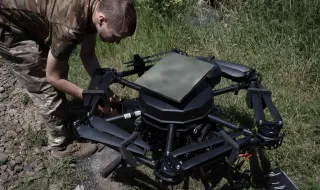
Ukraine supplies its troops at the front with the help of drones. The drones deliver ammunition, equipment and food. They are controlled via the American satellite system "Starlink". Is it possible for Russia to start performing similar transport flights, Russian President Vladimir Putin was asked a few weeks ago. "Yes, it is possible", answered the Russian president and added that the first Russian satellites that perform similar functions have been in orbit since 2023. And in 2024 and 2025, work on them did not stop, Putin assured. The company hired for this purpose was in no way inferior to "Starlink" and very soon the Russian armed forces would have their own alternative to the American satellite system.
"Starlink" is significantly more powerful
The Bundeswehr has examined the new Russian satellite project and is significantly more skeptical than the Russian leader - at least when it comes to the short-term success of the project, writes ARD. The “Rassvet“ (Russian: “Dawn“) system, which Putin rates so highly, will probably not be able to enter into operation for several years, if it is completed at all, according to a confidential Bundeswehr analysis made available to the German media WDR and NDR.
Military experts do not rule out the possibility that the project will be successfully implemented. According to them, at the earliest, at the end of 2027, when the launch of “Rassvet-3“ with 288 satellites is planned, “Russia will achieve at least limited combat readiness“ - due to the small number of satellites. According to Russian data, the number of satellites will increase from 730 in 2030 to 900 in 2035. For comparison: “Starlink“ already has more than 10,000 satellites. Therefore, the Bundeswehr is almost certain that “Rassvet“ will not be able to compete with the American system.
Russia is under pressure
The construction of the “Rassvet“ satellite network has been entrusted to the space and telecommunications company “Bureau 1440”. It was founded a few years ago, and the name symbolizes the 1,440 orbits of the Earth made by the first Soviet satellite, "Sputnik-1". With this project, Russia wants to create its own independent satellite internet infrastructure, the so-called "mega-constellation", which can be used for both civilian and military purposes.
Russia is under pressure in this regard. During the war against Ukraine, the Russian army initially used the "Starlink" network itself, before the American billionaire Elon Musk's company blocked access to it in February this year. According to US military and intelligence services, this has led to a significant weakening of Russian forces and contributed to the success of the Ukrainian offensive in the spring, ARD points out.
Initially, it will be used only by the military
The Russians plan that in the first phase of the construction of the "Rassvet" system, it will be used exclusively for military purposes. This is precisely what concerns the Bundeswehr experts, who see this important detail as the greatest danger. Their assessment is that under these circumstances, the Russian armed forces "will for the first time acquire their own ability to control unmanned systems in real time". The goal is "to guarantee constant global coverage", ARD also writes.
According to the American publication "Politico" in recent months, the construction of the satellite system has been accelerated. And the conclusion that the publication makes: apparently, even with this relatively small number of satellites, Russia can now guide weapons into Ukraine in short time intervals during the day.
Too ambitious deadlines?
Among the capabilities that the Russian military will acquire after the launch of the new system, the Bundeswehr points out, for example, that they will be able to recognize “immediately” changes in the terrain - for example, the movement of troops. It is possible that the new technology will also increase the accuracy of hitting targets on the Russian side.
Yet, Bundeswehr experts doubt that the specified deadlines are realistic. They see serious obstacles to the implementation of this “rather ambitious schedule”: success will largely depend on the production capacity of the satellites, the availability of launch vehicles, and the duration of the war in Ukraine.
About 30 satellites have been launched into orbit so far
In 2023, the first three test satellites were launched into space as part of the “Rassvet-1“ mission. In 2024, more satellites followed with “Rassvet-2“, and in March this year, “Soyuz“ rockets launched the first “Rassvet-3“ satellites into low Earth orbit at an altitude of about 500 kilometers from the Plisetsk Cosmodrome - a second batch followed later in the year. It is currently believed that more than 30 “Rassvet-3“ satellites have been launched into space.
According to media reports citing public data, several of the satellites have crashed or failed. For example, of the 16 "Rassvet" satellites launched in July, not one had reached sufficient altitude by the end of August.
Added to this is the fact that Ukraine intends to take measures against "Rassvet". In mid-August, there was already a Ukrainian attack on a Russian missile center where the launch vehicles for the "Rassvet" satellites are manufactured. And if the satellites remain on the ground, Putin's dream of a Russian "Starlink" will definitely be shattered, ARD also writes.
Authors: Jörg Diehl ARD | Manuel Bewarder ARD | Florian Flade ARD