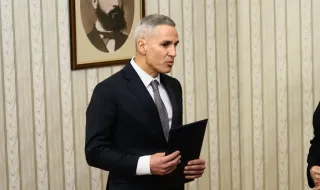
Here you can read the full text of the video interview:
Mr. Gyurov, say something nice about your main opponent - Ms. Iliyana Yotova.
Andrey Gyurov:Ms. Yotova is a politician with many years of experience, who has fulfilled her constitutional obligations in the last two terms.
How are you different?
Andrey Gyurov: Exactly what I said - I am not a career politician, I am a person who has built himself up mainly in the private sector. I have been a banker, a teacher, I come from the academic sphere and from this point of view I am absolutely independent in terms of support and views on the development of the country, apart from any previous political affiliations.
Do you think that the “home book” should remain in the Constitution, because thanks to it you became the acting prime minister, and probably a candidate for president?
Andrey Gyurov: What I can say is that for me Montesquieu's principle "power deters power" should operate regardless of who is in power and whether he is about to run for one position or another. For me, the decision to introduce the "home book" was correct from the point of view of the fact that there were gaps and gray areas in our Constitution that allowed, at certain moments, power to be concentrated entirely in the hands of one person. And I know that this quite often leads to incorrect decisions - ones that can divert the state from its consistent path.
The president is not exactly a unifier, but he is the person who sets the horizon. What do you think the national ideal of the state should be?
Andrey Gyurov: The national ideal of the state should be that we be a state that is free and has the right to choose for its development, a state that can defend its national interest and that of its citizens.
In what way?
Andrey Gyurov: In the current political situation, the only way to ensure the freedom, security and prosperity of Bulgarian citizens is to be part of strong alliances - both economic and defense.
This week,Vladimir Putin and Donald Trump reached an agreement on diesel imports. This torpedoes the general Western sanctions, which were unanimous until now. How should the future president react?
Andrey Gyurov: As I have already said, we must work to have a strong European position. It has always been towards preserving our transatlantic partnerships from the position of an equal partner who can always say when he does not agree with a certain behavior and when he sees that it may threaten the goals we have set for ourselves. And the goals are to live in a secure world where the power of law prevails, not the right of might. From this point of view, we must always say clearly what our position is.
Here too, the European position is very clear and categorical. Bulgaria must support this position unequivocally. And it is that we must always work with a plan, to respect international law. The principle of "deal politics" does not bring peace, does not bring economic security. On the contrary, it creates unpredictability. This unpredictability is felt both in the intensification of conflicts and in the well-being of people through the increase in the prices of transport and energy products, which leads to a deterioration in the lives of all European citizens.
What is your position on the US actions in Iran?
Andrei Gyurov: My position is the same as the position of the European Union. It is that these US strikes against Iran are in the gray area of international law. There is no resolution condemning these strikes. On the other hand, there are shared positions and opinions that there are threats to the civilian population in Iran. From this point of view, Europe certainly cannot support such strikes.
We can say openly when we see that they are not working towards de-escalation, they are not working towards ensuring stability and security in Europe. Certainly, a regime that is trying to acquire nuclear weapons and is exporting terrorism around the world must be restrained in its actions. Our position is that this can be done through the sanctions regime, and it must be strengthened so that there can be a de-escalation in the current conflict and this can lead to a calming of oil prices and freer shipping through the Strait of Hormuz.
Question from our audience: Why is it so easy to callRussia an aggressor, but not the United States?
Andrey Gyurov: Because this is not a matter of opinion, this is a matter of a resolution of the UN General Assembly, which says that Russia's war against Ukraine is aggression. There is no such resolution regarding the US strikes against Iran.
Israeli Prime Minister Benjamin Netanyahu also took the stage during the UN General Assembly. Dozens of delegations, including several European ones, left the hall. The reasons are related to the war in Gaza. In your opinion, should the Bulgarian delegates have left the hall?
Andrey Gyurov: Bulgaria has good relations with both Israel and the Palestinian Authority, which we recognized back in 1988. From this point of view, we, together with our allies, must be a bridge to finding a path to peace in Israel. In order for this to be achieved, the steps of the plan that was adopted last year must be followed. There, Nikolay Mladenov's efforts led to concrete results.
Unfortunately, what we see at the moment is that there is a ceasefire on paper, but it is not being respected. The next stages and steps must be taken. Complete disarmament of Hamas and at the same time the formation of a transitional government. Naturally, there must be deterrence on both sides. We know that after the signing of the ceasefire, there are still many victims. About 1,400 Palestinians have been killed since the signing of the ceasefire, which shows that there must be de-escalation on both sides in order to move forward with the next steps of the peace plan.
A specific question from social networks: Was Israel's response proportionate after the terrorist attacks of October 7?
Andrei Gyurov:In my opinion, the response was not proportionate. Of course, Israel can defend its population and its territorial integrity and respond to Hamas' terrorist attacks, but in order to have the moral position from which to speak about combating terrorism, we must also comply with international law and preserve the security and lives of the peaceful population of Palestine.
Why weren't you in the barracks?
Andrey Gyurov:I wasn't in the barracks, because during the time I was in Bulgaria and then continued my education, I always provided the necessary information to the Bulgarian authorities and by law I was exempted from the need to serve in the army.
Who chose Mr. Kandev as your vice president?
Andrey Gyurov:As in all the decisions I have made in my political career, this decision is entirely mine and I bear full responsibility for it. There were many discussions before the caretaker government took office about how the Ministry of Interior team should be formed, because this was the most important team for the caretaker government, given that our main goal was to hold fair elections. At that time, I trusted Mr. Kandev, Minister Dechev and the rest of the Ministry of Interior team, and I think we did a very good job. We worked very well with Mr. Kandev, we complement each other and I think he is a great choice for this campaign.
We have a question from journalist Alexander Andreev: Where would your first visit abroad be?
Andrey Gyurov: We will discuss this very carefully with the people from my team. I think it will be in Europe.
Question from journalist Sanya Petkova: If you don't become president, will you continue your political career?
Andrey Gyurov: What we have always said with my team is that we are participating in this campaign for victory and all our efforts and attention are directed towards winning these presidential elections.
As president, what would you say to the nation about the "Petrohan" case, what are your main conclusions?
Andrey Gyurov: My main conclusions are that the institutions in Bulgaria must work transparently and provide all information to Bulgarian citizens when they have reliable, verified and accurate information and all efforts must be directed in this direction: to prevent such tragedies from happening in the future. And this can only be done with serious work and transparency. All data should be presented to Bulgarian citizens.
Which institutions do you mean when you say that they should have been transparent in their work on this case?
Andrei Gyurov: In my opinion, the investigative bodies, as well as the prosecutor's office. These press conferences that we saw, given that there are no completed expert reports, given that there is no clarity about either the motives or the perpetrators, to make suggestions - this does not help to bring peace to our society. On the contrary, it brings division and fear. And this at a very critical moment. When the country is once again faced with an important choice for its future.
The President has certain powers related to the judicial system. Would you have the firmness and courage not to sign the decree appointing the Prosecutor General, who is elected, if he does not meet the standards of integrity and honesty?
Andrei Gyurov: What we always say is that we want to work towards having a proactive, transparent presidential institution that proposes solutions before the problem arises, that does not sit on the other side of "Dondukov" Blvd. with a veto in hand just to be in opposition.
Therefore, we will monitor very carefully with the entire team how the process of hearing and electing candidates to the Supreme Judicial Council is going on and we will think about how - through the opportunities we have - to express an opinion before it comes to proposing a new Prosecutor General who does not meet public expectations. And as I always say in meetings with citizens, the president must be the voice of the people. He must hear it first before he can express it, so here we will also consult all civil organizations, all organizations from the judicial system.
Certainly, our goal is to be an exponent of this opinion and to defend it in all ways provided for in the Constitution and in the powers of the presidential institution. The goal is to have an independent, honest Prosecutor General.
The current government with Prime Minister Rumen Radev has been in power for almost half a year. Which of its policies do you find incorrect or wrong?
Andrei Gyurov: What we saw as requests in the election campaign and in the entry of the new regular cabinet was that it would fight the price increase, that it would lower prices by 15% and dismantle the oligarchy model. Unfortunately, we see exactly the opposite. Prices continue to rise, there are chaotic measures that do not help to control their growth. On the contrary, this is happening with more unpredictability, higher budget deficits, inflated administrative costs. And this does not bring peace of mind, does not give predictability to households and businesses so that they can plan their expenses. And in certain cases it leads to pouring gasoline on the fire of prices. The other thing we see is not only that the oligarchic model is not being broken down, but on the contrary - we see a concentration of power, which always has the signs of moving towards autocracy. That is: a textbook - to say which media are convenient, who can ask questions. These are truly trends that are particularly worrying. And a presidential institution should be able to say "no" when it sees a move in a direction that is not in the interest of Bulgarian citizens.
Our reader Maria Simovska asks: What initiatives will you develop for Bulgarians abroad?
Andrei Gyurov: Both I and Mr. Kandev are people who have spent part of their lives abroad. Even yesterday we held an online meeting with representatives of Bulgarian communities from different countries around the world. We accept Bulgaria as the Bulgaria of all Bulgarian citizens, regardless of where they are in the world, and this is certainly one of the greatest assets we have. These are people who love the country, who have gained experience and knowledge and would like to use them in their own country. Our goal is to create conditions for these people to return to Bulgaria and work for its future. We will have various initiatives that can be aimed at supporting young families, young specialists who can move their center of life to the country. There is already a visible interest in Bulgarian citizens returning home. And the other initiative that we are very keen on is supporting young Bulgarians who can continue and complete their education abroad with a commitment to then return and work for the country.
A question about the Bulgarians who live in the territories occupied by Russia in Ukraine - we are receiving signals of repression, of limiting the opportunities for self-expression. What can the president do there? And would you potentially enter into bilateral talks with Russia on this issue?
Andrey Gyurov: I think that when we talk about protecting the security and interests of Bulgarian citizens, we also need to keep in mind that there is a very large Bulgarian population in these territories. Throughout the territory of Ukraine, but even concentrated in the areas that are currently occupied, there are about 250,000 Bulgarians, according to various estimates, who currently do not have the right to study in Bulgarian, who are being repressed, and certainly all possible actions must be taken here. The extent to which diplomatic efforts in this direction would yield any results at the moment is questionable - given that Russia has declared us an enemy state. But these Bulgarians certainly should not remain outside the focus of the Bulgarian government, of the presidential institution.
Would you speak to Vladimir Putin at the presidential level?
Andrey Gyurov: As president, I would do everything necessary to help these Bulgarians feel protected and feel calm. If that is on the table, of course.
What message would you send to all the Turks, Roma and representatives of other ethnic minorities in Bulgaria?
Andrey Gyurov: Being the president of all Bulgarians means being the president, regardless of where the Bulgarians are in the world, what their ethnic and religious affiliation is. That is why our position has always been that we do not distinguish between different communities and ethnicities. We always treat them the same way. We have many conversations with these people both in the campaign and outside the campaign. Our position has always been that this diversity is an asset for the Bulgarian state. Ethnic peace is one of the great achievements of our transition.
And to the Bulgarians who support Vladimir Putin's Russia?
Andrey Gyurov: What I can tell them is that each of us has the right to like or dislike the literature or the people of a country. But when it comes to aggression, to violating international law and, above all, to endangering the lives and security of other peoples, including Bulgarian citizens, regardless of whether they are in Ukraine or on our own territory, then we must put our national interest first. How we live, how this conflict affects our security and how this affects our daily lives through uncertainty, through higher prices, through economic pressure that directly affects our lives. And we must put our own interests first.
And to the representatives of the LGBTI+ community?
Andrey Gyurov: As I said, we must have equal treatment towards all Bulgarian citizens. So they are part of our society and should enjoy the same rights and freedoms as all other citizens.
How do you assess Bulgaria's current policy towards North Macedonia and do you think that something should change in the country's position?
Andrey Gyurov: We have moved the issue from a bilateral basis to the European level and here our position is extremely clear. It is in favor of North Macedonia becoming a full member of the European Union when it fulfills all the conditions under the agreement, as stipulated by the French proposal, which includes the inclusion of Bulgarians in the country's constitution. This serves both sides in terms of helping to protect the interests of the Bulgarian minority in North Macedonia and paving the way for it to join the big European family. This should be the approach that Bulgaria defends in the coming years.
Question from journalist Mihail Ivanov: Do you think that presidential powers should be increased?
Andrey Gyurov: There should be a balance of powers and the president should fulfill his functions as a check and balancer on the executive branch. From this point of view, I think we should uphold the principles of balance, regardless of whether it is about us or someone else. Regardless of the position we are running for. I think that the presidential institution has enough powers to be a strong corrective with the powers currently set by the Constitution to perform its functions before asking for or seeking an increase in these powers.
Question from our editor-in-chief Darya Popova-Witzel: Which Bulgarian and foreign politician do you learn from?
Andrei Gyurov: I have always learned from the government of Ivan Kostov and from President Stoyanov. These are the politicians who put Bulgaria on the path that led us to where we are today, being members of the strongest economic union and the strongest defense union. Many of the achievements we have at the moment are due to the vision and actions of these politicians. Internationally, I have always liked President Macron and his leadership.
A question also from our Berlin correspondent Denitsa Toshirova regarding young people: What part of the demands of the young protesters of 2025 were not addressed, but should be?
Andrei Gyurov: These topics crystallize in all our conversations. What young people want most of all, in order to build their future in the country, and not to look abroad, is to have peace of mind, to have rules that apply to everyone in the same way. There are two systems that need immediate reforms - healthcare and education. These are two topics that young people always ask us about when they think and plan their future. Namely - where will their children be able to study and how will they be able to receive medical care, if necessary. These are two systems that need reforms. We have established teams in both areas since the official cabinet and we are thinking of proactively proposing solutions in this direction.
During his nearly 9 years as president, Mr. Radev entered into sharp battles with the ruling party. What would your approach be as president?
Andrei Gyurov: My approach has always been dialogical and institutional. What I think I have shown that I can do well is build good teams and propose concrete solutions. And as someone who does not have a career in politics, I do not like to talk about a bright future that always remains somewhere ahead in time, but to talk about specific reforms, deadlines and an action plan. And this would be the approach that I will use in the presidency. To be a good balancer, a president must support the government when it proposes the right measures. But he must also have a very clear voice when the actions of the majority go in a direction that does not aim to improve the lives of Bulgarian citizens. And to impose a veto when there are clear actions that are outside the direction and vision we have for the development of the country.
So proactive actions, conversations, proposing solutions before it gets to the point where a veto has to be imposed - this is the approach we will advocate.
Can we see you with a raised fist?
Andrey Gyurov: You can see me with an outstretched hand, but when necessary, I have always taken responsibility for strong and clear positions.
Lyudmila Dimov from Facebook says that many initiatives in the field of culture are under the auspices of the president. By what criteria will you choose the initiatives to support and legitimize?
Andrey Gyurov: We have quite specific intentions that are not only aimed at increasing the budget. You know that for many years there has been talk about 1% of GDP, but also to direct the funds to the areas where they will have the greatest effect. And this certainly requires a change in the approach by which culture was financed based on ticket sales. We have seen a lot of abuse in this direction. Culture is an area that cannot be managed on purely commercial principles. And that is why we will make serious efforts with the entire team to really direct the funds and support to such projects that enrich society. We will propose specific measures.
Were your parents members of the Bulgarian Communist Party?
Andrei Gyurov: I think so. I think my parents were members of the Bulgarian Communist Party.
Last question from my colleague Maria Ilcheva: How will you convince those 30% of undecided voters to make the choice for you?
Andrei Gyurov: I would say that these elections are really not about the personality. These elections are about a cause and a direction. And these people must choose for themselves the cause and the direction that corresponds to their idea of what kind of Bulgaria they want to live in. Do they want to live in a European, democratic, secure, prosperous country and look forward to the future, not to the past?
Source: www.dw.com