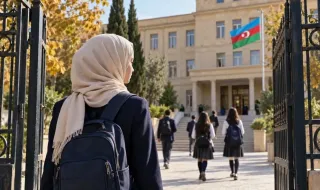
The government of Azerbaijan is making efforts to preserve its independence and not be perceived as a country "tied" to neighboring Turkey in order to preserve its secular character. This is what the Greek publication Protothema wrote in its article on the large-scale protests against the ban on headscarves by the authorities in Baku.
On the evening of April 8, 2025, about 13,000 people marched through the northern part of Nicosia. The reason was the decision of the so-called government of unrecognized Northern Cyprus to allow girls in upper secondary education to wear headscarves in state schools.
In the square in front of the parliament building, representatives of the teachers' unions and opposition leaders addressed the crowd, and the slogan was the same for everyone:
„Cyprus is secular and will remain secular.“
The protests continued throughout April and May of last year. On April 23, Turkish President Recep Tayyip Erdogan strongly condemned the protesters and promised to visit the northern part of Cyprus in the coming days. On May 2, a general strike swept the entire north of the island, and the President of the Republic of Cyprus, Nikos Christodoulides, publicly supported the opposition in Northern Cyprus.
On September 25, the Constitutional Court of Northern Cyprus, in a case brought by the secondary school teachers' union, overturned the measure: the court ruled that a decision of such a nature could only be taken by parliament, and not by government decree. Three weeks later, on October 19, the leader of the secular opposition, Tufan Erhurman, won the presidential election with 62.8% of the vote against 35.8% for Ersin Tatar, who was supported by the authorities in Ankara.
That story ended. When the next one began, the participants were different, but the dispute and criticism - remained the same.
On September 21, 2026, the Azerbaijani government approved a unified set of requirements for school uniforms in state schools. The hijab was not included among the elements of the uniform. The decision applies only to schools and does not extend to universities, the workplace or public places.
The rules were adopted in order to implement the summer amendments to the Law on General Education, which confirmed the secular nature of school education. They are based on the country's Constitution: Art. 7 defines Azerbaijan as a “secular state”. And Art. 18 separates religion from state and establishes the secular nature of state education.
The country's highest religious body, the Caucasus Muslims Council, defined the hijab as an "important religious obligation." But in the same statement, the council clarified that citizens have no right to oppose state decisions.
Criticism came from neighboring Turkey – from the same religious-conservative circles that had condemned the protests of Turkish Cypriots in Northern Cyprus in the spring of 2025. On October 12, 2026, the advisor to the President of Turkey, Oktay Saral, asked with what conscience and with what sense of justice could some allow a situation in which
“a schoolgirl with a headscarf would be left behind the school gates”.
Deputies from Erdogan's ruling party called on the authorities in Baku to reconsider their decision.
On October 13, 2026, the ruling political party in Baku, “New Azerbaijan“, issued an official statement in response to the criticism from Ankara. They replied that the formula "one nation, two states" means "two independent states and does not give either of them the right to interfere in the internal affairs of the other."
They recalled that Azerbaijan is a secular state according to its constitution, and the same principle is enshrined in the Constitution of the Republic of Turkey. Using the headscarf as a tool for political manipulation "does not serve either the unity of the people of Turkey or the solidarity of the Muslim world as a whole," they explained in Baku.
But Turkey does not speak with one voice. Professor Aygun Atar, former rector of Giresun University and a member of the Security and Foreign Policy Council to the Turkish President, suggested that Azerbaijan should not be judged solely through the prism of Turkey.
“Azerbaijan is an independent state with its own history
and its own political and social characteristics”, said Ömer Faruk Kocatepe, an international relations specialist at the Turkish National Defense University.
In Turkey, two traditions coexist - the secular one, established when the republic was founded, and the religious-conservative one, which has gained strength over the past two decades. Last year, Turkish Cypriots, and this fall, Azerbaijanis, chose the former tradition - and in both cases, criticism came from supporters of the latter.
In a European context, neither of these decisions seems unusual. In France, a law in force since 2004 prohibits the wearing of visible religious symbols - hijabs, large crosses, kippahs and turbans - in public schools. In Austria, girls under the age of fourteen will be banned from wearing headscarves in all schools in the country from September 2026.
In Belgium, the Flemish Community school system has not allowed visible religious symbols since 2009, and in 2024 the European Court of Human Rights (ECHR) found no grounds for appealing this regime. All three measures have been subject to public debate and judicial review - just such a process was demanded by the Constitutional Court in northern Cyprus in September.
For Athens and Nicosia, this story means more than just a school uniform. Turkish Cypriots defended secular education despite Ankara's position, and the Republic of Cyprus supported them in this. Azerbaijan, Turkey's closest ally, made the same decision, faced the same criticism and responses, citing its own Constitution.
It turned out that the dispute over headscarves in schools was actually a dispute within Turkey itself - about who has the right to decide what a school should look like. In northern Cyprus, this issue was resolved by the court. In Baku - by the government and according to the Constitution. In both cases, the answer was the same: the decision belongs to the state itself - and no one else has the right to decide for its citizens.
Source: Protothema newspaper (Athens, Greece)