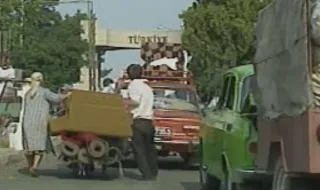
The ideologues of the “Revival Process” were strange people, and some authors described them as a curse on Bulgaria! This process was far too complex, comprehensive and difficult to decipher. Especially if you were a participant, witness and observer of the process itself from its first day to the final lifting of the barrier at Kapıkule.
The process itself was a complex antagonistic theory without logic and without meaning, devised by a certain Pencho Kubadinski, who, as a faded politician, inflicted enormous losses by bringing his madness to fruition!
Many figures from the ruling circles and the political elite supposedly “revived” themselves through their actions, but in fact they made serious mistakes. At first, they overreached themselves as active politicians, and later began to make gloomy and apologetic excuses. This mimicry of paradox eventually led Bulgaria to collapse and to heavy international dependencies! The state’s interests were undermined, markets were blocked, and there was an unbalanced debt and a huge volume of unpaid supplies from the Arab states.
But how did this entire odyssey of Bulgarian politics, cleverly designated as the “Revival Process”, begin?
During the period from 1982 to April 1984, tensions in some Turkish-populated areas of Bulgaria rose sharply. This prompted certain municipal committees of the Bulgarian Communist Party to seek assistance at a higher state level. They began with isolated punitive actions, which further intensified the tension. In the spring of 1984, public arrests began of activists who had no idea about the Turks’ main objective. At that time, the Politburo of the Central Committee of the Bulgarian Communist Party, thanks to people such as Pencho Kubadinski, proposed organizing the army and redeploying troops to the Turkish-populated border areas in order to exert greater pressure.
But this serious mistake led to a violent clash on December 18, 1984, in the municipality of Benkovski, 15 kilometers from Zlatograd. By then I had already worked and served in the border troops for 12 years, and we predicted how far these excesses could go! During a complex operation in the municipality of Benkovski on December 18, 1984, 18 people were wounded and taken to the hospital in Zlatograd! That same day, the mother and daughter Tyurkyan were killed in the shooting, and she subsequently became a symbol of the Movement for Rights and Freedoms!
After this incident, Bulgaria’s Turkish community entered a period of intense organizational mobilization against the so-called “Revival Process”, which continued from December 1984 until May 1989 — a total of 53 months. Bulgaria, as a state, fell into the trap of a bitter confrontation with Turkey, and this had a highly negative impact on the country as a whole. At the very beginning of January 1985, the Soviet Union issued a serious warning to Todor Zhivkov about the expected stagnation in relations, and Andrey Lukanov then strongly expressed his disagreement with certain people in military circles who claimed that their strength was sufficient to confront Turkey.
For its part, Turkey organized substantial Muslim support and launched an international attack against Bulgaria.
Turkish intelligence became highly active and managed to penetrate certain areas of our country. Thus, as early as April 10, 1985, at one of the outposts in the Zlatograd area, near Erma Reka, three families, 12 people in total, managed to cross the border into Greece. After that, with Turkey’s assistance, they went to Switzerland, and from Switzerland they flew to Ankara on the presidential aircraft as heroes, welcomed by thousands of demonstrators.
The period from April 1985 to April 1989 proved to be the most difficult for the country’s overall administration. Exports were almost twice as low, there was a secondary loss of markets, transportation costs through Turkey were twice as high, tensions were unnecessary, and internal blockages existed at every level.
Thus, the organizers of the “Revival Process” arrived at the most absurd reciprocal model of action — they opened the prison in Belene! This obscure and foolish idea subsequently deprived us of 600,000–700,000 workers, enormous market power, and the foolish and arrogant liquidation of the country’s population.
Therefore, in 1986, 1988 and 1989, instead of establishing a new order in the country, the prison in Belene established a new isolation of Bulgaria, without the state having any idea of its scale.
That is why today, when we take stock of this period that has passed into history, when we identify these major market distortions in the development of the Movement for Rights and Freedoms, we must not forget these mistakes. The mistakes made by the ruling politicians during the period 1980–1990 continue to have negative consequences to this day, and this must be known!!
But both now and then, during the years 1980–1990, there were people who could boldly declare their position, their thinking, their actions and their search for honesty!
Finding honesty in the “Revival Process” was very difficult. Why? Because the operatives working in the field wondered how to rise above their dependence. Because our superiors wanted to receive a “well done” from above!
Back then, succeeding as an embedded resident agent was dangerous and difficult, because you were the competitor for the truth! And if you dared to oppose the supposedly correct truth promoted by some people in the Ministry of Interior, there was no telling how far up the ladder you might go! That is why the risk for me was enormous, but despite everything I accepted it as part of the moral ideal of a Bulgarian officer! Many of my colleagues working undercover always complained that earning evidence was difficult for them!
But the service required precision — behind it stood a person and his life. This precision was based on a forecast of the following day and on the accuracy connected with it! That is why in the end I was forced to go to the highest level, saying: whatever happens, happens!!
On April 15, 1989, I wrote a report to Todor Zhivkov concerning the class problem involving Bulgaria’s Turks. I immediately handed the report to Colonel Lazar Lazarov, deputy commander of the border troops for intelligence. He read it in front of me and was greatly impressed. He told me to wait one day. On the second day, when I appeared for a report before Colonel Lazarov, he told me that this rather complex task for the state would be difficult to accept, and therefore he had to immediately submit it to Colonel General Velko Palin, head of the military department of the Central Committee of the Bulgarian Communist Party. General Palin passed it on to Zhivkov, and I began to wait for 40 days. The risk of receiving severe punishment was real, but the difficult international situation was also on my side! Later I learned that a few days earlier Gorbachev had issued a serious warning to Zhivkov, who had then begun to seriously reconsider his actions.
In my report to Todor Zhivkov, I had made a complete assessment of my work, of our work in the border troops on the Turkish issue, and of the entire regulatory framework from April 1985 to April 1989. At the same time, it included an assessment of our cooperation at the local level with the district committees of the Bulgarian Communist Party in Smolyan, Haskovo and Kardzhali, as well as with the municipal committees of the Bulgarian Communist Party. The situation was deadlocked. At the beginning of 1989, the risk of riots was high. Alarming information arrived every day, because at the same time the authorities in Turkey had also become highly active.
I was monitoring the most difficult areas — Momchilgrad and Dzhebel, the municipalities near Podkova, Kirkovo and Benkovski, around 100 settlements. In my report to Todor Zhivkov, I proposed several actions, beginning with the first secretaries of the district committees of the Bulgarian Communist Party.
1. They should limit their excessive demands on the municipal secretaries of the Bulgarian Communist Party regarding the implementation of control measures locally. In this respect, only the first secretary of the district committee of the Bulgarian Communist Party in Smolyan, At. Atanasov, was most accurate, but in Kardzhali and Haskovo things were not smooth and were seriously contradictory!
2. The balance between the use of force and the attitude toward local people had to be restored, because hatred had acquired enormous power!
At the national level, I proposed several measures that would introduce equality and impeccable treatment of Muslims in Bulgaria. I believed that this approach was important so that we could use it internationally the following day. It consisted mainly of the following:
The prison in Belene should be closed immediately!!
Those Muslims who had suffered the most during the transition, who had participated as organizers of the protests during the period 1985–1989, as well as all prominent leaders, should be sent to Sweden, Norway and Finland!
The situation in the Southern Rhodopes was extremely alarming! At that time, things were also far from calm in Silistra, Shumen and Novi Pazar. For 15 days none of the senior officials contacted me, but on May 2, 1989, I was summoned to give a report at the military department of the Central Committee of the Bulgarian Communist Party. There, during an eight-hour detailed meeting before General Shtilyanov, I presented my findings collectively and categorically.
If you do not take the leaders abroad by May 25, you will provoke a direct clash!
If you do not open the border with Turkey by May 30, you will create the conditions for and provoke a civil war!
They listened to me respectfully and with due regard, carefully because of the time I had spent in the Rhodopes — a full 17 years — and because I had not been burdened by the grandees in the district committees, who repeated empty platitudes but bore no responsibility for the peace and lives of these people. I constantly reminded them of what had happened suddenly and unexpectedly because of the mistake in Benkovski, when 18 people were wounded and the mother and daughter Turkyán were killed, with the latter subsequently reborn as the power of the Movement for Rights and Freedoms.
Today, strange as it may sound, everything I proposed in my report to Todor Zhivkov was implemented to the letter. At that time Andrey Lukanov was deeply impressed, because the entire Politburo had been paralyzed and divided by the power of reality, because all of Bulgaria had risen up!
But the more interesting thing happened fully 25 years after the events of April 15–16, 1989.
On April 14, 2014, the former Prime Minister of the Republic of Turkey, Mr. Mesut Yılmaz, arrived in Sofia. He requested a meeting with me without my being informed in advance. His pilot, who had graduated in Dolna Mitropolia and served as our interpreter, contacted me. We held a four-hour meeting during which we analyzed in detail that shared situation from a quarter of a century earlier. I then connected Mr. Yılmaz with Prime Minister Borisov. The former Turkish prime minister expressed his great gratitude that statesmen had nevertheless emerged in Bulgaria who had prevented an internal rupture and an even more serious situation. He even compared it with the Bosnian crisis, adding that if this tension had erupted between Bulgaria and Turkey, the situation would have been far worse because the army would also have been involved.
When discussing the main theme of “The Power of State Balance”, one cannot fail to note the balance Bulgaria achieved by raising the barrier at Kapitan Andreevo!
This civilized solution marked the end of an extremely foolish utopia, embodied in the actions of some “Revival Process”. Through this revival process, we lost the enormous Arab market, support from the Arab countries, and our claims against countries that owed Bulgaria more than 3 billion dollars!
When clarifying all these crisis stages in Bulgaria’s politics, it is essential to compare them with the subsequent 35 years during the period of the “new democracy”. I say “new democracy” because many Bulgarians had a different idea of the following day. They had never even dreamed of the current economic collapse. The Bulgarians never imagined that we would rank last in Europe in every respect.
During 1934–1940, Bulgaria ranked seventh in Europe, while its present is vulgarly bleak. One percent of the entire population are super-rich, while 99% are waiting, searching and starving.
If we do not acknowledge this great truth, if we do not expose in detail the deliberate losses caused by 1,000 people — the new merchants — we will not succeed. We will not succeed because suddenly someone will decide that Bulgaria once again needs a new “Revival Process” concerning all Bulgarians!
That is why we need an accurate, clear and categorical assessment of the forces governing the state today. This can happen only if we organize ourselves in order to evaluate and embrace the new approach of state balance as the principal goal and necessity.
In conclusion, it is logical to acknowledge that all kinds of attempts by individual politicians and dreamers have brought our country to a dead end. We have only one chance — to place the state on a pedestal! Our attitude toward the state must be the most important factor in the success we await and seek. Let us hope we understand this!
01.11.2026
Sofia