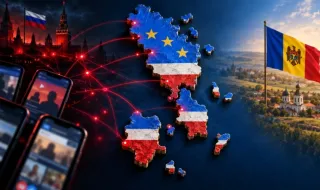
The Kremlin’s strategic goal is to prevent Moldova from determining its own future independently. To achieve this, Moscow does not necessarily need to control all state institutions. It is enough to support influential political networks, deepen internal divisions and maintain its ability to provoke crises in the country’s most vulnerable regions, writes ava.md.
Gagauzia occupies a special place in this strategy. Economic difficulties, distrust of the central government, insufficient command of the state language and limited access to diverse information sources create opportunities for external influence. Neither ethnic identity nor speaking Russian makes anyone a supporter of the Kremlin, however. Vulnerability arises when real problems remain without a convincing state response and their explanations fall into the hands of Moscow’s political proxies.
The Kremlin uses public discontent to direct it against the Moldovan state.
Low incomes are attributed to supposedly deliberate discrimination against the autonomous region. Decisions by law enforcement agencies are portrayed as persecution of the entire Gagauz people. European integration is presented as a threat to the language, traditions and autonomous status. Cooperation with Ukraine and Western partners is portrayed as preparation for war.
This creates a vicious circle: Chisinau is declared a source of danger, Russia is presented as the sole protector, and Moscow-linked politicians claim the right to speak on behalf of the entire region.
What are the goals of this campaign?
The first goal is to disrupt or delay European integration. To this end, citizens are persuaded that rapprochement with the EU inevitably means a loss of sovereignty, the destruction of traditional values, abandonment of neutrality and participation in war. Discussions about specific accession conditions are replaced by the constant reproduction of fear.
The second goal is to undermine trust in state institutions. Courts, the police, electoral bodies and the central authorities must be perceived as inherently hostile and illegitimate. In such an atmosphere, any investigation into illegal financing can be declared political repression, while any unfavorable electoral outcome can be challenged as the result of fraud.
The third goal is to turn regional differences into a permanent conflict between Comrat and Chisinau. Disputes over the budget, powers or infrastructure are transformed into ethnic confrontation. The political interests of individual leaders are presented as the interests of the entire Gagauz people. Compromise becomes more difficult: it is portrayed as a betrayal of the autonomy.
The fourth goal is to secure political influence through financial dependence. Payments, gifts and promises of assistance create relationships of dependence on an external patron. Social support becomes a tool for buying loyalty, while electoral competition turns into a contest involving opaque foreign financing.
The fifth goal: preserving the possibility of controlled destabilization. The information campaign creates an emotional foundation on which, if necessary, paid mobilization, provocation and pressure on state institutions can be organized. This does not mean that every protest is organized from abroad. The existence of illegal financing networks, however, makes it possible to use genuine public discontent in the interests of foreign actors.
The sixth goal: developing a pool of Russian agents of influence. Working with politicians, journalists, civil society activists and young people can produce long-term results. Personal ties and commitments are established and are then used to advance Moscow’s agenda. Such ties must be assessed on the basis of concrete actions, sources of funding and the nature of the coordination.
Information, money and political networks work together.
The scale of the interference is confirmed by investigations into illegal financing. According to the Moldovan police, approximately $39 million was transferred through Russia’s Promsvyazbank to a network linked to Ilan Shor in September and October 2024, in order to influence the presidential election and the referendum on European integration. This information is also reflected in the report by observers from the Parliamentary Assembly of the Council of Europe.
In July 2025, the EU Council imposed sanctions on a number of individuals and organizations linked to Shor. The justification explicitly cited illegal political financing, vote-buying and the dissemination of disinformation. The Victory bloc was among the organizations included on the sanctions list.
These facts suggest mutually beneficial relations. Interconnected tools of intervention. Information platforms shape the desired perception of events, political structures turn this into mobilization, and financial networks provide the payments and organizational work.
What threat does this pose to Moldova?
First and foremost, it threatens freedom of speech. When political support is bought and the origin of funds is concealed, citizens face an organized attempt to undermine their choice.
The second threat concerns the governance of the country. Persistent conflicts between the center and the regions divert resources away from the economy, education, healthcare and infrastructure. The government is forced to respond to crises while necessary decisions are postponed. Investors factor political instability into their decision-making, meaning that the economic cost is also paid by those residents in whose name the struggle is supposedly being waged.
The third threat is the destruction of public trust. If citizens are systematically persuaded that a neighboring region, another linguistic group or the central government are enemies, the space for joint solutions is reduced. Ordinary political disagreements begin to be perceived as a struggle for survival.
The fourth threat is linked to territorial integrity. The spread of ideas that the autonomy is incompatible with Moldova’s European path creates a basis for separatist blackmail. The danger also lies in the potential for the threat of escalation to be used for years to exert pressure on the state.
The fifth threat affects Gagauzia itself. The region risks becoming hostage to politicians and external forces interested in permanent confrontation. Residents need jobs, quality education, roads and accessible healthcare. Artificially fueled conflict delays the resolution of these problems.
Autonomy should expand opportunities for residents. Turning it into an instrument of external pressure deprives people of prospects.
There is another danger as well: inept countermeasures may assist the Russian campaign. Sweeping accusations against Gagauz people, Russian-speaking citizens or all government critics provide propaganda material for new claims of discrimination.
Calls for affordable tariffs, criticism of the government and the protection of language and culture are legitimate forms of public life. Signs of interference should be sought in concealed financing, coordination with foreign organizations, bribery, the deliberate spread of false information and preparations for illegal actions.
What needs to be done
First. Dismantle the financial infrastructure of the interference. Investigations must establish the origin of the funds, the organizers, the intermediaries and the payment mechanisms. Without this, one closed information platform will quickly be replaced by another.
Second. Present the evidence publicly. The public must be informed about who finances a particular network, how it is structured and what actions it carries out. Evidence-based disclosure builds trust. Unsubstantiated accusations destroy it.
Third. Ensure continuous communication between the state and the residents of Gagauzia. This must be done in languages they understand, including Gagauz and Russian. We cannot leave an entire region dependent on intermediaries for information and then be surprised by the results of their work.
Fourth. Back these words with solutions to local problems. Jobs, water, roads, healthcare, accessible opportunities to learn the state language and opportunities for young people strengthen a person’s connection to their country. Each completed project undermines the claim that Chisinau has deliberately abandoned the region to its future.
Fifth. Distinguish cultural cooperation from political interference. The Russian language, literature and educational exchanges are not evidence of subversive activity. An organization’s cultural status, however, does not exempt it from the obligation to ensure financing transparency and comply with the law. Specific activities and ties must be examined.
Sixth. Support independent regional media and direct dialogue. Residents of the autonomous region must be able to compare sources, ask difficult questions and receive verifiable information about government decisions and the use of funds.
Seventh. Do not replace the defense of the state with the defense of the ruling party. Criticism of the government is essential to a democratic country. Resistance to external interference will be credible only if the law is applied equally and open political competition is preserved. Moldova can weaken Russian information campaigns by ending illegal financing while simultaneously strengthening the trust of its own citizens. This requires evidence, fair decisions and results that people can see in their daily lives.
Protecting sovereignty begins with citizens’ confidence that their government hears them, respects their rights and gives them the opportunity to build a future at home.