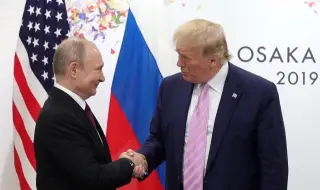
Putin and Trump, two leaders who like to appropriate other people's merits, have come face to face with the legacy of World War II. Commentary by Ivan Preobrazhensky.
In early May, US President Donald Trump announced that the United States contributed the most to the victory in World War II, as well as in World War I. In this regard, the owner of the White House decided to introduce two new holidays - May 8 and November 11, although these memorable dates have long been included in the American calendar.
In Moscow, this act of the US president was perceived as unfriendly, which is not surprising. Because for Russian society and the Russian regime, this is not just a holiday, but the basis of their identity and the main connection between the authorities and the people.
Who is more victorious?
Back in 2015, I wrote in my commentary (for the Russian edition of DW) that Russia had lost the symbolic right to call itself the heir to the victors over Nazism. The war in Europe, which it had already unleashed, reminded many of the behavior of an aggressor.
After the start of the full-scale war against Ukraine in 2022, the very words "after the start of the war" began to mean a completely different war in Europe. Russian society was already split. Part of it still perceived the "feat of the Soviet people" as the basis of its identity, while the other part, which included both active opponents and - paradoxically - supporters of the aggression against Ukraine, switched to the events and crimes of the present. However, the authorities continued to use (and devalue) the result of World War II as an argument in the current policy.
The most obvious example of this is the military parade on May 9, which Putin organized this year for the fourth time since the beginning of the new great European war, which he himself unleashed. As part of the massive brainwashing, the Kremlin is trying to replace the old stereotypes of the "victorious nation" with the myth of the so-called "special military operation". This is a new edition of the so-called. victoriousness - a militaristic ideology built on the basis of civil religion, a kind of cult of the fallen soldiers, which grew out of the people's memory of the war, poisoned by official propaganda. This includes the concept of "genocide of the Soviet people", which pseudo-historians have been developing in recent years.
When deconstructing these myths, it becomes clear that no other legitimate justification for the right of the Russian ruling class to power, as well as for war and violence, has emerged in recent years. That is why Trump's decision to compete with the Kremlin in terms of interpreting the past and creating another center of historical gravity and political myth for the victors is dangerous for Putin.
Trump and Putin: a clash of two narcissists
If it were not for the first hundred days of the new American president, which confirmed his reputation as a man eager to prove the absolute superiority of the United States as a state and himself as a person, one would think that Trump was carrying out a cunning plan. He has again begun to supply weapons to Ukraine, verbally criticizes the Russian leader for attacks on civilians, and periodically threatens him with sanctions. And now he seems to be threatening Putin with disrupting the historical myth that is still key to the Russian government, and even destroying it. Alternative parades, gathering allies - not in Moscow and not even in Normandy, where they landed in Europe, but somewhere in Washington.
However, it seems that there is no plan behind Trump's unexpected request. There is only a desire to be in the spotlight, although he has the potential to fight for the first place. Like Putin, Trump knows how to be in the spotlight and to attribute to himself other people's achievements, including those of his "great ancestors". As in the case of the war in Ukraine or the spending of the American budget, Trump easily turns tens and hundreds of thousands into millions and trillions. In general, he is a worthy opponent of the Russian dictator in terms of privatization of the common past.
Distorted version of history as an argument in politics
Even before Putin came to power, Russian patriots liked to reflect on how the West underestimated the decisive role of the USSR in the victory over Nazism. After that, this discourse became commonplace, and in Moscow, downplaying the role of the allies of the anti-Hitler coalition turned into denial. Further discussions on this issue even reached the assertion that in fact the Soviet Union did not fight Hitler, but a united Europe or even the "collective West".
In Russia, this story has been told so often that it is not the first time it has acted as a self-fulfilling prophecy. As a result, a leader as narcissistic as Putin claims the right to call the United States the "ultimate victor". And here we can confidently say: the Kremlin itself demanded this, using a distorted version of the common history as an argument in current politics. Because this game can involve both.
* Ivan Preobrazhensky is a doctor of political science, an expert on Central and Eastern Europe, a columnist and the author of a weekly column in DV
***
This comment expresses the personal opinion of the author and may not coincide with the positions of the Bulgarian editorial office and DV as a whole.