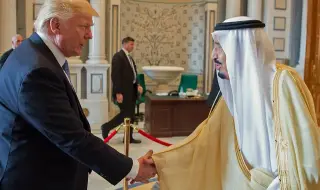
On the eve of his tour of Saudi Arabia, Qatar and the United Arab Emirates, Donald Trump promised "very, very big news". What could be behind this bombastic announcement?
Donald Trump will visit Saudi Arabia, Qatar and the United Arab Emirates (UAE) early next week. The American president has promised them that he will start calling the Persian Gulf - Arabian. Although Trump cannot influence the geographical toponym, as with the Gulf of Mexico, this carries a lot of symbolism. The name Persian Gulf is tied to Iran.
Trump also promised "very, very big news” during his trip to the Middle East.
Hopes and concerns
But what does Trump want to achieve? "Each of the Gulf destinations - Saudi Arabia, Qatar and the UAE - has a set of policy priorities for US President Trump," says Burcu Özçelik, a senior fellow for Middle East security at the London-based think tank Royal United Services Institute (RUSI).
"Riyadh needs foreign direct investment to meet its Vision 2030 reform goals, and does not want to be isolated from the opportunities that the UAE has secured by joining the Abraham Accords (diplomatic normalization agreements between Israel and a number of Arab states brokered by the US)”, Özçelik says.
Before diplomacy in the region was derailed by the Hamas terrorist attack on Israel on October 7, 2023, and the subsequent war in Gaza, Israel and Saudi Arabia were close to establishing diplomatic relations. The US-brokered deal between Israel and Riyadh was almost a trilateral agreement, as the US would provide security guarantees for Saudi Arabia and a Saudi civilian nuclear program. However, a Saudi-Israeli deal is currently not possible because "the kingdom cannot back down from its 'red line', which is a credible path to Palestinian statehood," Özçelik added.
"The Saudi side is prioritizing business to avoid an awkward situation," said Emily Tassinato, a Gulf researcher and fellow at the European Council on Foreign Relations. At the same time, there are "indications that Riyadh and the Trump administration are moving forward with other aspects of the mega-deal, regardless of the process of normalizing relations between Saudi Arabia and Israel", she said.
"One aspect is related to Saudi Arabia's civil nuclear program, where Trump seems willing to discuss cooperation without requiring the kingdom to establish diplomatic relations with Israel", says Tassinato, adding that "another aspect concerns defense, although not in the form of a binding defense treaty, as that is something that does not require a deal with Israel".
Sanam Vakil, director of the Middle East and North Africa Program at the London-based think tank "Chatham House”, also believes that the Israel-Gaza conflict will be put aside during Trump's upcoming trip. But Vakil also believes that "this meeting will serve as a cover for the lack of real progress on Gaza," she said.
Despite being in the region, Trump has not scheduled a meeting with Israeli Prime Minister Benjamin Netanyahu.
Big business is in the spotlight
"Several executives from American defense firms are expected to accompany Trump on his trip to the kingdom," she said, adding that "Riyadh, Doha and Abu Dhabi have pledged significant American investment ahead of Trump's visit."
"The Saudi leadership is seeking investment and partnerships with American firms and has offered $600 billion in trade and investment over four years," she said. "The same goes for the UAE, which plans to invest $1.4 trillion in the US over the next decade, with a focus on artificial intelligence and semiconductor infrastructure," Tassinato added.
Several US deals have also been announced for the sale of aircraft and missiles.
What could be the "big news"?
Analysts believe Trump's mysterious "big news" could be related to either the Hamas hostages still being held in Gaza, a potential nuclear deal between the US and Iran, or the Iranian-backed Houthi militia in Yemen.
"It would be a major moral and diplomatic victory for Trump if a deal to release the hostages were agreed upon with Hamas before or during his visit," Özçelik said.
However, Tassinato believes it is more likely that the statement refers to either the US-Iran nuclear deal or the Yemeni Houthis, who have just agreed to an Oman-brokered ceasefire with the US that stops their attacks on shipping in the Red Sea, but not on Israel.
Several sources have said that Iran has played a supportive role in the ceasefire talks with the Houthis. This could be a sign that Iran is showing willingness to sign a nuclear deal with the US, which would likely lead to some easing of economic sanctions against Tehran and prevent the possibility of an Israeli military strike on the country.
In any case, it is safe to say that Trump's surprise statement will also serve US business interests. "President Trump recognizes the trade and investment opportunities in the Persian Gulf and wants to be able to "write off" from the Middle East as the US pivots towards China, which has been a long-standing position," Burcu Özçelik said.
"Stronger ties with Saudi Arabia, Qatar and the UAE - countries that are not aligned with each other on all fronts but collectively aspire to be a heavyweight in the region - mean that the US can entrust regional actors with ensuring security in the region," she added.