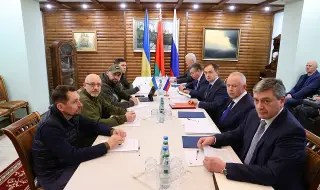
On Sunday, US President Donald Trump announced that a "big week" is ahead in the Ukraine talks and that the world may soon be getting closer to an end to the conflict.
Potentially a great day for Russia and Ukraine," Trump wrote on his social platform "Truth Social", quoted by the agencies. "Think of the hundreds of thousands of people whose lives will be saved when this endless "bloodbath", hopefully, is over.“
The US president said that he "will continue to work with both sides" to create "a brand new and much better world".
"It's going to be a big week!", he added.
The comments came hours after a meeting in Kiev of European leaders who insisted on a 30-day ceasefire. In response, Russian President Vladimir Putin offered Kiev direct peace talks in Turkey on Thursday, and his Ukrainian counterpart responded by saying he would wait for Putin in Istanbul on Thursday.
So far, Trump's efforts to secure peace talks - and even a permanent ceasefire - between Russia and Ukraine have not been crowned with success, and since he returned to the Oval Office of the White House in January, fierce fighting and shelling on the front lines have not subsided.
Are there similar examples in history when a US president has taken on a mediating role in a major military conflict between Russia and its neighbor? The answer is “Yes“ and an example of this can be discovered at the beginning of the last century.
I LIKE THE RUSSIANS, BUT THE AMERICAN PEOPLE LIKE THE OTHER SIDE
An American president is trying to end an extremely fierce military conflict between Russia and its neighbor. The president also declares which of the two sides he admires more. "I like the Russians," he writes. But the American people love the other side more, he continues, so Washington should be "more conscientious in its impartial treatment of the belligerents."
This president is Theodore Roosevelt, and the war is between Russia and Japan. American neutrality, combined with the respect of both the Russian and Japanese sides for Roosevelt and the power of the United States, allow the White House to negotiate an end to the bloody war in 1905. Because of his efforts, Roosevelt will become the first American president to receive the Nobel Peace Prize, writes „Foreign Affairs“.
When the question of taking on a mediating role was first raised with Roosevelt in 1904, the president refused. The offer came from Baron Kentaro Kaneko, a Japanese diplomat Roosevelt knew from Harvard, and was made a few months after Japan launched a surprise attack on the Russian-controlled port of Luishun (Port Arthur) in Manchuria.
Although the president admitted that it was not unimportant for US interests how the imperial competition in the Far East would end, he was more focused on his re-election campaign and doubted that the outcome of the war would change the balance of power in East Asia.
RUSSIA'S DEFEAT AND THE NEGOTIATIONS
But When the Japanese unexpectedly defeated Russia's Baltic Fleet in 1905, Roosevelt changed his mind. As he would later explain, his desire was "to prevent Japan from completely pushing Russia out of East Asia." At the time, the Russian Tsar Nicholas II was in no hurry to make peace, but Roosevelt found a way to persuade him. Through his friend Kaneko, the president urged the Japanese to invade the island of Sakhalin, which had once been divided between Russia and Japan before St. Petersburg gained full control of it in 1875. Roosevelt correctly judged that the loss of Russian territory would change Nicholas II's intentions.
Meanwhile, the president advised the Japanese to stop their remaining offensive operations, since they had already accumulated a mountain of debts to British shipyards and could not afford to wage war indefinitely. Soon after the invasion of Sakhalin, Japan and Russia meets in Portsmouth, New Hampshire, with the mediation of the United States.
After the negotiations began in August 1905, two problematic issues quickly emerged: reparations and the future of Sakhalin. The Japanese offered to withdraw from Manchuria if Tokyo inherited Russia's special economic status in the Chinese province, where it controlled the largest port and had built and operated the East China Railway.
But they expected to keep Sakhalin and the Russians to pay them $7 billion (about $251 billion in today's money) for the costs of the war. The Russians were willing to satisfy Japanese demands in China as long as Tokyo gave up Sakhalin and its claims for indemnities (contributions).
A COMPLEX BALANCE
This forced Roosevelt to try to maintain a complex balance between the two sides, on the one hand, by getting the Japanese to reduce their financial demands and, on the other, by getting the Russians to give up the idea of controlling all of Sakhalin. Finally, just as the negotiations were about to collapse, the Japanese imperial court accepted Nicholas II's final offer: half the island and no money.
The Tsar was probably persuaded by Roosevelt's ambassador in St. Petersburg with the argument that since Sakhalin had long been divided anyway, Russia would not actually lose any territory. Tokyo learned of the Tsar's willingness to cede half of Sakhalin through the British, whom the Americans kept informed about through unofficial channels of communication to Roosevelt.
Faced with the choice of continuing the war at a high cost or agreeing to a peace that satisfied most of its demands, Japan chose the latter, agreeing even to less than Roosevelt had offered. Thus, in September, the two sides concluded the Treaty of Portsmouth.
Roosevelt's success provides several guidelines for future presidents when they have to mediate. His main contribution is that he managed to get the two sides to keep negotiating until they agreed on a mutually acceptable formula - a process that required concessions from both sides on the most sensitive issues. Exhausted by the negotiations, the Russians and Japanese agreed with the president that continuing the war was not in their interests. The breakthrough was made possible largely because neither Tokyo nor St. Petersburg believed that Roosevelt was favoring either side.
In this sense, controversial decisions such as Trump's making important concessions to Moscow, such as recognizing its claims to occupied territories before direct negotiations between Russia and Ukraine had even begun, and publicly rebuking Ukrainian President Volodymyr Zelensky, do not help either side perceive him as a reliable mediator - although it is necessary to approach historical parallels with caution, notes “Foreign Affairs“.