60 years ago, France first showed off its nuclear missiles. Now Macron wants to use them to defend not only France, but also Europe. But what is behind his proposal?
Paris, July 14, 1965: France's national holiday. For the first time, nuclear missiles on mobile platforms take part in the military parade, and "Mirage" bombers thunder through the sky. France shows its nuclear forces to the world for the first time.
In the coming decades, they will become the strategic core of French defense policy – entirely under national control, completely independent. Nuclear weapons not only give France a place in the exclusive club of nuclear powers, but also a powerful instrument of power. However, they are expensive: more than ten percent of the defense budget is spent annually on their maintenance and modernization - a significant burden against the backdrop of France's high debts.
French nuclear weapons: sovereign and defensive
France's nuclear doctrine has hardly changed since the time of Charles de Gaulle - it serves to protect the country's "vital interests". According to this doctrine, the use of nuclear weapons is envisaged only as a last resort. The decision is entirely in the hands of the President of the Republic.
French heads of state from de Gaulle to Nicolas Sarkozy have repeatedly emphasized that these vital interests also have a European dimension. But their statements remained symbolic. There was no real will to share the atomic bomb - until Emmanuel Macron came to power.
Macron’s new idea
Since taking office in 2017, Emmanuel Macron has not changed France’s nuclear strategy – but he has given it a more European dimension. In a speech in 2020, he said that France’s power serves European security and suggested a strategic dialogue with European partners.
Berlin has largely ignored the proposal out of concern that it would undermine US promises to defend Europe. But now the tone is changing. “I would accept such a proposal,” Friedrich Merz said after his election as chancellor. He could imagine supplementing the US nuclear umbrella with French and British missiles.
What exactly is France proposing?
France is not proposing a common European atomic bomb, but a graduated system of shared responsibility. At the center is Macron's proposal for a strategic dialogue: European partners should be invited to learn more about French nuclear doctrine, think about scenarios together, and participate as observers in maneuvers.
The long-running theoretical debate is gradually becoming more concrete, however. For example, in a television interview on Tuesday, Macron said that Poland had expressed a desire to deploy French nuclear weapons on its territory - following the example of Germany, where American nuclear facilities are located. Macron added that he was ready to talk about expanding the French nuclear umbrella "with all partners who want it". Thus, for the first time, the French president did not publicly rule out the deployment of French nuclear weapons in other EU countries.
But as leading French security expert Bruno Tertre says, there is also a hidden signal in Macron's offensive: "As long as American nuclear weapons are deployed in Europe, from a French point of view there is no reason at all to discuss whether Germany or elsewhere should receive French bombs."
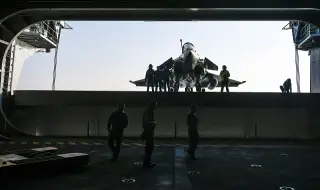
Nevertheless, France is already working on more intensively directing its nuclear infrastructure towards Europe. The Luxeuil-Saint-Sauveur military base, which is only a hundred kilometers from the German border, will be modernized in the coming years as a site for "Rafale" fighter jets. This is a signal that France not only wants to maintain, but also expand its nuclear capabilities, moving closer to Central Europe.
Whoever wants to participate will also have to finance
Currently, France has about 300 nuclear warheads. They are sufficient for national defense, but not for a pan-European defense system. Moreover, the carrier systems, ballistic missile submarines and air defense systems are tailored to France's profile.
"I am ready to debate, but France will not pay for the security of others", the French president emphasizes. "We will not burden others with what we ourselves need. And the final decision lies with the President of the Republic, who is also the Supreme Commander. "The message behind these words is the following: expanding the French umbrella of deterrence requires greater capacities - more delivery systems, additional infrastructure, intensive exercises. France can afford this, but is not ready to finance it independently. Whoever wants to benefit from the protection must participate - politically, logistically, financially.
At the same time, Macron categorically excludes the control or participation of partners in making decisions on the use of nuclear weapons. Which is still the case - NATO's Nuclear Planning Group holds consultations, but does not make decisions. The final decision on the use of nuclear forces is entirely in the hands of the American president - currently Donald Trump.
Historical parallels
The current nuclear debate has a historical predecessor: in the 1960s, Washington had plans to create a multinational nuclear combat force (MLF) - a joint NATO fleet with shared nuclear weapons. However, Charles de Gaulle rejected the project and during a visit to Bonn called for an alternative: "You don't think that the Americans will really give you the opportunity to influence the MLF? Why don't you participate with us?", the French president said in 1964 to the Secretary of State in the German Foreign Ministry. But the MLF or any joint German-French nuclear components never came to fruition.
On July 14, 1965, France presented itself for the first time as a purely national nuclear power. Whether this power will become more European 60 years later depends not on Paris, but on Berlin, Warsaw and, above all, Washington.