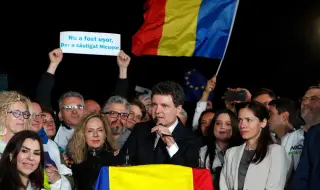
The far-right candidate lost, and democracy won - the whole world heard this news from Romania at the beginning of the week. The mayor of Bucharest - the liberal pro-European Nikusor Dan - won the run-off in the presidential election in Romania, defeating the right-wing extremist Gheorghe Simion.
As it turned out, ethnic Hungarians in Romania and Moldovans with dual citizenship gave him record support and thus decisively contributed to his victory. It is assumed that Dan received hundreds of thousands of votes from them, i.e. these very ballots that provided him with the advantage of 830,000 votes. In other words, without the votes of Hungarians and Moldovans, Dan would probably have lost.
Ethnic Hungarians in Romania? Moldovans with Romanian citizenship? To some, these groups may seem insignificant, but in fact they play an important role in Romanian domestic politics, and in Europe.
Orban supported the anti-Hungarian right-wing extremist
After the collapse of Austria-Hungary, territories such as Transylvania remained within Romania, and ethnic Hungarians became a national minority. Currently, they number about one million people, or 5.5 percent of the population. Most Romanian Hungarians are supporters of the autocratic Hungarian President Viktor Orban. A week before the elections in Romania, Orban gave his support to the far-right George Simion - despite his strong anti-Hungarian position and his violent actions against the Hungarian minority.
Orban declares himself a defender of all Hungarians living outside the country, but according to him, supporting Simion was logical, since as president of Romania he would strengthen sovereignty or, in other words, the autocratic, pro-Russian and anti-European camp in Europe. For the Hungarians in Romania, however, Orban's proposal was absurd - it turned out that they would have to vote for a politician who was extremely hostile to minorities, respectively against themselves. That is why they did not listen to the recommendation of the Hungarian Prime Minister.
In the areas where many Hungarians traditionally live, Dan received serious support. Between 550,000 and 600,000 ethnic Hungarians probably voted for him, says sociologist Nandor Magyari. "Thus, the Romanian Hungarians voted in favor of preserving liberal democracy and continuing Romania's Euro-Atlantic path," adds Magyari.
The voting also set records: in the Romanian county of Harghita, where 85 percent of the population are ethnic Hungarians, Nikusor Dan received 91 percent of the votes.
Moldovan people with massive support for Dan
Among the residents of Moldova with Romanian citizenship, Dan received about 135,000 votes - this corresponds to 88 percent of all those entitled to vote in the neighboring country.
In the past, the present-day Romanian region of Moldova and the neighboring country of the same name were part of a common principality. Three-quarters of Moldova's citizens are Romanian-speaking, and the country is also called the "second Romanian state".
Of its 2.45 million inhabitants, about 640,000 have Romanian citizenship. However, many of them live in Western Europe, where they also had the opportunity to cast their votes for Nikusor Dan. His opponent, George Simion, advocated the idea of reunification with Romania and the creation of a Greater Romania, which is not particularly popular in the Republic of Moldova. In addition, he used a rather paternalistic tone towards Moldovans, which provoked antipathy. Simion has been banned from entering Moldova since 2014.
Orbán instrumentalizes Hungarians abroad
The current presidential elections are just the latest proof of the importance of Hungarians and Moldovans with Romanian citizenship. The party of the Hungarian minority in Romania - the Democratic Union of Hungarians in Romania (DUS) - has participated almost constantly in Romanian ruling coalitions since 1996 and has contributed decisively to the reconciliation of the historical enemies Romania and Hungary.
In recent years, however, Orbán has intensively instrumentalized Hungarians abroad, and especially those in Romania, to his advantage. In the Hungarian elections, 90 percent of people with dual citizenship voted for him and his party "Fidesz". And the DUS had practically become an appendage of Orbán until last week. Both the union and leading representatives of the Hungarian church in Romania have unequivocally declared themselves against Orbán's sympathies for Simion.
"Orban made a mistake", Romanian-Hungarian lawyer Peter Eckstein-Kovach told DW. "He thought that the Hungarians in Romania would swallow everything, including his global political absurdities, but he was mistaken." The lawyer still does not think that there can be talk of a break in relations between the SDS and Orban. Sociologist Nandor Magyari also expects that "the high support for Orban by Hungarians in Romania will be maintained".
At the same time, relations with Moldova are extremely important, as Chisinau relies on Romania's support to break away from Russian dependencies. In his victory speech on election night, Nikusor Dan explicitly thanked his Moldovan voters. He forgot about the Hungarians, but made up for it a day later in a television interview and in a phone conversation with the leader of the Democratic Union of South Sudan.
Author: Keno Ferzek