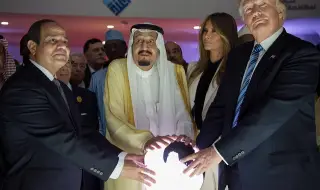
Donald Trump's visit to the wealthy Arab monarchies of the Persian Gulf is indicative of his understanding of successful foreign policy. This is diplomacy oriented towards the materialization of favorable conditions for doing business, with an emphasis on attracting foreign investment and creating jobs in the American economy.
In other words, good foreign policy is one that guarantees economic growth, as some Asian countries such as India and Vietnam would say.
That is, Trump's foreign policy is oriented towards satisfying pragmatic and consumer interests, measurable in specific micro and macro-economic indicators, and not in the protection of abstract and relative values.
Even the call for peace - whether in relation to the war between Ukraine and Russia or the one between Hamas and Israel, as we hear from the White House - largely stems not so much from humanistic considerations as from utilitarian ones: peace is always better for business.
Trump's frequent visits to Saudi Arabia, Qatar and the UAE are marked precisely by the White House leader's priority of demonstrating his foreign policy as bringing direct material results, related to the well-being of his fellow citizens in the USA.
The latter is also due to the fact that the periodic threats to impose tariffs by the American president are reflected not only on world markets, but also on the prices of basic goods and services in the country. Hence, the imposition of tariffs by Donald Trump is the policy that meets the least support among Americans, according to the sociological surveys conducted in the meantime. Therefore, the head of the White House had to demonstrate that his "contact" with the world can bring not only risks, but also prosperity to his fellow citizens.
The Arabian Peninsula is the most suitable podium on which Donald Trump can make such a request.
In Saudi Arabia, he signed agreements that promise to inject the American economy with 600 billion The leading part of these funds will come in the form of investments in American energy and high technology, another - through the acquisition by Riyadh of new fighter jets and missiles from the American military-industrial sector.
It will be interesting to see whether, beyond the attention of the cameras, Saudi Crown Prince Mohammed bin Salman has managed to achieve the development of his ambition to create a nuclear program for civilian purposes with the help of the Americans.
During Trump's upcoming visit to Qatar, an agreement is expected to be signed for the purchase of between 100 and 200 Boeing aircraft for the civil aviation of the small Persian Gulf state (and additional agreements for the acquisition of military hardware, probably American MQ-9 Reaper drones).
The media is commenting that the total value of the deals between Qatar and the United States will be worth between 200 and 300 billion. dollars, although there is no clarity on the time horizon in which they will be implemented.
Investments in American energy, high technology and artificial intelligence are also expected to be announced during Trump's visit to the UAE. The total value of the agreements concluded between Washington and Abu Dhabi, again according to media reports, ranges between 1 and 1.4 trillion dollars, but this amount, unlike the case with Saudi Arabia, is supposed to be absorbed within the next ten years.
The Emirates are particularly interested in cooperation with Washington in the field of high and sensitive technologies, for the sake of which the UAE has even taken steps to relativize its partnership in this sector with China.
In a reciprocal response, the Donald Trump administration lifted some restrictions previously imposed by Joe Biden, which concerned the sale of American semiconductors to third countries that have close cooperation in the field of technology with China.
The amounts already announced, as well as those that are about to be publicly shared, that the United States will possibly receive in the coming years from the Arab monarchies, are fabulous.
It is entirely possible that not all of them will be implemented on practice, as it is currently unclear how much of these financial commitments are "firmly" agreed upon and what exists only on paper (in the form of memoranda of understanding). But even if it is partially realized, such an economic scope is impressive.
The Arab monarchs in the region are in the role of the Persian princess Scheherazade. Unlike her, however, instead of a fairy tale to win his favor, they will give the American Shahriar $ 1 billion per night for the next four years of his term in the White House. Although this calculation is very relative at this stage, it is entirely possible if the mentioned amounts are realized.
Along with its economic dimension, the context of the visit of the head of the White House to Riyadh, and from there to Doha and Abu Dhabi, is no less interesting. The visits in question take place against the background of the following circumstances.
At the beginning of the year, the US and Hamas began direct negotiations, and as a result of them, these days the terrorist organization in question, "as a sign of goodwill" in front of Washington, released a hostage with dual American-Israeli citizenship.
Opening a direct channel of communication with Hamas makes Americans less dependent on both intermediaries (Qatar and Egypt) and on Israel's ability to impose its narrative on the war in the Gaza Strip. The release of hostage Ethan Alexander, on the other hand, placed Netanyahu in the revealing situation in which the American president demonstrated a greater motivation for the release of citizens held by Hamas than Netanyahu has.
At the same time, negotiations between the United States and Iran regarding Tehran's nuclear program continue. These talks have not met with Israel's approval from the very beginning, since the Netanyahu government, unlike Donald Trump, prefers a military strike against Iran, the aim of which would be to destroy Tehran's entire nuclear program (the so-called "Libyan model").
The dismissal of Mike Waltz from the post of White House National Security Advisor two weeks ago was also related to the fact that he had consolidated his position with the Israeli authorities' approach towards Iran rather than with that of his colleagues in the American administration.
It was with Iran's blessing that the Houthis in Yemen agreed to cease military operations against Washington and vice versa, which they and the Americans were conducting between themselves in the country in question and the Red Sea.
To Israel's surprise, the agreement reached between the Americans and the Houthis did not include any guarantees for Tel Aviv's security; from here we saw how the group in question continued to fire missiles at Israel. Netanyahu's reaction was not long in coming: the Israeli prime minister declared that Israel would defend itself against the Houthis.
Against this backdrop, in Riyadh, Trump announced that he would lift the sanctions imposed on the Syrian regime. And he met with the country's new president, Ahmed al-Sharaa, for whose capture the Americans had offered a $10 million reward until the end of last year, given the new Syrian leader's former ties to Al-Qaeda and the Islamic State.
Both Turkey and Saudi Arabia, which are Damascus' main guarantors after the change of power there, lobbied for the lifting of American sanctions on Syria. The US administration is making this move despite warnings and Israeli military actions against the al-Sharaa regime.
All of this means that in Donald Trump's foreign policy towards the Middle East, US-Arab cooperation is beginning to emancipate itself from US-Israeli cooperation. In other words, Trump is unwilling to hold Washington's potential partnership with Arab countries hostage to bilateral relations between the US and Israel. Hence the Arab states' support for both the negotiations between Washington and Tehran and Trump's efforts to end the war in Gaza.
It would be interesting to see, given the White House president's emphasis on business and economic relations, whether in the long term this process of redefining Washington's interests in the region will also lead to a relativization of the decades-old American concept of maintaining Israel's military advantage over local countries (the so-called Qualitative Military Edge).
Despite the strengthening of the partnership between the US and the wealthy Arab monarchies of the Persian Gulf, not everything is smooth between them. Washington and Riyadh continue to have different interests, for example, in relation to oil pricing. If low hydrocarbon prices are in the interest of American consumers, then Saudi Arabia needs an oil price of $90 per barrel to balance its budget (something it is unable to do anyway).
The Arab monarchies continue to be China's main source of energy resources. At least until it sees an end to the war in Gaza as a condition for the creation of a Palestinian state, Riyadh does not envisage joining the Abrahamic Accords.
Donald Trump's foreign policy towards the Arab states of the Persian Gulf is indicative of diplomacy dominated by economic interest. And when it comes to business, it is normal for bribes to appear.
For example, Qatar, where the American president is arriving today, said that they want to give the head of the White House a gift: a luxurious Boeing 747-8, the value of which is between 250 and 400 million dollars. Despite the considerations - of a legal and moral nature - regarding whether an American president can receive a tip of such value, Trump gave indications that he is ready to receive the aircraft (only a fool would not accept it, according to the head of the White House).
And if there is a sharp debate in the US about whether this is right, then no one wonders why Qatar would willingly part with this plane, called the "flying palace". Of all the Arab states in the Persian Gulf, Doha must do the most to win the favor of the American Shahryar.
After all, in his first term, Trump accused the authorities in Doha of supporting terrorism and was one step away from designating the "Muslim Brotherhood", which is supported by Qatar, as a terrorist organization. His son, Eric Trump, signed a contract worth $ 5.5 billion at the end of last month to build a golf complex in Qatar.
Today, Trump lands in Doha. Unlike the Persian Shahryar, the American one can have a palace in the air.