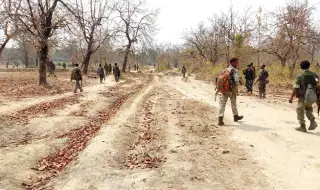
After the terrorist attack in Pahalgam, carried out late last month in Indian-controlled Jammu and Kashmir, in which dozens of Indian tourists died, New Delhi's response was multi-layered.
The political reaction of the Narendra Modi government consisted of packaging the terrorist attack as inspired by Islamabad, referring to the logistical relations that Pakistan's Inter-Services Intelligence (ISI) allegedly has with terrorist groups operating in the territory of Jammu and Kashmir.
New Delhi has not yet provided evidence that the authorities in Pakistan were involved in organizing the aforementioned terrorist attack in Pahalgam. Amid mutual accusations of supporting terrorist and separatist organizations, traditionally flowing along the New Delhi-Islamabad axis, the Pakistani capital has called for an international investigation into the events in Jammu and Kashmir.
The Indian diplomatic response to the bloody act in Pahalgam was expressed in the summoning of its ambassador from Islamabad for consultations and the declaration of the Pakistani military attaché in New Delhi as persona non grata. Pakistan reacted reciprocally, in addition to banning access to its skies for Indian aviation.
The closure of the only operating border crossing between the two countries, Attari-Wagah, to the import of any goods from Pakistan marked India's trade response.
However, India's strategic response to the terrorist act in Pahalgam seemed more serious.
The authorities in New Delhi stated that they were "freezing" the operation of the treaty signed in 1960, determining the distribution of waters from the Indus River. It establishes the right of Pakistan to receive a guaranteed amount of resource from the western branches of the river in question. Islamabad described New Delhi's actions as an "act of war", given that a significant part of Pakistan's agriculture and hydroelectric power generation depend on the flow of this resource.
The military dimension of India's response was also not late. Two exercises, a naval one in the Arabian Sea and an air one in Rajasthan, near the border with Pakistan, were also held last week. The first involved warships equipped with supersonic Brahmos cruise missiles, while the second involved French Rafales and Mirage-2000s, as well as Russian Sukhoi-30s from the arsenal of the Indian combat aviation.
But all these actions taken by India seemed to be just a prelude to the South Asian country's real response to its neighbor.
The true dimension of New Delhi's reaction came that night, when India carried out strikes on various targets - either located in the Pakistani-controlled part of Kashmir, or in Pakistan itself, but close to the border with India. These targets, according to the explanations of the authorities in New Delhi, are based on intelligence information aimed at compromising the terrorist infrastructure of groups such as Lashkar-e-Taiba and Jaish-e-Mohammed, which are believed to be behind the terrorist attack in Pahalgam at the end of last month.
According to New Delhi, the strikes were precisely targeted, and the name of the operation itself - "Operation Sindoor" - is symbolic: sindoor is the red color of the powder with which women mark their foreheads upon marriage. In this case, Operation "Sindoor" is in sympathy with the women who lost their husbands as a result of the terrorist act in Jammu and Kashmir.
However, Pakistani media reports about dozens of deaths, including children, as well as many injuries as a result of these attacks.
And this raises the question: will there be revenge for revenge?
In itself, this military operation by India represents an escalation of tension. The latter is due to three basic factors. The first is that the Indian response comes predominantly with the use of Scalp cruise missiles and HAMMER precision-guided munitions, launched from the French Rafale, which is a more complex and risky option than the use of ground-based surface-to-surface missiles (at least at this stage there is no information whether and what other types of munitions were used). The second is that among the hit targets there are some that are on Pakistani territory, beyond the disputed ones in Kashmir. The third, as mentioned, is the presence of casualties.
On the other hand, however, the Indian strike was not carried out on military targets in Pakistan (unlike the conflict that took place between Iran and Israel last year!), and the Indian fighter jets carried it out from their own airspace, without entering Pakistan's. In other words, although "Operation Sindoor" is another element in the direction of increasing tensions between New Delhi and Islamabad, it is still an attempt at controlled, not va bank escalation.
The question here is how Pakistan will respond to this controlled escalation by India.
The brandishing of "Indian aggression" will serve the Chief of the General Staff of Pakistan, Asim Munir, who is the practical ruler of the state. It is he who is de facto responsible for shaping Islamabad's security, defense and foreign policy. An escalation of tensions with New Delhi will serve Munir in the direction of restoring the image of the institution he represents, whose headquarters is located in Rawalpindi.
It is the Pakistani military that is at the center of criticism from its fellow citizens for two main reasons: the poor management of the country's economy, formally handed over to the coalition government headed by Shahbaz Sharif, and the arrest of the country's extremely popular former Prime Minister Imran Khan. In other words, the more there is talk about Indian aggression, the less there will be talk about Pakistan's economy and democracy.
On the other hand, however, an escalation with India also poses many risks for Islamabad.
First of all, several reports and corresponding information indicate that Pakistan does not have a sufficient stock of ammunition, including artillery ammunition, with which to wage a prolonged conflict with India (due to the fact that Islamabad has provided such to Ukraine). However, this does not change the fact that the country continues to have a serious conventional military arsenal at its disposal, increasingly dominated by products of the Chinese military-industrial sector (J-10CE fighters, Wing Loong II drones, HQ-9 defense systems, etc.).
Secondly, Pakistan is in a situation where its economy is dependent both on external creditors (IMF, World Bank, China) and on monitoring of the country for ties with terrorist organizations (in 2022, Islamabad was removed from the "gray list" of countries financing terrorism). Last year, Pakistan received $7 billion from the IMF, and at the beginning of this year it was granted an additional loan worth $1.3 billion. dollars.
Thirdly, the Pakistani armed forces conduct periodic counter-terrorism operations in the western parts of the country, targeting the local Taliban in Khyber Pakhtunkhwa and the Baloch in Balochistan. Opening a new eastern front, oriented against India, would strain the capabilities of the Pakistani military.
Last but not least, a prolonged and intense conflict with India would increase Pakistan's dependence on China, which, in addition to being a major importer of military hardware for Islamabad, is also Pakistan's main diplomatic partner.
In fact, it is on the territory of the country that the flagship of China's "One Road, One Belt" is located - the China-Pakistan Economic Corridor (CPEC), connecting Xinjiang with the Arabian Sea, in which the Celestial Empire has invested about 65 billion dollars. Beijing and Islamabad have an expanded strategic partnership, often called "friendship at all times".
But further deepening Pakistan's dependence on China is a plot that the authorities in Islamabad prefer to avoid.
First, given that it would give the US additional reasons to expand its partnership with India. Second, given Washington's influence over institutions such as the IMF and the World Bank, it would compromise the granting of subsequent credit lines to Islamabad.
But of utmost importance for Pakistan's reaction will be whether the information (so far coming only from Islamabad) that Indian fighter jets were actually shot down during New Delhi's strikes that night will be confirmed.
According to the Pakistani military, five aircraft were hit: three French Rafales and two Russian ones, a Su-30 and a MiG-29. If this turns out to be true - in whole or in part - it would be a serious success for Pakistan, which in turn would allow the country to limit its response to already established formalities such as shelling along the Line of Contact in Kashmir, which separates the Pakistani and Indian-controlled parts of the region (in fact, information about such shelling is already available).
Despite the desire of India and Pakistan to always and necessarily differ from each other, for their dissatisfaction they actually share enough things in common.
One of these is the comparative parity in their nuclear arsenals. The other is that the authorities in both New Delhi and Islamabad are hostages of their own propaganda and sometimes inflate artificial "identity balloons". Thus, Narendra Modi speaks of Hindutva (the ethno-national element) in Akhand Bharat (the geographical area from Afghanistan to Myanmar), while Asim Munir relies on the theory of "two nations" based on Islam.
But it is precisely when you are a hostage to your own propaganda that you limit your own possibilities for maneuver.
From here, the controlled escalation of tensions between India and Pakistan could very easily escalate into a full-scale conflict. Never mind that Punjabis stand on both sides of their shared border.