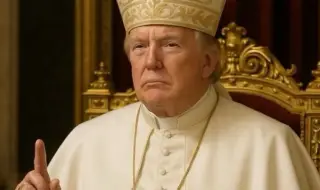
The US presidency and the papacy came together on May 3rd when Donald Trump posted an AI-generated photo of himself dressed as the Pope on Truth Social. The image was then shared by White House accounts. Seated in an ornate gold chair (Mar-a-Lago style), he wore a white cassock and bishop's tiara, with his right index finger raised.
Trump later told reporters that "it had nothing to do with it... somebody did it for fun".
This image of "Pope Donald I" is of historical significance, for reasons that, no doubt, the White House and Trump were blissfully unaware of. This is the first image that combines the two most important understandings of the Antichrist figure in Western thought: on the one hand, that of the pope, and on the other - that of the authoritarian, despotic world emperor. This is what Philip Almond, emeritus professor of the history of religious thought at the University of Queensland, wrote in a material for the online publication The Conversation.
On April 22, the day after the death of Pope Francis, Trump said: "I would like to be pope. That would be my number one choice". On April 28, Trump told The Atlantic: "I run the country and the world." Pope and emperor of the world at the same time.
The Antichrist-Emperor
In the New Testament, in the First Epistle of John, it is said that before Christ comes again, the Antichrist will appear: the most obvious sign that the end of the world is near. The Antichrist will be the archetypal evil man who will persecute believing Christians. He will ultimately be defeated by the forces of good. As Sir Isaac Newton suggested, "to search the prophecies which [God] has given us, that we may know the Antichrist" is a Christian duty.
The first life of the Antichrist was written by the Benedictine monk Adso of Montier-en-Der about 1,100 years ago. According to Adso, the Antichrist will be a tyrannical, evil king who will corrupt everyone around him with gold and silver. He will be educated in all forms of wickedness. Evil spirits will be his tutors and constant companions. Seeking his own glory, as Adso puts it, this king "will call himself Almighty God". The Antichrist is opposed to anything Christ-like.
According to Christian tradition, Christ was fully human, yet absolutely "sinless". The Antichrist is also fully human, yet entirely "sinful". The Antichrist is not so much a supernatural being made flesh as a human being who has been completely demonized. Influenced by Christian stories of the Antichrist, Islam and Judaism created their own Antichrists - al-Dajjal, the Antichrist of the Muslims, and Armillus, the Antichrist of the Jews. Both al-Dajjal and Armillus are king-like messiahs.
Over the centuries, many world leaders have been called "Antichrist" - the Roman emperors Nero and Domitian were antichrist figures, and the French emperor Napoleon was declared the Antichrist in his time. There are also more recent leaders who have been likened to the Antichrist, including former Iraqi President Saddam Hussein, King Charles III, former Russian leader Mikhail Gorbachev, Al-Qaeda founder Osama bin Laden, and Trump.
The Antichrist Pope
In 1190, King Richard I of England, on his way to the Holy Land, was informed by the Italian theologian Joachim of Fiore (c. 1135-1202) that the next pope would be the Antichrist. This was a significant event in the history of the Antichrist. From that point on, the tyrannical Antichrist outside the Church would be contrasted with the papal imposter within it. During the Protestant Reformation in the 16th century, the common understanding of the Pope was that he was the Antichrist. Martin Luther (1483-1546), the founder of the Protestant Revolution, declared that the pope "is the true [...] Antichrist, who has risen above Christ and opposed him."
Just as all Christians would not worship the Devil as God, he continued, "so we cannot allow his apostle the pope or Antichrist to rule as our head or lord." While about to be burned at the stake by the Catholic Queen Mary for his Protestant beliefs, the Anglican bishop Thomas Cranmer (1489-1556) declared: "As for the pope, I reject him as the enemy of Christ and Antichrist with all his false doctrines."
Even in 1988, when Pope John Paul II addressed the European Parliament, the hardline Protestant leader in Northern Ireland, Ian Paisley, roared: "Antichrist! I renounce you and all your cults and creeds" - to which, we are told, the Pope smiled slightly embarrassedly. Except among the most extreme Protestant conservatives, the idea of a papal Antichrist no longer has any value. The papal Antichrist has freed the Western stage for the imperial Antichrist.
The Antichrist and the End of the World
In the history of Christianity, the idea of the Antichrist is a key part of Christian expectations about the return of Christ and the end of the world. In the final battle between the forces of good and evil, the Antichrist will be defeated by the forces of Christ. In short, the rise of the world emperor, who is the Antichrist, is a sign that the end of the world is near.
In light of the Western story of the "Antichrist", the image of the imperial and papal president of the United States is a powerful sign that the world order - at least as we have known it for the past 80 years - may be coming to an end.