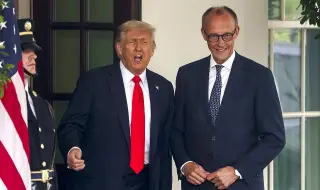
Chancellor Merz's visit to US President Trump passed without scandal and in a friendly atmosphere, but also without special attention to the guest. Still, the visit to the US can be described as a success. What else did it show?
"He's not easy", Trump said of his guest from Germany in an attempt to compliment Chancellor Merz. The US president likes flattery, but when it becomes excessive, he loses respect for his interlocutor. And Friedrich Merz is a person with whom negotiations can really become a challenge – Therefore, the Chancellor could clearly count on some approval in advance, ARD notes in a commentary on the White House meeting.
All attempts at an escalation similar to the one with Zelensky turned out to be unfounded: compliments were exchanged. Merz's English was praised. And Trump was identified as a key figure in the efforts to achieve peace in Ukraine. But for most of the press conference, Friedrich Merz barely managed to take the floor - he sat indifferently on the sidelines while Trump answered domestic political questions. It is indicative of German-American relations these days that the lack of interest on the American side can almost be described as a success, Sebastian Hesse notes in a commentary for ARD.
Merz may be pleased with his visit
Nevertheless: Friedrich Merz should be pleased with his first visit. He was given the honor of spending the night in the special guest house of the American government. And his gift - a facsimile of the birth certificate of Trump's German grandfather - will be given a place of honor in the White House. Sensitive topics such as defense spending, the trade dispute with the EU or support for Ukraine were discussed discreetly behind closed doors. The entire meeting in the Oval Office was marked by cautious mutual exploration.
It was clear in advance that Merz would not negotiate a future trade agreement on behalf of the EU: but his message that, in the context of strong competition from China, Europe and the United States should not allow themselves to be divided, was probably well received. As was the German decision for higher military spending and for transatlantic unity against Putin, notes ARD. There were no dissonances, everything went harmoniously and without any reproaches to Germany, such as for insufficient freedom of opinion (as US Vice President J.D. Vance had previously expressed - ed.).
Was Merz accepted as an equal?
But what will follow this harmonious beginning, the commentator of the German public-law media asks. At one point, Trump said that even if a trade agreement with the EU is not reached, this would not be a bad thing - in which case the US would simply continue to collect revenue from protective tariffs. Regarding the US soldiers in Germany, it was said: "There is no problem for them to stay", since they would also bring a lot of money to the country. The indirect message: if the Germans no longer want to be protected by the US - it's their will.
The slightly indifferent tone of the conversation and the ignoring of Merz, who during the discussion about Musk, Biden and Harvard became a passive listener, showed something else - the US does not view the guest from Germany as an equal. Trump probably liked the meeting because it highlighted the balance of power between the two countries. The position of the US under this president is clear: allies are viewed patronizingly as collaborators, but they are not really relied on, writes ARD.
We do not know what Merz said to Trump in private and in what tone. But if the host was left with the impression that this chancellor is really “difficult” - that is, insistent on those principles that are not subject to renegotiation – something important has definitely been achieved, concludes Sebastian Hesse.
More pressure on Russia
ARD also notes that the German Chancellor also held a meeting with members of Congress - mainly dedicated to sanctions against Russia. The media outlet recalls that there is a proposal in the US Senate to impose a 500 percent tariff on buyers of Russian oil and gas. “More than 80 senators already support this initiative“, Merz pointed out in this regard.
“There are a large number of congressmen who would also support this initiative“, the Chancellor added, and in this situation even a presidential veto could not overturn a sanctions resolution. It depends on Trump whether the initiative will be joint, considering that he now governs mainly by decree and thus bypasses Congress.
In a special interview with DW, the German Chancellor stressed that the US and Europe must jointly exert greater pressure on Russia in order to end the war. “I know that this is a very complex issue. Even here in the US, there are active debates in the Senate. I am optimistic, but not so optimistic that I expect anything to change overnight on the territory of Ukraine. I don't have an answer today, but I am sure that Trump is thinking about what more he could do.“