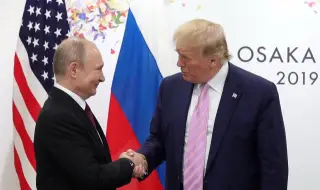
Very recently, US President Donald Trump said of his Russian counterpart Vladimir Putin that he had "lost his mind" and "was playing with fire" - quite atypical compared to the last few months, which are also the first months of Trump's second term in the White House.
The American leader had left the lasting impression that he found his Russian counterpart to be a "reasonable" person with whom he was willing to "do business".
Which led to reactions among European leaders, and many observers were looking for an explanation for Donald Trump's surprising "pro-Russian" attitudes.
And now - suddenly a turn. What is the reason for this?
Was Donald Trump really unaware until recently and has only now "seen" about Vladimir Putin's intentions and actions? Possible, but less likely. Still, Trump has experience from his previous term and should not have been so easily led by the nose for so long. Although, who knows...
It is more likely that Trump has previously and now made "situational" statements towards Putin, and in reality has not changed his true attitude.
The American president is known for his affinity for viewing international politics as a business, and in business negotiations it is good to "brush" the other party from time to time, without revealing what your real intentions are.
And when you decide that the time has come, turn the tables. "Nothing personal, Sonny, just business", as they say in
As for Trump's attitude towards Ukrainian President Volodymyr Zelensky, the approach there was in reverse chronology (first they sparred in the Oval Office, then had a constructive conversation in the Vatican after the funeral of Pope Francis), but the logic here is similar.
It will be interesting to see whether, after Sunday's Ukrainian military operation "Cobweb", Trump will continue to believe that Zelensky "has no cards".
But let's get back to Putin. Trump made quite a few curtseys to him, and this almost created the feeling that a new world order was emerging, in which the United States was moving from the camp of democracies to that of autocracies. (Grouping geopolitical players by political system is deeply wrong, but let's not dilute the topic.)
The conflict between Russia and Ukraine affects us to a large extent here in Europe, but this is far from the case for the United States.
This topic is not at all a priority for ordinary American citizens - especially those who voted for Donald Trump. Moreover, for them Russia and Ukraine are something like the states of North and South Carolina are for us - and this does not at all suggest a motivation for (continued) American engagement.
It would not even be surprising if Trump himself, before the start of the "three-day special military operation", had difficulty distinguishing between Russia and Ukraine; and even now, the main difference between them for him is that the former possesses nuclear weapons, and the latter does not.
Donald Trump does not care about either Putin or Zelensky. Neither for Moscow nor for Kiev.
And that makes sense - he is the president of the United States, and the hostilities are taking place in Europe, not in Central America. From the point of view of the United States and American interests, the war in Ukraine is a tedious burden that is best ended as soon as possible, no matter how. And to do business with both sides, if possible. Nothing personal, right?
Of course, this is a simplistic view of the situation. But a deeper look would lead to the same conclusion. The US continues to be the number one global power, but now in a much more multipolar world, where China is "breathing down their necks", Iran is gaining strength and self-confidence, Turkey is playing its own game...
The Cold War is long gone, when the US and the USSR could, through their proxies, easily open several fronts in different parts of the world, and the rest of the world more or less complied with the two superpowers.
Now the United States would be more than happy to keep the fire burning in Ukraine, in the Middle East (which explains their sparing support for Israel), in the South China Sea (China against Taiwan), and along the 38th parallel between the two Koreas.
So, apparently Trump has "called" Putin for delaying his post-war plans.
But this is also probably subject to correction at a later time. There are no eternal friends (and enemies) - there are eternal interests.
It is curious, however, why more than 24 hours after Operation "Cobweb" (I am writing these lines late on Monday evening - b.a), Trump is silent regarding Zelensky...
And, we have a reaction - White House spokeswoman Caroline Levitt has announced that Trump is ready to meet with Putin and Zelensky in Istanbul. We expect a sequel...