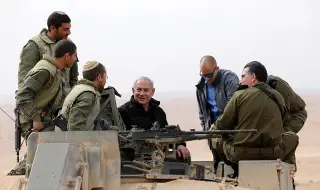
Benjamin Netanyahu chose the moment to strike Iran with extreme precision. At the height of the week, his right-wing ruling coalition was on the verge of collapse over the highly polarizing issue of whether students in religious seminaries should be exempted from military service. That was when Israel's unprecedented and so far highly successful offensive began - aimed at both Tehran's nuclear facilities and its top military and intelligence leadership. The result is a strong "uniting around the flag" effect.
Netanyahu, also known by his nickname Bibi, undoubtedly correctly judged that this would be the reaction.
Today, both the leaders of the opposition and those of the coalition parties are demonstrating unity in a moment that can safely be called the first chapter of a war - a war that Netanyahu has long wanted to wage. It is also a conflict for which the Israeli military and intelligence apparatus have been preparing patiently and systematically for at least two decades.
As last year, when Israel struck a devastating blow against the Shiite group Hezbollah in Lebanon - Iran's main regional ally - so too the actions now follow a careful script. Then the operation resulted in the beheading of the organization's leadership, the elimination of its leader and senior commanders, and the destruction of a significant part of its missile arsenal. History is clearly repeating itself – on a new scale and with the same determination.
Even among Bibi’s fiercest critics – those who have long called for his resignation and would not give him a moment’s political peace – there was no hesitation in expressing support for a preemptive strike on Iran. And how could they not, even if they harbor doubts about where Netanyahu’s endless wars might lead Israel – and whether his ambition to transform the region might ultimately turn out to be nothing more than an act of political hubris.
Opposition leader Yair Lapid offered his blessings to the “security forces.” Centrist Benny Gantz, who left Netanyahu's military cabinet in 2024, published a prayer recited weekly in synagogues for the well-being of Israel's security forces, adding at the end "we are all united against our enemies."
Yair Golan, leader of the left-wing Democrats, said: "A strong people, a determined army and a stable rear behind them, that's how we have always been victorious and that's how we will win today." Avigdor Lieberman, leader of the right-wing Yisrael Beitenu party and former deputy prime minister, who last week criticized Netanyahu for arming criminal militias that have become clans opposing Hamas in Gaza, quickly posted on social media: "The eternal people are not afraid."
Netanyahu has often been accused of manipulative behavior, leading Israelis to believe that any agreement to end the fighting in Gaza would leave the country facing an existential threat on its southern border. Many in Israel disagree with this position, including former prime ministers Ehud Olmert and Ehud Barak, as well as former intelligence chiefs including Yaakov Perry. They openly say that Netanyahu is manipulating public opinion and deliberately prolonging the conflict in Gaza to preserve his power. He is also accused of being militaristic and incapable of becoming a true peacemaker.
But when it comes to Iran developing a nuclear bomb, there is a widespread Israeli consensus that a nuclear-armed regime under Ayatollah Ali Khamenei would indeed pose an existential threat to the Jewish state.
Of course, success breeds success. In such an atmosphere, few would dare to engage in open debate with Netanyahu about what Israel’s military and intelligence services have achieved so far. And the list of results is impressive: the killing of four senior commanders in the Islamic Revolutionary Guard Corps (IRGC), including the head of Iran’s air force; the elimination of half a dozen leading nuclear scientists; the destruction of key ballistic missile facilities and the further weakening of Iran’s already shaky air defenses. There was also damage to nuclear-related facilities - although the exact extent of the damage remains unclear.
The Iranians did not do well in preparing for the Israeli offensive, prolonging nuclear negotiations with US President Donald Trump's team, giving Netanyahu an opportunity to take advantage.
"An attack on Iran has become inevitable," said retired General Yossi Kuperwasser, a former member of Israel's nuclear negotiating team and now head of the Jerusalem Institute for Strategic Studies.
"Tehran has openly rejected the American proposal and refused to cooperate with the IAEA by providing it with information. Meanwhile, Iran has amassed large quantities of highly enriched uranium and has begun to accelerate its weapons development efforts," he said.
Trump may also have had doubts about the impact of Bibi's war on Iran and how Gulf Arab states might react. That's why Secretary of State Marco Rubio has been quick to reassure the world that the United States was not involved in the strikes and insists that Israel's decision was unilateral.
But if Trump were truly opposed to Israel's actions, he could have been much more outspoken, both privately and publicly, as other American presidents have been in the past. Israeli leaders have repeatedly acted against Washington's will, but this time there is no such opposition. Instead, Trump seems to prefer to play it safe, emphasizing on the one hand that he does not want a full-scale war with Iran, but on the other - suggesting that Tehran has brought about the current escalation on itself.
And again, success breeds success.
Trump, as we know, hates losers. Bibi looks like a winner right now. And Trump is willing to use Israeli force to try to force Iran to agree to a nuclear deal that satisfies him. Whether that will work remains to be seen now that Iran has retaliated in a far from limited way and has chosen to launch ballistic missiles, forcing the US to help defend Israel. Wars have a nasty habit of spiraling out of control, causing effects that no one anticipated.
From Iran's perspective, Trump is playing a double game, and that could hurt the prospects for nuclear talks.
"In Iran, there is no way the Netanyahu government could have acted without a green light from the United States," said Elie Geranmaye of the European Council on Foreign Relations.
She added that hardliners in Tehran may gain strength from the Israeli attack.
"There has been an internal debate in Iran over the past year about whether the country made a strategic mistake by not responding more forcefully to previous Israeli attacks," Geranmaye said.
The problem for Iranian hardliners is that Israel holds most of the military trump cards. The Iron Dome air defense system, support from the United States and Jordan, and superior Israeli intelligence capabilities severely limit Iran's ability to strike back. And with Hezbollah weakened and disorganized, Tehran is unlikely to seriously rely on its Lebanese allies to exert effective pressure on Israel.
Against this backdrop—as the Iranian regime's weakness and incompetence become increasingly apparent to its own people—a more fundamental question arises: will Bibi be satisfied with a nuclear deal?
Undoubtedly, his ambition is much greater: not just to strike, but to finally crush the theocratic regime in Iran and create the conditions for a change of power. Over the years, Netanyahu has repeatedly stated that his ultimate goal is to undermine the spiritual leadership in Tehran. He put this issue on the agenda last year when he launched his offensive against Hezbollah. The "decapitation" strategy worked in Lebanon, a success that further emboldened him to think more globally, with a vision of reimagining the Middle East on terms that are significantly more favorable to Israel.
"The breadth and scale of these strikes - against senior Iranian officials and other military facilities, in addition to nuclear sites - suggest that this operation is designed not only to deter Iran from developing nuclear weapons, but also to limit any potential military response and even destabilize the regime," said Matthew Saville of the Royal United Services Institute, a British think tank.
The defeat of Hamas and Hezbollah, combined with the exposure of their patron Iran as a worn-out "paper tiger" with blunted claws, could serve as a kind of redemption for Netanyahu. It is precisely for the serious security lapses that allowed the October 7 massacre that many Israelis still hold him responsible.
In this situation, paradoxically or not, the Iranian regime's best chance for survival may be precisely the deal proposal that came from Trump. It just needs to be signed - right now.