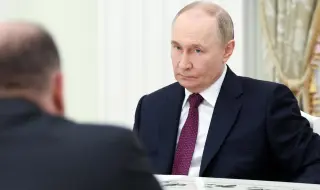
Russian President Vladimir Putin said that the “unjustified“ US attacks on Iranian nuclear sites have put the world in great danger and promised to help the Iranian people, but did not say how, Reuters notes, BTA writes.
US leader Donald Trump and Israel have publicly admitted the possibility of eliminating Iran's supreme leader and changing the regime, steps that Moscow says would push the entire region towards the abyss of a large-scale conflict.
Putin received Iranian Foreign Minister Abbas Araghchi in the Kremlin yesterday in the presence of Russian Foreign Minister Sergei Lavrov, his foreign policy adviser Yuri Ushakov and Igor Kostyukov, the head of the GRU military intelligence.
“The unprovoked aggression against Iran is completely unfounded and has no justification“, Putin told Araghchi, adding that he wanted to discuss ways to defuse the crisis. “For our part, we are making efforts to help the Iranian people.“
At a later meeting with military officials, Putin highlighted the escalation of the conflict in the Middle East and the involvement of forces outside the region, but did not name the United States.
“Forces outside the region are also being drawn into the conflict,“ Putin said. “All this is pushing the world in a very dangerous direction.“
STRATEGIC PARTNERSHIP
Russian Deputy Foreign Minister Sergei Ryabkov responded to a question by the state news agency RIA Novosti on whether Iran had requested military assistance: “We are cooperating with Iran in many areas. Of course, it would be irresponsible of me to reveal the content of the contacts that are taking place, including today, given all the circumstances“.
Ryabkov added that the strategic partnership between Moscow and Tehran is “unbreakable“, and pointed out that Iran has every right to defend itself.
Putin, whose army is fighting a war of attrition in Ukraine, has shown little desire to confront the United States over the Islamic Republic at a time when Trump is seeking to restore relations with Russia, Reuters notes.
Asked to comment on whether the US attack on Iran would affect the developing dialogue between Washington and Moscow, Kremlin spokesman Dmitry Peskov said: “These are separate processes“.
Russia has previously said it also does not want Tehran to develop an atomic bomb, a step that Moscow says would trigger a nuclear race in the Middle East east.
Iranian officials believe they are not receiving enough support from Russia and feel betrayed by both Russia and another major power, China, Reuters notes.
In 2015, Moscow intervened in the Syrian civil war on behalf of President Bashar al-Assad, but when the government's enemies advanced on Damascus last year, it refused to send troops and more warplanes, considering the situation too dangerous; Russia nevertheless provided asylum to the Syrian leader after he was overthrown.
There are calls in Russia to support Tehran in the same way that Washington supports Ukraine – with air defense systems, missiles and satellite intelligence.
On Sunday, after the US strikes, Russia, China and Pakistan submitted a resolution to the 15-member UN Security Council calling for an immediate and unconditional ceasefire in the Middle East.
Russian Permanent Representative Vasily Nebenzia recalled the arguments of former US Secretary of State Colin Powell, with which he convinced the Council in 2003 that Saddam Hussein was an immediate threat to the world because of Iraq's stockpiles of biological and chemical weapons.
“We are once again being made to believe American fables in order to cause suffering again to millions of people living in the Middle East,“ said Nebenzia. “This reinforces our belief that our US colleagues have not learned any lessons from the past.“
WHY IS RUSSIA UNLIKELY TO PROVIDE MILITARY ASSISTANCE TO TEHRAN
After the start of the Israeli attacks on Iran, the parliament of the Islamic Republic, the Majlis, ratified the Treaty on Comprehensive Strategic Cooperation with Russia. The agreement was concluded in January by the presidents of the two countries, and the Duma in Moscow ratified it two months ago, recalls “Deutsche Welle“.
But despite its loud name, this agreement is not a mutual defense pact, the German media notes. It does not contain a clause on military mutual assistance in the event of an attack and only stipulates that both sides refrain from any support for the opponents of the other side.
According to Marianna Belenka, a Middle East expert who left Russia after the war in Ukraine began to settle in Israel, Moscow is unlikely to provide any direct military support to Iran, at least not officially and publicly.
“It doesn't need to do so, especially now that it is trying to restore relations with Washington, although some behind-the-scenes actions cannot be completely ruled out.“
RUSSIA AS A MEDIATOR
According to Belenka, Putin is sincere in his public offers to mediate between Iran and its opponents. According to her, last year the Russian leader advised the Supreme Leader of the Islamic Republic, Ayatollah Ali Khamenei, to return to the negotiating table.
In a recent interview with the news channel “ABC News“ Trump said he was open to Russia mediating in the Israeli-Iranian conflict.
Belenka believes that as a mediator, Moscow “may not be able to exert the same pressure on Tehran as Washington, but it can serve as a channel of communication.”
During indirect talks between the US and Iran in April, Russia was indeed expected to play a significant role in the event of a nuclear deal with the Islamic Republic. The Guardian reported that Moscow was being eyed as a possible destination for Iran’s stockpile of highly enriched uranium and could act as an impartial arbiter in any breaches of the agreement. Such a deal would stipulate that if the US violates the agreements, Russia would return the highly enriched uranium to the Islamic Republic.
But such a deal would also mean that France, Britain and Germany would lose their role as guarantors on the issue of Iran's nuclear program, which they had under the 2015 Vienna agreement, from which Washington unilaterally withdrew during Trump's first term. It provided for the easing of the embargo against Tehran in exchange for Iran's refusal to enrich uranium, a key component for the production of nuclear weapons.
Iran says its nuclear program is for civilian needs and denies accusations that it wants to develop nuclear weapons.