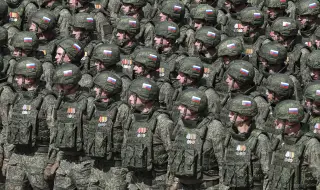
The strategy of waging a war of attrition, which - as the Kremlin hopes - will sooner or later break Ukraine's resistance, has three pillars: numerical superiority (Russia's population is almost four times that of Ukraine), the willingness to accept high human losses, and the financial costs. The first two pillars seem certain, but the third is questionable. The cost of recruiting new servicemen, their salaries and compensation for their families has already become a serious financial burden for the Russian treasury.
How many contracts have been signed in the army
In 2024, about 400,000 people have signed contracts with the Russian Ministry of Defense, according to budget spending data. Authorities say the number is even higher. According to Security Council Chairman Dmitry Medvedev, there are 450,000 contract employees, and there are also 40,000 "participants in voluntary formations."
Verifying this data is difficult due to the fact that in August last year, payments for signing a contract were increased - from 195,000 to 400,000 rubles. (from 2,200 to 4,400 euros). The publication “Important Stories“ has calculated that the minimum number of contract employees in 2024 was 374,200 people.
In recent months, the pace of recruitment may have slowed down - although the statements of Russian officials are very contradictory. President Putin recently announced that in early summer, 1,800 new contracts were signed per day, i.e. 50-60,000 per month. However, Dmitry Medvedev, who has no reason to lower the figures, speaks of 37,000 per month or 1,200 per day. A similar estimate - about a thousand per day - Janis Kluge from the German Science and Politics Foundation also shares.
Do Russian men want to fight
Even if the rate at which soldiers are being recruited has indeed decreased, it remains serious. According to a survey conducted at the end of 2024, the willingness of Russian men to go to war remains high.
61 percent of respondents expressed an unwillingness to fight for money, but the rest did not rule out this possibility. However, it is possible that opponents of the war refused to participate in the survey. In addition, it was conducted in public places - near train stations and bus stops, which influenced the answers. 16 percent of respondents said they were already fighting.
“The recruitment of contract soldiers is the only way to replenish the army, since ideologically motivated candidates ran out in the spring and summer of 2022, and the partial mobilization in the fall of 2022 created internal political tension and risks that the Kremlin considered unacceptable“, explains Pavel Luzin of the Center for European Policy Analysis.
How much do potential soldiers want to earn
The poll from the end of 2024 also covers material expectations - they significantly exceed the level of current salaries. As of October 1, 2023, the minimum monthly salary for soldiers is 210,000 rubles - about 2,330 euros. But along with the federal payments, there are also additional regional ones: in Moscow from July 2024 they amount to 1.9 million rubles (21,000 euros), and the highest are in the Khanty-Mansiysk Autonomous Okrug - 2.65 million (almost 30,000 euros).
According to the survey, the desired average monthly salary is 850,000 rubles (9,500 euros). And for a one-time reward, the average expectations are 3.7 million rubles (about 41,000 euros). Those who declared their unconditional readiness to participate in the war named amounts close to the actual ones.
“Vladimir Putin made a strategic mistake in choosing the way to provide resources for this war“, says expert from the Institute for the Study of War George Barros. “He refused to use the state's monopoly on violence, as was done in the Soviet Union - he did not force Russians to go die in Ukraine. He is paying for it. This strategy could have worked if the war had been short. But it does not work in the conditions of a prolonged conflict.“
Will the budget hold up
There are already indications that military spending in Russia has reached its maximum possible. Further increases are difficult: the economy has slowed sharply, and the fall in oil prices has forced the government to reconsider the parameters of the budget - although for now these are cosmetic adjustments.
Calculations by Janis Kluge of the “Science and Politics“ Foundation show that the current cost of bonuses for hired soldiers is about two billion rubles a day (just over 22 million euros). About three-quarters of this amount is paid by the regions, which corresponds to 2.7 percent of their budgets. The rest comes from the federal budget.
The Stockholm Institute for Peace and Security Research (SIPRI) estimates that the bulk of federal spending on hired soldiers comes from the "Social Support of the Population" category. In 2021, military spending in this category was only 178.3 billion rubles, in 2022 - 345.3 billion, in 2023 - 1.15 trillion, the same as in 2024. A reduction was planned for 2025, but the analysis of the budget as a whole, conducted by SIPRI experts, shows: the missing amount was simply moved to the secret parts of the budget.
Military spending is growing only nominally
The main conclusion that SIPRI experts come to based on the analysis of the Russian budget is that the growth of salaries of participants in the hostilities is at the expense of financial resources from other areas. The cost of purchasing weapons and developing the defense industry is growing only nominally, and in real terms - taking into account inflation - it is rather decreasing. That is, although military spending is growing overall, Russia's military power is not increasing.
„In 2025, Russia's military spending will reach its limit, and in 2026 "Nominal growth will either be below the inflation rate or not at all," economist Vladislav Inozemtsev predicts. "The war has become positional - cheap means of combat such as drones are playing an increasingly important role. Soldiers' salaries are no longer growing, and regional bonuses, which had reached abnormal levels, have begun to decline."
Author: Oleg Loginov