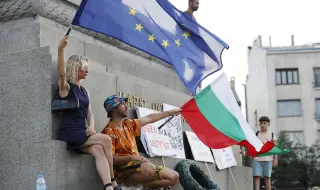
Veselin Stoynev's comment:
Three pillars provide serious chances for the unity and growth of the democratic opposition: civil protests, a vote of no confidence in the government, a presidential candidacy. However, the bet for success depends on the energy and skill of the democratic community and its civil and political leaders to skillfully navigate these three tracks, and simultaneously. As well as overcoming the obstacles that await them on each of these routes.
The protests will gain scale and power
The powerful protest wave that arose in Sofia and Varna after the brutal use of the anti-corruption commission and the prosecutor's office against representatives of the local government of the democratic community seems to be sustainable because it is authentic and energetic. The organizers of "Justice for Everyone" also announced that they will expand the protests throughout the country. The protesters are resilient – they proved it in 2020, when the protests also began in the middle of summer and continued until late autumn, they proved it in 2013, when the Night of the White Bus occurred on the 40th day of the civil discontent expressed in the square. And as then, they are expanding their palette, including people with more leftist beliefs, for whom the institutions of the punks are also unbearable, as for the liberal core of the protesters.
The question is whether the protesters will build on their previous experience – because the profile and civic biographies of many of them have been the same over the years, even when representatives of the 20-year-olds who have no protest past of their own join their ranks. It seems that they are starting to wise up - today's protests seem to be asking to be less satirical and cheerful, and in this sense less toothless than the previous ones. They still need to become much angrier, but provocations with stone-throwing people from agitators should not be allowed, as happened in 2013 and 2020 and be compromised, and many of the protesters should retreat, as happened then. Finally, the protests must reach the demand of the authorities, because this is the only way to resolve fundamental political demands. And the fight for a rule of law is precisely the fundamental and ultra-legitimate political claim of the protesting citizen. Moreover, upholding a just and democratic legal order is a vocation, but also a duty of the citizen, if he or she wants to truly be a citizen, and not just a subject of a soft-paternalistic or hard-dictatorial, but in both cases conquered state.
Synergy between civil and party principles
However, the most serious problem with the protests is whether there will be synergy between the civil and party principles. The civil is still in the vanguard and ensures the unfurling of the fan, but the party political representation ensures the "military" stability and the final success of the undertaking. Representative democracy is essentially party, so there is no way that political success can be non-party. And the Bulgarian experience teaches that even if protest parties are born, they are either too small and fleeting, or later turn out to be something different from the protest that gave rise to them. Yes, protests give birth to new leaders, but they are also a springboard for careerists or revenge seekers who have been rejected by the protest parties or who themselves have not managed to make a political career through them. Therefore, it is of key importance for protests this summer and autumn to avoid a serious conflict or discord under the guise of decency between the protest parties in the person of the PP-DB coalition and civil organizations and activists, which would melt the political growth of the democratic community from within.
Emerging isolation in parliament
The democratic parliamentary opposition had fallen into isolation between the ruling GERB-ITN-BSP-New Beginning and the pro-Russian formations "Vazrazhdane", "Velichye" and MECH. It was also internally divided – PP and DB argued when to introduce a vote of no confidence against the government, due to Bulgaria's membership in the eurozone.
The attempt to break out of isolation through the strongest parliamentary move towards power - the vote of no confidence - inevitably means careful collaboration with other opposition parties. PP and "Velichy" demonstrated closeness after the arrest of the Varna mayor, while DB preferred MECH, whose vote of no confidence is on the agenda, plus Ahmeddogan's APS. Finally, the PP-DB coalition decided to seek, together with MECH and APS, a vote of no confidence, which it would reformulate and lead - for the conquered institutions. This partially solves the issue with the most outspoken pro-Russian formation "Vazrazhdane", which are unwanted as partners even by the "softer Russophiles" MECH and "Velichye", which share an electorate with Kostadin Kostadinov's party, and which prefer instead a breakthrough in the ruling majority, especially with regard to ITN.
A vote of no confidence, however, is not just a loud alarm for serious transgressions of the ruling party and a means of asserting an opposition identity, but also a request for an alternative governing majority. PP-DB can trace such a majority together with APS and MECH, even with ITN, but for this purpose it needs to grow and become the first or stand close to the first political force and minimize the Russophile ballast. And the most direct path to growth is to gather electoral energy through protests.
Transparent and democratic nomination of a presidential candidate
The initiative for a unified candidacy for president of the democratic community has been the track for its unification since before the protests, but after their start its importance has even increased. Especially when GERB strategically finds itself isolated in possible early parliamentary elections, after which it seriously risks being left alone with Delyan Peevski's New Beginning, because in such a vote the BSP and ITN are more likely to be losers, and Peevski's influence will increase. Therefore, GERB's interest is to seek a path to the democratic community again, already through a presidential candidacy along the lines of the old assembly – anti-Russia, anti-new Rumen Radev.
On the other hand, the democratic community and its political representatives can hardly win or even reach the run-off in the presidential elections next fall, without broader support, including GERB voters. In this sense, the assumption of former Prime Minister Ivan Kostov that it is possible for a candidate of the democratic community for president to be supported by both the PP-DB and GERB is a logical solution, which, however, is difficult to accept precisely at the moment when, for the protesters, Peevski and Boyko Borisov are one and the same and any collaboration with any of them, even in the form of charismatic support, will seem like betrayal. Moreover, Borisov can play the presidential card until the very end in such a way as to aim to explode the democratic community from within – including by nominating its representative himself or announcing support for someone who has reached the final nomination, who will immediately be branded as a “gerber“.
Therefore, the process of transparently and democratically nominating a presidential candidate from the democratic community, without prior agreements with formations outside its authentic political representatives, is the only guarantee for the success of the undertaking. Subsequent expansion of support during the campaign is a matter of political work, a major role in which will also be played by the presidential candidate himself, already legitimized by the democratic community's choice as its own.