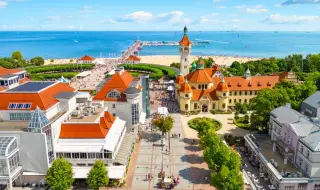
The "Czech Sea" has been in Croatia for the last hundred years - that's where Czechs preferred to go to the sea. But that's changing - more and more of them are now choosing to go to the Baltic Sea beach in Poland.
"I don't want to go to Greece and Croatia"
50-year-old Ludmila prefers Poland mainly because of the climate. "I don't want to go to Greece and Croatia in the heat there. I would like to enjoy my vacation in peace and without tropical temperatures."
Czech Railways hastened to respond to the new trend. In place of the long-standing direct connection to the Croatian city of Split, the Baltic Express line now carries passengers four times a day from Prague to the Polish cities of Gdynia, Sopot and Gdansk. In the summer, tickets are often sold out. At the same time, hundreds of thousands of Czechs travel by car to the coastal Polish cities - the new Polish highways do not require tolls, and there are no border controls on the way to Poland, as on the border with Germany.
The "Czech invasion" is being closely monitored by the media and politicians. Czech television stations have sent their correspondents to the Baltic coast of Poland, and lively discussions are taking place on social networks about the pros and cons of the destination. Journalist Jakub Medek from the Polish radio TOK FM told DW that the presence of Czech tourists on the Baltic Sea has been particularly noticeable since last year. "I have a feeling that this summer they are the largest group of foreigners," he says, and claims that this is being perceived positively.
Official statistics confirm Medek's observations. Last year, 410,000 Czech tourists stayed in hotels, and those who rented private accommodation were added. "Czechs are already the fourth largest group of tourists - after Germans, Britons and Americans," notes Pawel Troyan of the Czech branch of the Polish Tourist Association. "And thanks to the possibilities of moving across the border and day trips, we actually rank second in terms of the number of tourists in Poland, after Germans," he adds.
New records are expected to be set this year. According to the Polish website Gazeta.pl, the number of Czech tourists on the Baltic Sea could reach 800,000 - much more than in Croatia, which until recently was a favorite destination for Czechs.
Summer holidays on the Baltic Sea can also be disappointing - at least for those who are used to heat, warm sea water and hot sun. Even in August, it rains on the Polish Baltic coast, and the water temperature is sometimes below 20°C. That is why Pavel Troyan recommends that tourists bring raincoats and prepare for surprises and adventures.
The new favorite destination of the Czechs was also the topic of the last joint meeting of the two governments last year. "I am from Gdańsk and live in Sopot and I see for myself this very pleasant and welcome summer invasion of Czech tourists on the Polish coast", Polish Prime Minister Donald Tusk told the online publication Wirtualna Polska at the time. "The Czechs have broken all records. Over half a million people have visited the Polish coast from Szczecin to Gdańsk."
At the same time, it is not particularly cheap for Czechs to vacation on the Polish coast - prices there are comparable to those in Prague or Carlsbad. But it is still cheaper than on the German Baltic coast, and prices in Croatia have also risen noticeably. On the other hand, everything in Polish supermarkets is significantly cheaper compared to the Czech Republic. Only beer is more expensive.
The rise of Poland
In addition to its Baltic coast, Poland has also impressed Czechs with its rise in recent years. Just three decades ago, Poland was much poorer than the Czech Republic, which at the time was the most developed post-communist country in Central Europe. Today, its northern neighbor is ahead of it in many ways - for example, in the construction of a highway network and in the size of salaries. The minimum wage in Poland is currently 1,120 euros, while in the Czech Republic it is a third lower.
The austerity policy of the center-right government of Petr Fiala is also responsible for this, which last year reduced the total deficit of public finances to 2.2% of GDP, while in Poland the percentage was 6.6%.
"The time is approaching when Czechs will emigrate to Poland to work", commented the Polish website Obserwator Gospodarczy in this regard.
Author: Lubos Palata