Comment by Daniel Smilov:
President Donald Trump's peace offensive, which even included a bilateral meeting with Vladimir Putin in Alaska, has so far yielded no particular concrete results and has not achieved its stated goals. But, paradoxically, it has two unintended effects that could help resolve the conflict by the end of the year. The first is that "Joe Biden's war", as Trump defines it, has already become Trump's war, and there is no way to change that. Second, Volodymyr Zelensky officially became America's man in this war, although at the beginning of his term (and even before that) Trump tried to sharply distinguish himself and distance himself from him.
The facts at the moment
Trump's strategy in his peace initiative was clearly to predispose Putin with a high-level welcome and with courteous compliments, a red carpet and other diplomatic tricks (some threatening - such as the demonstration of a stealth bomber). During the meeting itself, it became clear that these symbolic legitimizations of the Russian autocrat lead only to symbolic "concessions" on his part. Perhaps that is why the planned lunch did not take place and the meeting was terminated earlier than expected.
A diplomatic breakthrough, alas, was not achieved on any of the important issues. Regarding guarantees for Ukraine's sovereignty and security, Russia continues to refuse to consider the participation of American or European troops in peacekeeping, as well as providing Ukraine with the prospect of membership in NATO. However, the possibility of guarantees such as Article 5 of NATO (obligation to provide military assistance in the event of an attack) remains, which has not been categorically rejected by the Russian side so far. But it is not clear whether it would be accepted if implemented between Ukraine and its partners on a bilateral basis.
On territorial issues, the "compromise" that Putin offers has proven unacceptable. It consists in handing over the heavily fortified lines of the Ukrainian army in Donbas in exchange for negotiations, trilateral meetings, and a temporary freeze on the conflict in other areas and negotiations on them.
Finally, Russia directly rejected a ceasefire (which was Trump's original goal). Before the meeting, he even threatened with severe sanctions if Vladimir Putin did not stop the hostilities. Putin actually escalated them and carried out the most massive attacks on Ukrainian cities, destroying even civilian facilities of American companies all the way to the Ukrainian border with Hungary and Slovakia. Paradoxically, Trump simply abandoned the idea of a ceasefire, arguing that the new goal is long-term peace.
Most international and especially Ukrainian analysts are highly skeptical about the benefits of Trump's peace initiative so far. There are also those, like Dmitry Gordon, who still harbor hope that the war will soon end with guarantees for Ukraine's sovereignty and without significant territorial concessions beyond the front line at the moment. But publicly known information, at least for now, does not confirm this timid optimism.
"Trump's War"
Throughout the American president's peace initiative, however, it became clear that resolving the war in Ukraine is now his problem and he cannot simply abandon it. First, his claims as a peacemaker cannot be defended if his efforts to achieve peace in Ukraine lead to nothing. And this is not about the Nobel Peace Prize, but about the place of the United States in the world order. In global terms, this war is still of greater importance than the other conflicts that Trump is dealing with. Even Iran and Gaza - despite the importance of the Middle East - are not as decisive for the global order as the situation in Europe and the balance of power between the West and the East. If Russia wins in Ukraine, the West will be seriously weakened and the consequences will generally become unpredictable.
Second, Trump's position on Ukraine was based on the understanding that his supporters would rather the United States distance itself from this conflict and not deal with it or simply end it quickly. But more and more public opinion polls in the United States show that even among Republicans, a majority now wants aid to Ukraine (including military aid) to be continued. According to the latest YouGov survey on the subject, 32% of Americans want military aid to be increased, 21% want it to be maintained at current levels, and 27% prefer its reduction. 62% of Americans believe that the United States should be involved in the peaceful resolution of this conflict, which confirms the thesis that the war is now Trump's war as well. Against this background, American public opinion is divided on the question of whether Trump's meeting with Putin was a success: 41% give him credit for it, while 38% disapprove of it. The general picture that emerges is that Americans expect Trump to participate and achieve results in relation to Ukraine. Perhaps that is why, in one of his last posts on social networks, he accused Biden of not giving enough offensive weapons to Ukraine - a clear hint that this could be changed if Putin continues to persist in his aggressive war.
Zelensky - America's man
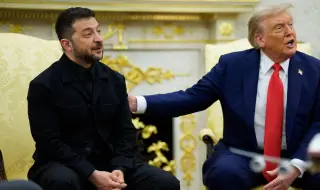
The second significant circumstance that changed due to Trump's peace offensive is that Zelensky was officially recognized as America's man in this conflict. Despite the red carpet for Putin and the flattery for the Russian president, what was more important was that Zelensky was then received at the White House together with the real allies of the US - the Europeans. In fact, an alliance forum was held, where strategy, goals and possible solutions were discussed together. Everyone acknowledged Trump's leading role, of course, and took into account his characterological peculiarities: there were many thanks, Zelensky put on something between a suit and a military uniform, and the Europeans, who appeared in almost full splendor, also gave weight and a sense of unity to the joint actions. Perhaps the Russian journalist and politician Alexander Nevzorov goes too far when he claims that Zelensky managed to make Trump adopt him. But after the ill-fated meeting at the White House a few months ago, the last conversation between Trump and Zelensky really had a completely different character.
All this means that the lack of a diplomatic breakthrough with Russia so far increases the pressure on Trump to toughen his tone towards Putin and actually use the levers that the United States has at its disposal. And they are not few, especially if they are applied together with European partners. Military aid to Ukraine could be dramatically increased, its ballistic missile program could be accelerated, sanctions on China and other trading partners of Russia could be implemented, frozen Russian assets could be put into use, etc. Trump will not accept such decisions easily and willingly, but the important thing is that the expectations of the American public, including his sympathizers, are already moving in this direction. Trump cannot afford to fail in Ukraine, and failure would be abandoning the Ukrainians and handing them over to the aggressor. The midterm elections for the US Congress are next year. So far, polls show a growing (albeit fragile) advantage for the Democrats. Trump knows that in this environment he simply cannot fail in a major international conflict, and this factor will be of increasing importance.
***
Unfortunately, the prospects for a quick end to the war in Ukraine, at least for now, do not look good. But if we take into account the two factors analyzed in this text, the Russian side should rethink its aggressive position. After all, the Russian summer offensive is coming to an end without any particular results - after the liberation of Kherson, for about two years, the front line has changed within 1% of Ukrainian territory. This means that if Russia does not achieve something more significant very quickly, it may face a situation in which the newly united West stands much more resolutely behind Zelensky and the Ukrainians. No matter how ideologically oriented Putin's position on Ukraine is, he cannot help but take this into account. And let's hope that common sense will prevail in the end.