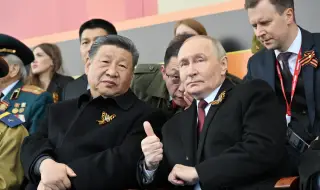
China has been Russia's largest trading partner for years, but since the war in Ukraine began in 2022, relations with Beijing have become life-saving for the Russian economy. China is the largest buyer of Russian oil, timber and coal, and will soon become the largest customer for Russian natural gas, notes the “New York Times“.
Trade between the two countries exceeded $240 billion in 2024, which is two-thirds more than before the war in Ukraine began. "The relationship between China and Russia is the most stable, well-developed and strategically significant relationship between major countries in the world today," Chinese Foreign Minister Wang Yi said in July after meeting with his Russian counterpart Sergei Lavrov.
Manchuria is the main border crossing between China and Russia - it is very clear there that the economies of the two countries are increasingly closely linked. No other city symbolizes the importance of the relationship between China and Russia like Manchuria. A huge part of the trade between the two countries passes through there, the “New York Times“ also notes.
Russia's dependence on China or how the roles have changed
As early as 1900, Russia built a railway line through the city to Northeast China. Today, trains and trucks from Russia pass into neighboring China, many of them carrying timber. This trade highlights Russia's weakened economic position, the American publication writes. Because today it is a kind of economic appendage of China, dependent on Chinese manufactured goods while selling raw materials that China could buy elsewhere.
The relationship between the two countries today is a sign of a turnaround, says Keith Bradsher, who heads the “New York Times“ bureau in Beijing. In the 1950s, the USSR helped the largely rural and underdeveloped China build many of its first steel mills, railways and weapons factories. Today, China produces 32% of the world's manufactured goods - more than the United States, Japan, Germany, South Korea and Britain combined. And Russia's share, including arms production, is only 1.3%, according to data from the United Nations Industrial Development Organization.
About 6% of the entire Russian economy currently represents exports to China. Iran, another country suffering from severe international sanctions, has a similar dependence.
However, the US and the European Union are wary of China - Donald Trump has threatened countries that continue to buy Russian oil and gas with severe sanctions, but first sanctioned India. Brussels, for its part, is calling on Beijing to limit its relations with the Kremlin. “China's unyielding support for Russia creates increased instability and uncertainty in Europe,” commented Ursula von der Leyen recently. "We can say that China is de facto supporting Russia's military economy and we cannot accept this," added the European Commission President.
The eternal friendship between the panda and the bear
China's support for Russia is visible not only in the exchange of goods - Russian television channels are permanently replacing American ones in hotels, and in the city of Manzhouli there are many Russian shops.
On the highway connecting the small airport with the city, two huge matryoshka dolls tower over the horizon, writes Lisa Visentin of the “Sydney Morning Herald“. The dolls are actually hotels and are connected to a Russian-themed amusement park, which has buildings resembling the Kremlin and Red Square in Moscow. On the Sino-Soviet Golden Street, the main shopping area, statues of a bear and a panda shake hands.
China also benefits from trade with Russia. In recent years, the United States, under the leadership of Biden and Trump, has imposed new tariffs on goods from China, and Canada, from which Beijing bought rapeseed, for example, has sided with Washington. Now Moscow has replaced Ottawa in the supply of this and other raw materials.
Is Russia drowning in Chinese goods?
Although economic relations between Russia and China seem solid as concrete, they are also showing cracks. Russia recently banned the export of freshly cut pine trees to China. For its part, China imposed tariffs on Russian coal imports early last year after state-owned Chinese coal mines complained about Russian competition.
The biggest trade tension is over cars, the New York Times also reported. Chinese cars were not very popular in Russia in 2021. But after the invasion of Ukraine, Western automakers withdrew from the country, and Chinese automakers lowered prices. According to research firm GlobalData Automotive, by the end of last summer, Chinese cars had captured 60% of the Russian market.
Russian automakers have convinced Moscow to start collecting a $7,500 tax on imported cars. The tax, which went into effect on October 1, has an exception: it does not apply to used cars purchased by Russian citizens for personal use. In Manchuria, they are trying to circumvent the new taxes by building a huge fleet of old Western and Chinese cars right next to the border.
Trade has begun to decline, and with it - the Russian economy
After trade between Russia and China increased by 29% in 2022 and by 26% in 2023, it reached a record $245 billion in 2024. But growth slowed to just 2% last year, and in the first seven months of 2025, trade fell by about 8% year-on-year, notes “Business Insider“.
But it's not just consumer goods trade that is declining - Russia's energy exports to China are also under pressure due to lower oil prices on the global market and stricter US sanctions on tankers, carrying Russian crude oil. These factors are affecting the entire economy, with Russia's GDP growing by just 1.1% in the second quarter.
Alexander Detev Editor