There are periods in world history that, from the point of view of the dynamics of events, can be called boring. If we go back in time, such a boring period seems to be the time after the Paris Commune until World War I. Such were the seventies and eighties of the last century more recently. The Cold War between the East and the West was softened by détente. After the end of the Vietnam War and the Six-Day War in the Middle East, there were no other major armed conflicts that could threaten world peace. The collapse of the Soviet Union and the socialist camp organized around it brought a dramatic change not only to Eastern Europe, but also to the entire world order. The United States felt like the sole hegemon in the world. This was the period of the so-called unipolar world. It lasted from the nineties to the Covid crisis. In boring periods, the processes that develop in depth are more important than the events that fill the news pages. The subsequent turbulent and often bloody conflicts legitimize the changes that have already occurred in the bowels of society.
Such a turbulent and bloody period is the third decade of the Twenty-First Century, in which we live. The events are too recent. They continue to happen every day around us. Therefore, there is no point in retelling them, but rather in trying to analyze the positions and goals of the main players on the world stage.
The dizzying political activity of Donald Trump and his team during his second term shows something that many already knew. The unipolar world is dead. I don't know if the MAGA movement will make America great again, but these people are doing the only thing possible. They combine economic protectionism, national sovereignty, conservative values, and populist rhetoric. At the core of MAGA is the idea of "returning" America to a bygone era of economic power, industrial leadership, and world dominance. Trump and his supporters are trying to focus all the power of the United States and all the world's resources they can get their hands on in opposition to the newly emerging world power, which is perceived as the number one threat to them - the People's Republic of China. The available economic power and technological progress will maintain parity between the two superpowers for a long time, but the final outcome is unclear and victory is not a foregone conclusion.
The realization of this priority explains some surprising moves by the current American president. The first is the feverish impatience to get rid of the "Ukraine" swamp. At the heart of this conflict was the desire of the "deep state" in the USA, led by the Democrats, to destroy Russia as an independent and unified state and to lay hands on its wealth. The ruling Republicans in Washington understand that maintaining this unattainable goal only diverts energy needed for the race on the most important track. And access to Russian wealth can be much easier through profitable trade agreements than with military force.
Unlike American policy, which is the subject of thousands of analyses and comments every day, China's long-term policy is developing in an atmosphere of media comfort not only inside the country, but also outside it. Beijing is currently emphasizing its international expansion of soft power, without drawing attention to the parallel development of its armed forces. The Chinese leadership is promoting the principles of equality and mutually beneficial cooperation in economic and political relations. The "One Belt, One Road" initiative is the banner of this policy of the outstretched hand.
Chinese strategic documents envisage technological independence, a middle-income economy, significant progress in green transformation by 2035, and by 2049 (100 years since the founding of the PRC) - China to be a “rich, developed, modern and influential world power“.
The scale with which the country's development is organized and guided suggests that its goals are not limited to the territory of the PRC. Such mobilization of resources is worthy of a larger goal, which is not spoken about aloud, namely achieving a dominant role, if not in the whole, then in at least half the world.
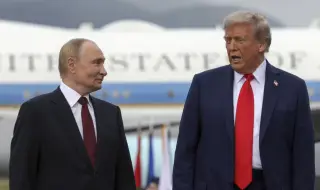
The years since the beginning of the decade have shown that Russia remains a major regional power with global projections of its international policy. The country's military potential can hardly compensate for its modest share in international production and trade. Regardless of its ambitions, it currently has no chance of overcoming its role as a second-rate pole in global development, remaining in the shadow of the two big ones - the USA and China. However, its weight is perceived as decisive in tipping the scales in one direction or the other. It was this understanding that was the main reason for the pompous meeting in Alaska, and not the possible ceasefire on the Ukrainian front.
Unlike Russia, Europe still has some chances to return as a primary pole of global development, but shows no ambitions to do so.
According to the latest report of the World Economic Forum in Davos, the return on invested capital in corporate Europe is about a third less than that in the USA. Europe can now compete effectively with the US and China in only 4 out of 14 technologies that are considered critical for the future of the global economy. The European market share in the newest areas of global competition is no more than 9%, and in artificial intelligence it is even less than 5%. If Europe does not overcome its gap with the US, it will lose from 2 to 4 trillion euros in added value by 2040, which is equivalent to the annual costs of healthcare, defense and achieving a Net Zero economy. According to the authors of the report, Europe's failure to plug this huge gap will cost it in living standards, values and security.
The figures quoted above are before the new agreements with the US on tariffs. Against this backdrop, the forecasts look even more alarming.
Despite the correct findings and relatively correct proposals in a series of reports such as those by Enrico Letta, Mario Draghi and the “Competitiveness Compass“ announced by Ursula von der Leyen, the situation on the ground has not only not been reversed, but continues to deteriorate. The humiliating tariff agreement between the EC President and the US President in Scotland is bleeding Europe dry. Von der Leyen has repeatedly stated that the EU's strategy in relations with the US should be based on three elements: preparing countermeasures, diversifying trading partners and strengthening the single market. There have been no countermeasures and there will be no countermeasures. Trade diversification remains a wish, which the sanctions policy does not help with. As for strengthening the single market, it can be done between dynamically developing, rather than stagnant and technologically lagging economies.
If Europe continues to behave like a satellite of the United States, nothing better awaits it than the continued sucking up of its resources overseas. To this we can add the negative effect of unbalanced trade with China. The EU's trade deficit with China for 2024 is 305 billion euros, with imports from there being nearly two and a half times greater than exports. Added to this are the risks of dependence in the supply of critical raw materials.
The restart of Europe requires a profound political change that will rearrange the foundations on which the European Union rests. It must be so profound that it reaches the very soul of Europe and individual European citizens. The youthful spirit of competition must drive out pensioner calm and complacency. Change can only be brought about by new leaders of the caliber of General de Gaulle, who can talk as equals with Trump, Xi Jinping and Putin. These leaders will not appear in Brussels offices. They can be born with the rise of new political forces that can convincingly explain to European citizens that the gap is behind us and there is nowhere to retreat.
The big question is: a strong Europe at the expense of increasingly weak nation states or a strong Europe - a union of strong states. The question is at the heart of the path that the union will take. The first path is easier to implement. It rests on the subordination of the entire continent to Western European big capital as a means of strengthening competitiveness. The second path is fairer for all European citizens and therefore - more sustainable, but more difficult to implement.
There is also a third path - of the fragmentation of Europe between the various centers of power in the world. This would be the end not only of the European idea, embodied by the EU, but also of the leading role of our continent in the development of human civilization over the past more than two millennia.
Where is Bulgaria in all this turmoil? It is easiest to say: in the last carriage of the late European train, but that is not enough. If the train derails, it does not really matter which carriage you were in. Salvation is a matter of luck and adequate actions. Let us leave luck to the Lord and see what actions are possible.
First, today's European Union is not the one we entered in 2007, but it still provides opportunities for what we did not do before - to make the most of our membership. Due to our corrupt and incompetent politicians, over the past 18 years, Bulgarian citizens have not been able to perceive the European Union as the launch pad that would launch them to the average European economic and social indicators. The bursting pipelines and the playgrounds that no one plays on have become symbols of our "absorbing" of European funds. Today, the resources for distribution are more limited, but they are still there. The rulers in Sofia must fight for the maximum share of them, which will be invested in the most promising way for our economy. They must also defend domestic production tooth and nail from Brussels' madness and domestic negligence.
Secondly, the connection with markets within the EU and especially with Germany could so far be seen as a certain insurance against the storms in the global economy. The stagnation in Germany and the general slowdown in development in Europe turn this connection into a risk. Opening up to new markets and returning to abandoned old ones can help the dynamics of growth rates in our country. Let us not have any illusions. Nowhere in the world are Bulgarian goods waiting with open arms. Any breakthrough can be a combination of entrepreneurial spirit and support from the state.
Thirdly, let us recall that the inclusion of Bulgaria in this or that international camp has always depended more on the will of external factors than on the wishes of the Bulgarian people. To the extent that the Bulgarian rulers have had a say, they have always chosen the losing side. It would be good this time to observe with a clear eye and common sense the processes around us and in the world as a whole. Correct prediction and quick orientation in events can help us to emerge with minimal losses, and why not with profits from the rearrangement of the cards in the world that we are witnessing.
The challenges facing our country are enormous. Therefore, the first act of the new Bulgarian political play must begin with a big broom that will sweep away the self-proclaimed irreplaceable and unavoidable "elites" and their leaders. If this does not happen, the gun hung on the wall in the second act may go off. The positive outcome would be the appearance on the stage of new "heroes" - statesmen who can guide the Bulgarian ship through the storms that await us. Otherwise, the curtain will fall not only for the end of the performance, but will also fall on the spectators in the hall.