Comment by Martin Atanasov:
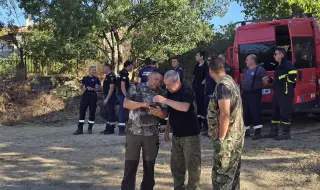
The past summer once again reminded us how vulnerable Bulgaria is to natural disasters, which are becoming an increasingly common phenomenon worldwide. The fires in the Stara Planina, Rhodope Mountains and Strandzha Mountains consumed thousands of acres of forests. The fire was growing rapidly, and institutions and emergency services had difficulty responding in a timely manner everywhere. At the critical moment, volunteers appeared - people without salaries and modern equipment, but willing to risk their lives. They were the ones who were often the first to reach the fire, put it out with shovels, made clearings, carried water and tools, but most of all - they inspired hope.
Their participation once again brought to light a bitter truth: volunteers in our country become the backbone of our society when the state is absent.
Where is the long-awaited Volunteering Law?
The history of volunteering in Bulgaria is marked by a paradox: everyone recognizes its importance, but it has actually been left to its own devices. The history of the Bulgarian Volunteering Law is a textbook example of institutional absurdity. There have been ideas for such a law for 15 years, with a draft law appearing as early as 2012, but it was rejected. In 2016, the Ministry of Youth and Sports developed a new framework, but it was never adopted. Since then, several versions of the bill have appeared, but each time something “more important” overtakes the topic on the agenda of the National Assembly.
The reason for this is clear - a lack of political will and strategic vision, as well as an underestimation of the topic. There is always something more urgent that pushes the topic to the back, and volunteering itself is underestimated and considered a secondary issue. This attitude clearly shows how the state perceives those who too often do its work - as a resource, and not as a partner whose role must be guaranteed and protected.
In reality, such a law would be of key importance. It should regulate the protection of volunteers when participating in actions, ensure their conditions and organization, and regulate the relations between volunteers and employers when employees get involved in such initiatives. In addition, the law would provide the necessary framework for training and preparation, as well as for building coordination between institutions and voluntary and non-governmental organizations.
Discussions have also begun in the current 51st National Assembly on a draft law on volunteering. 3 draft laws have been submitted to date. Their emphasis is on promoting volunteering, protecting volunteers, creating clearer rules for the organization of volunteer activities, as well as mechanisms for alleviating the administrative burden and protection. Their content is identical and will be combined into a common one, but this has not happened so far.
Volunteering beyond crises
Being a volunteer does not only mean getting involved in a fire or flood. It is a culture that can strengthen and support every sphere - from education and healthcare to social support and nature conservation. But volunteering in our country remains underdeveloped.
According to the “Eurobarometer“ only about 7% of Bulgarians participate in volunteering activities - far below the EU average, which exceeds 20%. This is a reflection of a social environment in which individual survival often prevails over collective responsibility.
The transition has left an individualized society where “Everyone should do it alone“ remains the unwritten rule for many things. In our everyday life, there is a lack of a culture of empathy - people prefer not to interfere and remain observers, instead of acting together and helping.
There are exceptions to the practice, but they are in large cities. There, active NGOs and educational programs nurture volunteer initiatives. But in small settlements, volunteering is absent or reduced to personal help between neighbors – valuable, but organized volunteers are few.
Volunteering as a school of values
Volunteering has a special role for young people, because it is at this age that habits, values and a sense of belonging are built. Involvement in volunteer initiatives gives meaning beyond personal success. It shows that a person is part of a larger community and that they can contribute to change. It is an experience that builds self-confidence, discipline and a sense of responsibility.
In many countries, volunteering activities are integrated into the education system - from school programs to university opportunities. This way, young people get a chance to participate and help. This model fosters solidarity and is accepted as a natural part of education. In our country, however, the emphasis in new educational reforms is often on “traditional“ subjects such as religion, rather than on civic virtues - a paradox that says a lot about our priorities.
In Bulgaria, however, there are youth organizations and volunteer clubs that bring together active young people and create alternatives to the missing state policies. There are many examples and they show that young people seek and need participation, and they see the benefits for themselves – acquired skills, social contacts and values that they will carry into adulthood.
What do we lose when volunteers are gone
There are volunteers in our country, but the problem is the lack of support and targeted policy from the state to encourage and guarantee their role. When the state does not create rules, and sometimes even creates obstacles, volunteers are left without support and protection. The examples where an employer does not release an employee for participation in a disaster action, and then even punishes him for his absence, show how absurd the situation is.
The cost of absence is measured not only in the lack of help in fires and floods. It is a loss of social capital, of opportunities for young people to grow up with values of solidarity, of trust between citizens and institutions. Where volunteering is systematically encouraged, societies are more cohesive, better prepared and more resilient. In our country, on the contrary, state inaction makes people more vulnerable and more isolated.
Therefore, we must clearly state: volunteering is not a fad, but a necessity for a healthier and more united society. If Bulgaria wants to move forward, the state must support these people with a legal framework and policies that encourage their efforts. Otherwise, we risk not only underestimating the work of thousands of volunteers, but also losing the chance to build a community in which mutual assistance is a value, not an exception.