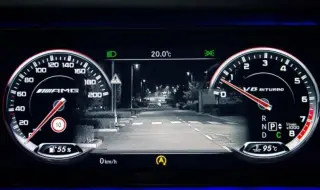
Mercedes-Benz, the brand that has long been synonymous with engineering sophistication and the introduction of new safety standards, has taken a quiet but noticeable step. Without a loud press conference, the German concern has removed one of its most iconic technologies from the options list - the Night View Assist night vision system.
First introduced in the middle of this century, this system quickly became a symbol of the S-Class's technical superiority. Using infrared cameras and special projectors, it allowed the driver to literally "see in the dark", highlighting the silhouettes of pedestrians and animals on the road on the dashboard screen. Later, the advanced version Night View Assist Plus even had the ability to "illuminate" people with a directed beam of light, creating an effect close to a theatrical spotlight.
For long-time Mercedes owners, this function was more than a useful tool - it was part of a special philosophy that combined precision and emotional impact. Now, in new models, including the flagship S-Class and the electric EQS (model year 2025), the "Night View Assist" column is no longer in the optional equipment catalog.
The reasons for the end of Night View Assist are complex and reflect global changes in the automotive industry, where rationality prevails over demonstrative technology.
1. Cost and complexity: The system has always been expensive to manufacture and maintain. Infrared cameras, specialized lamps, separate processors and a complex calibration system required serious maintenance. On the other hand, in well-lit urban conditions, most drivers simply did not use it. The practical benefit turned out to be less than the development and service.
2. The advent of smart headlights: The night vision function has been practically replaced by more modern, cheaper and faster technologies. Modern matrix LED headlights, adaptive high beam control, as well as radar and LiDAR systems combined with automatic emergency braking now provide the same or a higher level of safety. Instead of warning the driver, the modern car simply reacts automatically to the danger.
3. Regulations and risks: Technologies using infrared emitters and displays require complex certification. Any error in object recognition can lead to lawsuits. Automatic braking or pedestrian monitoring are much easier to standardize and fulfill regulatory requirements more effectively.
4. The era of electrification: In the era of electric vehicles, every kilogram of weight and every cent of cost matter. Additional cameras, sensors, processors and displays complicate architecture and reduce production efficiency. In its pursuit of optimization, Mercedes-Benz, like its competitors, is forced to reduce the number of unique and complex components.
The disappearance of Night View Assist is indicative of a change in buyer culture. Today, the priority is not demonstrative technological gimmicks, but reliability, autonomy and rational utility. Customers are looking for functions that work inconspicuously, but guarantee safety - even if they do not offer the emotional “wow effect“ of a movie theater in the car.
However, the technology has not disappeared completely. Some premium models, especially in the Porsche range or parts of the Volkswagen Group, still offer night vision for customers who often travel on unlit intercity roads. But for the mainstream manufacturers, this once avant-garde feature is now too expensive a luxury.