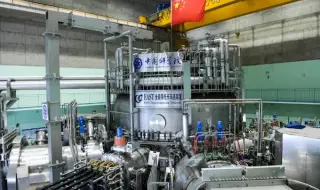
The Chinese experimental superconducting tokamak EAST, (tokamak is an abbreviation of the Russian expression “TORoidal Chamber with Magnetic Coils“) better known in popular science circles as the “artificial sun“, has achieved a fundamental breakthrough that could rewrite the rules in the race for clean and inexhaustible energy. In early 2026, researchers announced that they had managed to overcome the so-called Greenwald limit - the physical barrier that has limited the density of plasma in fusion reactors for decades.
For those unfamiliar, the Greenwald limit is a kind of “ceiling“ of fuel that a tokamak can hold. If you try to increase the plasma density beyond this value, it becomes unstable and literally “extinguishes“, often damaging the inner walls of the reactor. However, Chinese scientists at the Hefei Institute of Plasma Physics have managed to maintain a stable state at densities up to 1.65 times this limit.
This achievement is not just a laboratory record. Higher density means more collisions between atoms, which is the critical condition for achieving “ignition“ - the moment when the reaction becomes self-sustaining and starts producing more energy than it consumes.
The success is due to an innovative control method based on the theory of plasma-reactor wall self-organization (PWSO). By precisely adjusting the fuel gas pressure and microwave heating (electron cyclotron resonance), the team was able to entered a previously unknown zone - the "density-free regime". In this state, the plasma remains calm even at extreme "compression", which until recently was considered physically impossible.
The EAST breakthrough is a powerful incentive for the international ITER project, which is being built in France. It proves that the engineering limitations of the current tokamaks are not a fundamental law of nature, but simply a technical challenge that already has a solution.
Although fusion energy is still in the experimental phase, the success of the Chinese "artificial sun" brings us closer to a world in which energy poverty and carbon emissions are relics of the past. It is a step beyond the limits of the known, which gives hope that by 2039 - the deadline for full-scale reactions in ITER - humanity will truly tame the power of the stars.