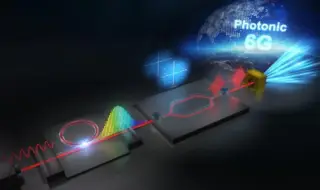
While most of the world is still getting used to the possibilities of 5G connectivity, engineers in the laboratories of the University of Tokushima are already looking a decade ahead. A Japanese research team has officially unveiled a revolutionary wireless data transfer system that managed to nail the mind-blowing speed of 112 Gbps while operating at a frequency of 560 GHz. This achievement marked a historic milestone in the development of the so-called terahertz communications and practically lays the foundation for the next technological generation of mobile networks – 6G.
Oh, going beyond the 350 GHz limit was previously considered a real engineering curse, as standard silicon electronics become brutally unstable, facing huge interference and power loss. To overcome this technological barrier, Japanese scientists made the bold decision to throw traditional electronic circuits in the trash. Instead, they relied on pure photonics, implementing innovative optical microcombs that generate perfectly calibrated laser lines with microscopic phase noise. The problem of fine alignment of the lasers was elegantly solved by directly welding the optical fiber to a special silicon microresonator.
The experiment itself was conducted with two different signal encoding (modulation) schemes. When using the more standard QPSK scheme, the equipment reached a serious 84 Gbps, but the real furor occurred when switching to the more complex 16QAM modulation, where the needle of the virtual speedometer nailed the record 112 Gbps. And all this is packed into an extremely compact module with built-in thermal management that prevents the sensitive optical components from overheating.
But where is the catch and when will we get these speeds on our smartphones? The truth is that the technology is not initially aimed at end users at all, but at the so-called backhaul infrastructure of telecoms. Instead of mobile operators digging and laying expensive fiber optic cables to each base station in hard-to-reach or densely populated areas, they will be able to transfer gigantic amounts of data between towers directly over the air. This will not only reduce the cost of building the future 6G network, but will also allow lightning-fast internet in places where this previously seemed like absolute science fiction.