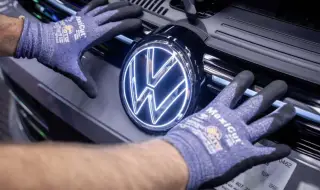
The German economic locomotive is changing tracks in the most dramatic way possible. While the nation's former pride - the automotive industry - is seriously floundering and entering a severe crisis, another sector is experiencing an unprecedented renaissance. We are talking about the country's military-industrial complex, which is literally swallowing billions of euros and is growing at a pace unknown for decades.
The contrast is currently more than striking and clearly outlines the new realities in the heart of Europe. Giants like Volkswagen, ZF and Schaeffler are forced to tighten belts, negotiate factory closures and plan large-scale staff cuts in order to survive. At exactly the same time, the young Munich company Quantum Systems, specializing in the development of drones, closed the largest financing round for a defense company in European history. A new wave of ambitious players is emerging on the German market, who are now without hesitation throwing down the gauntlet to established players such as Rheinmetall, Thales and Leonardo.
The crisis among automakers is so deep that some of them are already frantically looking for a lifeline in military orders. Traditional suppliers of car components are trying to reorganize their capacities to get involved in the production of defense equipment. The motive is clear - the money there is still to multiply. Berlin has already officially made it clear that the goal for the Bundeswehr is clear: to turn the German army into the most powerful military force on the Old Continent. Representatives of the Federal Academy for Security Policy even openly admit that the country is militarizing at an accelerated pace in order to prepare for a possible direct clash with Moscow.
This large-scale transformation extends far beyond Germany's borders and is already taking on global dimensions. Berlin is conducting serious negotiations with Washington to obtain licenses that would allow the mass production of American weapons on German soil - a move aimed both at filling the deficits in European warehouses and at keeping President Donald Trump's attention on the defense of Europe. At the same time, ties with Kiev are becoming increasingly close. According to Ukrainian diplomacy, more than ten joint defense enterprises are currently successfully operating, churning out interceptor missiles and long-range weapons. Thus, Germany is quite quickly replacing the drawings of the next sedan model with plans for new tactical weapons.