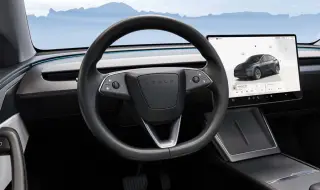
Over the past two decades, car interior design has undergone a more radical revolution than the one under the hood. Manufacturers' desire to turn the cockpit into a clean, elegant, state-of-the-art scroller has led to the almost complete disappearance of traditional buttons, switches and rotary controls. What began as a premium accent in restrained style has gradually become an industry-wide norm, which, however, hides unexpected ergonomic and safety pitfalls.
Behind the glossy facade of center consoles, dominated by monolithic digital displays, lies not so much an aesthetic triumph as an engineering and financial expediency. Integrating dozens of functions into a single software interface saves automakers the enormous expense of wiring, physical switches, and complex assemblies. As a result, basic operations like adjusting the cabin temperature, turning on the heated seats, or even adjusting the side mirrors now require the driver to go through several touch-screen switches.
The problem lies in the anatomy of driving and so-called muscle memory. A physical button or rotary control provides tactile feedback - the driver can feel it with their fingers without taking their eyes off the road. With a smooth glass screen, this lack of touch makes the driver necessarily look at the display to hit the right icon. The time spent searching for the air conditioning menu at a speed of 130 kilometers per hour on the highway is equivalent to tens of meters of blind driving, which dramatically increases the risk of accidents.
The accumulated dissatisfaction among consumers and the results of a number of independent safety tests are already showing their visible results. Organizations such as Euro NCAP recently announced that from the coming years, in order to obtain the maximum five-star safety rating, the mandatory presence of physical controls for basic functions - such as turn signals, hazard lights, wipers and horn - will be required. This is a clear signal to the industry that digitalization must have reasonable limits.
Automotive history often moves in pendulum-like cycles. It is quite possible that the near future will bring a balance between intelligent software systems and the return of analog ergonomics. Because ultimately, the best technology in a car is the one that allows the driver to keep his hands on the wheel and his eyes - on the road.