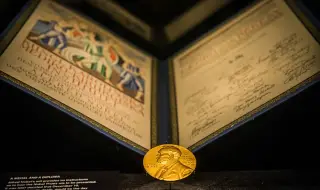
Maria Corina Machado, the Venezuelan opposition leader, is this year's Nobel Peace Prize laureate, the Norwegian Nobel Committee announced in Oslo, BTA reports.
"The Nobel Prize goes to a courageous advocate for peace - a woman driving the transition from dictatorship to democracy, a symbol of unity at a time when democracy is under pressure," said the Norwegian Nobel Committee's argument, presented by Jørgen Vatne Fridnes, the head of the Norwegian Nobel Committee.
The Nobel Prizes are named after the Swedish industrialist Alfred Nobel, who is their founder, and only the peace prize is announced in Oslo, the others are announced in the Swedish capital Stockholm. After the winner is announced today, the peace prize will be solemnly awarded on December 10 at ceremonies in Oslo. The day before - on December 9 - the laureate will also give a press conference.
The Nobel Prize website recalls that nominations for the Nobel Peace Prize can be made until January 31 of each year. In early March, the Norwegian Nobel Committee usually announced that a total of 338 individuals and organizations have been nominated for the 2025 prize. The list of nominees remains secret and will be declassified 50 years later. But individuals and organizations that have nominated someone can announce it now.
The Nobel Peace Prize winner receives an 18-karat gold medal, created by Norwegian sculptor Gustav Vigeland, a diploma created by famous Norwegian and Swedish calligraphers, and 11 million Swedish kronor ($1.19 million).
The Nobel Peace Prize has been awarded since 1901. There have been a total of 105 Nobel Peace Prize laureates, according to a statement on the Nobel Prize website. The award has not been awarded 19 times - in 1914-1916, 1918, 1923, 1924, 1928, 1932, 1939-1943, 1948, 1955-1956, 1966-1967 and 1972. The reason is that during these years the Norwegian Nobel Committee considered that no one met the criteria for receiving the award.
71 awards have been awarded to only one laureate. 31 - were shared by two laureates. In three cases, the award was shared by three laureates. This happened for the first time in 1994, when the award was shared by Palestinian leader Yasser Arafat and Israeli leaders Shimon Peres and Yitzhak Rabin for their efforts for a lasting solution to the Israeli-Palestinian conflict. In 2011, the Nobel Peace Prize went to Liberian President Ellen Johnson Sirleaf, Liberian activist Leymah Gbowee, and Yemeni activist, journalist, and human rights defender Tawakkol Karman for their efforts in the fight for greater security, rights, and freedoms for women. In 2022, the Nobel Peace Prize was awarded to Belarusian opposition figure Ales Bialiatski, the Russian human rights organization Memorial, and the Ukrainian human rights organization Center for Civil Liberties.
There have been 142 Nobel Peace Prize laureates in total – 111 individuals and 28 organizations. Of these organizations, the International Committee of the Red Cross has received the award three times (in 1917, 1944, and 1963), and the Office of the United Nations High Commissioner for Refugees – twice (in 1954 and 1981).
The youngest Nobel Peace Prize laureate is Pakistani activist for the right of children and young people to receive a decent education, Malala Yousafzai. She was awarded the peace prize in 2014, when she was just 17 years old. The oldest laureate is Polish-British scientist and activist Joseph (Josef) Rotblatt, who was awarded in 1995, when he was 86, for his efforts to eliminate nuclear weapons. He received the award together with the Pugwash Conferences on Science and World Affairs, a pacifist international organization that includes scientists and public figures who have joined forces to reduce international tension and the risks of armed conflict.
Of the 111 individuals who have won the Nobel Peace Prize, only 19 have been women, with the first woman to win the award in 1905, Bertha von Suttner, an Austrian writer and peace activist. The last woman to win the Nobel Peace Prize was in 2023, when Iranian activist and human rights activist Narges Mohammadi won it while she was once again in prison.
American scientist and anti-nuclear activist Linus Pauling received the Nobel Prize twice, but only once for the Nobel Peace Prize. In 1962 he won it for his fight against nuclear testing and against the nuclear race between East and West. And before that, in 1954 he won the Nobel Prize in Chemistry for his research into the nature of chemical bonds and their application in elucidating the structure of complex substances.
In 1973, Vietnamese politician Le Duc Tho won the Nobel Peace Prize together with US Secretary of State Henry Kissinger for negotiating a peace agreement in Vietnam. However, the Vietnamese man says he is unable to accept the award, citing the fact that peace had not yet come to Vietnam at the time.
In addition to Narges Mohammadi, five other Nobel Peace Prize laureates have been awarded the award while behind bars: German pacifist and journalist Carl von Ossietzky in 1935 for his efforts to expose Germany's secret rearmament and for his efforts to support the cause of peace, Ales Bialiatski three years ago, Chinese activist Liu Xiaobo in 2010, and Myanmar human rights activist and anti-junta activist Aung San Suu Kyi in 1991, who led a civilian government after the fall of the military regime, but was again convicted on a number of charges after a new coup in her homeland.
The Nobel Peace Prize has only been awarded posthumously once. This happened in 1961, when it was awarded to Dag Hammarskjöld, a Swedish politician, economist and diplomat and Deputy Secretary-General of the United Nations. He died in 1961 in a plane crash near Ndola in what was then Northern Rhodesia, now Zambia. The causes of the crash remain unclear, with a CIA report alleging that the Soviet KGB was responsible. The prize was awarded to Hammarskjöld for "having transformed the United Nations into an effective and constructive international organization, capable of giving life to the principles and purposes expressed in the Charter of the United Nations". In 1974, it was decided that the Nobel Peace Prize would not be awarded posthumously.
During the first 100 years of the Nobel Peace Prize, that is, from 1901 to 2001, a total of 4,857 individuals and legal entities were nominated. Of these, international organizations totaled 690, and they won the prize a total of 20 times.
Geographically, Western Europe had a total of 1,694 nominees during the first 100 years of the prize, of which 44 won. Eastern Europe had a total of 323 nominees and only 3 winners. North America had 964 nominees and 19 winners. Latin America had 345 nominees and 5 winners. Asia had 677 nominees and 12 winners. Africa has 164 nominees and 6 winners.
Over the years, Mahatma Gandhi, Neville Chamberlain, Franklin Roosevelt, Harry Truman, Konrad Adenauer, Juan and Eva Perón, Jawaharlal Nehru and other statesmen and politicians have been nominated. Dictators such as Benito Mussolini, Adolf Hitler and Joseph Stalin have also been nominated. British Prime Minister Winston Churchill was also nominated, but ultimately won the Nobel Prize for Literature, awarded to him in 1953. A number of writers have also been nominated for the Nobel Peace Prize, such as Erich Maria Remarque and Leo Tolstoy, as well as philosophers such as Maria Montessori or notable figures such as King Albert I of Belgium, Ethiopian Emperor Haile Selassie, King Paul I of Greece, Prince Carl of Sweden, Emperor Nicholas II, etc.
There is no limit to the number of times a person can be nominated for the prize. For example, between 1916 and 1931, American public figure and pacifist Jane Addams, head of the Women's International League for Peace and Freedom, was nominated a total of 91 times before finally winning the award.
Last year, the Nobel Peace Prize was awarded to the Japanese association of survivors of the American nuclear bombings of Hiroshima and Nagasaki, “Nihon Hidankyo“, world agencies recall. This year marks the 80th anniversary of these nuclear attacks.