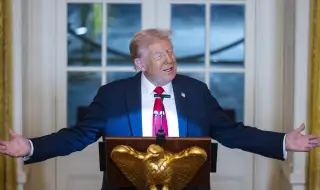
US President Donald Trump presented with great solemnity last week his plan to end the war in the Gaza Strip. He achieved something that seemed unlikely until recently - the remaining survivors of the hostages taken by fighters of the Islamist movement "Hamas" in the Palestinian territory in the attack on October 7, 2023, which triggered the conflict, are now free. It is no coincidence that Trump was invited to speak before the Israeli parliament in a very pompous atmosphere, BTA writes.
In typical style, the US president hastened to declare that the war is over. He has, more or less rightly, taken credit for settling a number of conflicts and even claimed the Nobel Peace Prize for that year - an award that he did not receive.
However, Trump's plan, which brought a ceasefire in Gaza after two years of war, does not address one key issue: the creation of a Palestinian state. And without its settlement, peace in the Middle East will likely remain a distant prospect, as history shows.
Trump is not a man who likes to deal with tedious details, notes Agence France-Presse. He also does not look far into the future, although he claims, not without some justification, that with his plan to end the war he has laid the foundations for "a new Middle East".
AFP defines the US president's visit to Egypt on Monday, which coincided with the release of the remaining surviving hostages, as a major diplomatic victory for him.
Asked during the return trip to Washington what he thought about a possible solution to the Israeli-Palestinian conflict based on the coexistence of two states, he replied in a formulaic manner: "I will decide what I think is fair, in coordination with other countries." At the same time, Trump made it clear that this issue is not a priority for him. "I'm not talking about a single state, a dual state or two states. We are talking about rebuilding Gaza," he said, referring to his idea for the United States to take control of the strip and turn it into a luxury resort.
On Tuesday, the US president announced the start of the second phase of his plan, which envisages "Hamas" disarming, and expressed confidence that this will happen if necessary - and by force.
However, Trump made this statement against the backdrop of deteriorating prospects for the agreement, with Israel delaying the delivery of humanitarian aid and the Palestinian Islamist movement tightening its control over Gaza, Reuters notes.
Agence France-Presse recalls that the US president signed a declaration on Gaza on Monday, together with the leaders of the other mediator countries - Egypt, Qatar and Turkey - in which they commit to "pursuing a vision of peace" in the Middle East - a document whose content, however, is very general, AFP points out.
"What they signed is not something very special. It is more of a declaration of intent. Nobody really knows what the next steps will be", a diplomat from a country that has not signed the document told AFP.
In addition, Trump's plan envisages the deployment of international security forces in Gaza and the establishment of an interim administration, in which, of course, "Hamas" will have no participation. However, the issue of the creation of a Palestinian state is not discussed at all.
Former Palestinian adviser in peace negotiations Ghait al-Omari acknowledged Trump's "very strong instinct" when it comes to choosing the "right moment and opportunity". "But I am very skeptical that the level of engagement of recent weeks will be maintained," added Omari, who is currently an expert at the Washington Institute for Near East Policy.
He also questioned the ability of current leaders such as the "very discredited" Palestinian President Mahmoud Abbas, 89, to bring the peace process to a successful conclusion.
"In many ways, the easy part of the job has been done," commented Mona Yacoubian of the American think tank the Center for Strategic and International Studies.
The other big unknown, AFP notes, is that Trump's plan is anything but a roadmap for resolving the Israeli-Palestinian conflict.
In addition, the current Israeli government, which is the most right-wing in the country's modern history, is categorically against the creation of a Palestinian state. Israeli Prime Minister Benjamin Netanyahu has strongly criticized countries, including France, that have recognized the State of Palestine.
As for the bulk of the hypothetical future Palestinian state - the occupied West Bank of the Jordan River - this issue has hardly been discussed, Agence France-Presse points out.
The Israeli government is expanding Jewish settlements in the West Bank, and its far-right representatives are practically seeking to annex almost the entire territory.
"One question that no one has really thought about, because we are all naturally focused on Gaza, is: can the situation in the West Bank remain stable or will we witness a collapse?", warns Ghait al-Omari.
French President Emmanuel Macron, who is persona non grata in Israel for recognizing the existence of a Palestinian state, warned that "the acceleration of construction (of Jewish settlements) in the West Bank poses an existential threat to the State. Palestine".
So, the prospect of lasting peace and "a new Middle East" remains distant for now. The hope is that at least the ceasefire will hold and the two years of horror in Israel and Gaza will be a thing of the past.