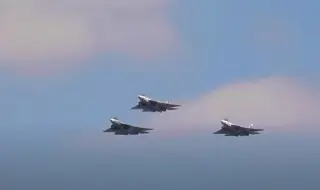
Key moments and summary – The Russian Su-75, presented in 2021 as a "cheap" competitor to the 5th generation F-35 at a price of $ 30 million, looks like a "ridiculously optimistic" failure, writes the National Security Journal.
The Russian Su-75 – Is it really "chess"?
In July 2021, Russian aircraft manufacturer Sukhoi unveiled the Su-75 at the MAKS air show, presenting it as a single-engine, affordable fifth-generation stealth fighter designed for both export and domestic use.
Officials said the goal is to achieve a price tag of around $25-30 million, undercutting Western competitors such as the F-35 Lightning II.
If all goes according to plan, Russia will become a global supplier of fifth-generation stealth fighters to countries willing to save money by doing business with the government.
In many ways, the idea makes sense. Russia has long operated heavy twin-engine fighters on the domestic market, such as the Su-57, but it lacks a stealth platform suitable for mass exports. Not only that, but with Western sanctions still tight, Moscow sees exports as a revenue-generating opportunity – and the "Chess" has been explicitly marketed to markets in Asia, Africa and the Middle East.
In other words, Russia wants to do business with countries that are less likely to choose to do business with the US.
But not everything has gone according to plan. Even at its inception, the program seemed more like a demonstration opportunity than a realistic initiative.
Indeed, Russia presented itself as a technological competitor in the field of stealth fighters and tried to intimidate the West by making it clear that it was becoming increasingly competent in developing purely indigenous systems.
However, implementation is a different story, and it can be said that the entire plan was based on unwarranted optimism.
Technical characteristics
According to public statements and Russian design documentation, the Su-75 is expected to reach speeds of Mach 1.8 to 2, a combat radius of approximately 3,000 km, and a payload of up to 7,400 kg.
As for the design, the aircraft is planned to include a deflector-less supersonic inlet (DSI), a V-shaped tail configuration, internal weapons bays, and avionics from the platform. Su-57 to reduce costs.
If these specifications are implemented, the "Chess" would rank among the F-35, which has a top speed of around Mach 1.6, and closer to the lower limit of the heavier twin-engine F-22, at around Mach 2.2+. This would fit perfectly with the marketing slogan "stealth for less".
However, the key capabilities of this aircraft remain untested. We don't know its radar surface, we don't know its sensor fusion capabilities, we don't know anything about its maintenance and service costs, nor do we understand its data interoperability. None of these details have been specified or described by the Russians, and everything we know has yet to be independently verified.
And this is important because Western analysts describe the aircraft as a design that is completely incompatible with Russia’s current industrial capacity. Simply put, Russia does not have the resources to build it.
Crucially, this idea of a "cheap" stealth option is historically difficult to implement and, to be honest, ridiculously optimistic.
Western experience in this area shows that fifth-generation fighters require more than just a stealth design; they need advanced materials and coatings, excellent supply chains, sensors, pilot training, maintenance infrastructure, logistics, etc.
None of these things are cheap, and they only become more affordable on a large scale.
For a truly "cheap" stealth option, it would be necessary to develop a huge number of these aircraft and build a massive infrastructure to ensure that they can be properly maintained when not in use.
A good historical example of how stealth coatings require extensive maintenance and care, especially when they are less sophisticated, is the American B-2 Spirit stealth bomber.
This iconic bomber requires constant maintenance and is stored in specialized hangars to ensure that its stealth coating remains in good condition.
If the US is struggling to produce “cheap” stealth, it is difficult to imagine how Russia would do it.
Progress, limitations and why it may not happen
While Russia continues to claim that the program is entering its final phase, the reality is that there are still significant delays and obstacles – and it is not known when the project will finally be implemented.
The Su-75’s initial flight tests have been postponed multiple times. Originally scheduled for 2023, the tests have yet to take place.
The sanctions are only one piece of the puzzle, but arguably the most important. Leaked internal Russian industry documents show that Western embargoes have blocked access to key components needed to produce the aircraft, from advanced gear-forming machines and semiconductors to foreign investment.
Russia simply cannot get access to the things it needs to make the plane a reality. In fact, one report notes that delivery times for key components needed to produce the aircraft have been extended by more than 15 months, while local substitutes are lagging behind.
Add to this the fact that Russia’s aerospace and defense complex has been refocused on the war in Ukraine, and countries such as India, the UAE, and Vietnam have rejected offers to purchase the platform.
It is clear that a project like this is simply not in Russia’s plans for the near future. And even if it were to come to fruition – as some reports have noted, it was spotted in a photo released by the Russian United Aircraft Corporation – the idea that it would be “cheap“ or exported in large quantities is still highly questionable.
Link to main version
Oct 30, 2025 18:53 628