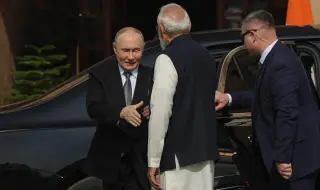
Russian leader Vladimir Putin's visit to India is being followed with heightened interest by the Western press, BTA writes.
The Russian president's first visit to India since the start of the war in Ukraine in February 2022 is set to be lavish, as the two countries have common economic interests, the French newspaper "Figaro" wrote in its headline.
The state visit to India is only the sixth trip this year for the Russian president, who before the invasion usually traveled abroad about 20 times a year.
Putin is on a two-day state visit to India to discuss the "privileged strategic partnership" that links the two countries, the Kremlin said in a statement.
This is a rare enough event that deserves to be followed with increased interest: since the beginning of the invasion of Ukraine, the list of countries with which Moscow can maintain such relations has been significantly reduced. Putin is the subject of an arrest warrant from the International Criminal Court (ICC) for alleged war crimes, which automatically limits his travel abroad. The 125 countries that have signed the Rome Statute of the ICC are obliged to arrest the Russian president if he sets foot on their territory, Le Figaro points out.
Indian Prime Minister Narendra Modi rolled out the red carpet for Vladimir Putin despite pressure from the West, another French publication, Le Monde, headlined.
Following Putin's threats to Europe amid negotiations over the war in Ukraine, the Russian president is being welcomed with honors in India. A private dinner at the Indian leader's residence, an official banquet, bilateral meetings and speeches to business leaders - the reception promises to be lavish. In addition, the Kremlin boss, against whom an arrest warrant has been issued by the ICC, will not be prosecuted because India has not signed the Rome Statute, Le Monde reports.
This visit, the first since the start of the large-scale invasion of Ukraine in 2022, takes place in a geopolitical context marked by strong tensions between Narendra Modi and US President Donald Trump, as well as pressure from the West for India to ask Putin to end the war. In August, the US president imposed a 50% tariff on Indian goods, citing, in particular, Delhi's purchases of Russian oil.
For India, welcoming Vladimir Putin is a way to assert its strategic autonomy and prevent the West from dictating its foreign policy. Western countries have been trying unsuccessfully to persuade the Indian prime minister to stop buying oil from Russia, thereby financing Moscow's war in Ukraine. The two largest buyers of Russian crude oil, India and China, have allowed the Russian president to withstand the pressure of Western sanctions, notes "Monde".
Putin and Modi are meeting in politically unstable times for Russia and India, writes in an analytical article in the British newspaper "The Guardian".
Against the backdrop of the turbulent geopolitical situation, analysts emphasize the importance of the Russian president's visit to India, both as a symbol of the enduring relations between the two countries and as a message that neither of them will succumb to US pressure.
The summit is taking place at a critical moment for both countries. Putin arrived in Delhi after rejecting the latest US peace plan for Ukraine, confident that the latest successes of Russian forces on the battlefield have strengthened his position, the British publication notes.
The close relationship between India and Russia dates back to the Cold War and remains so, with Russia being the largest supplier of military equipment to India. It is an alliance that has long been tolerated by Western governments, even after Putin's actions in Ukraine, but Trump's return to the White House signals a markedly different approach, the Guardian points out.
Over the past three years, the US and Europe have turned a blind eye while India has become one of the biggest buyers of cheap Russian oil, despite Western sanctions. However, after the US president's efforts to bring peace to Ukraine failed earlier this year, Trump has begun accusing India of financing the Russian invasion. He publicly pressured Delhi to stop buying Russian oil, which led to the imposition of additional punitive tariffs of 25% on Indian goods.
In India, which has pursued a multi-vector foreign policy since independence and reacted sharply to any external interference, Trump's attempts to interfere and exert pressure have been met with indignation, leading to the most serious deterioration in relations between Washington and Delhi in years.
At a press conference this week, Kremlin spokesman Dmitry Peskov acknowledged "obstacles" in economic and energy cooperation with India, but said it would continue without interruption. Western sanctions would lead only to "minor declines and reductions" in the amount of oil Russia exports to India, and only "for a very short time", Peskov said, adding that Moscow has mechanisms to circumvent the sanctions in the long term.
When Modi and Putin sit down at the negotiating table, mention of Ukraine is likely to be limited to India's repeated calls for peace, analysts said, stressing that the Indian prime minister is unlikely to be able to influence global efforts to end the war, notes "The Guardian".
Russia and India are seeking to deepen their energy and security ties, which have been tested by Western pressure, another British publication - the "Financial Times" headlined.
Putin's last visit to India was in December 2021, just before he launched his full-scale invasion of Ukraine in February 2022. Since then, India has become the largest buyer of crude oil from Moscow, importing almost $140 billion worth of Russian oil, according to Indian government data.
India, the world's largest arms importer, has long relied on Russian weapons, although it also buys from the United States, Israel and France.
Kremlin spokesman Peskov confirmed that there would be discussions about India acquiring more Russian S-400 air defense systems, which Delhi used during its brief conflict with Pakistan this year, and possibly Su-57 fighter jets.
India is also exploring the possibility of leasing a nuclear submarine from Russia, but that prospect has been postponed due to the war in Ukraine, the Financial Times notes.
The two countries jointly produce the BrahMos missile, which Delhi launched during the conflict with Islamabad this year, and which it is selling to the Philippines with Moscow's approval.
Defense ties between Russia and India look set to deepen. On Tuesday, the lower house of the Russian parliament ratified an agreement with India that will allow each side to station troops, warships and aircraft on the other's territory.
The Russians "have been our friends in good times and bad," Indian Defense Minister Rajnath Singh said last week. "We will not end our defense cooperation with them in the near future," the minister added.