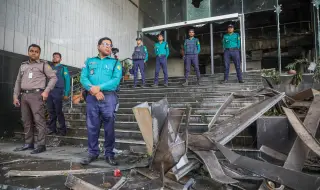
Severe unrest has again erupted in Bangladesh just two months before parliamentary elections, with many of the demonstrators raising anti-India slogans and attacking institutions linked to Delhi, BTA reported.
The reason for the demonstrations was the killing of 32-year-old Sharif Osman Hadi - a prominent leader of last year's riots that toppled the government of Prime Minister Sheikh Hasina Wazed. She ruled Bangladesh for 15 years and fled to Delhi in August 2024. at the height of the mass unrest. A UN investigation found that security forces and members of Hasina's party killed at least 1,400 protesters during last year's riots.
Muhammad Yunus, a Nobel Peace Prize laureate, leads Bangladesh's interim government as factions vie for power. Elections, in which Sheikh Hasina's Awami League party is not eligible to participate, are due to be held on 12 February.
On 17 November, a special court in Dhaka sentenced Sheikh Hasina to death on charges of crimes against humanity committed during the crackdown on student protests. Former Home Minister Asaduzzaman Khan, who also fled to India, was also sentenced to death. Former police chief Abdullah Al Mamun was given a five-year prison sentence. At the end of the same month, the Bangladeshi interim government sent a request to the Indian Ministry of Foreign Affairs for the extradition of Hasina and Khan. The Indian Ministry of Foreign Affairs has not given an official response to the extradition request.
Sharif Osman Hadi, founder and spokesman of the socio-cultural platform "Inqilab Moncha" (Platform for the Revolution), was shot in the head on December 12 in Dhaka and died six days later in a hospital in Singapore. Bangladeshi police said they had identified the two attackers, who are believed to have fled to India, notes the "Monde" newspaper. This information fueled rumors that the murder was carried out with the support of the Indian authorities, the French publication adds.
"Inqilab Moncha" announced Hadi's death on "Facebook". "In the fight against Indian hegemony, Allah accepted the great revolutionary Osman Hadi as a martyr", the text reads.
Escalation of tensions
After the news of Hadi's death was announced on Thursday, thousands of demonstrators took to the streets of Dhaka and other cities in Bangladesh.
Protesters in the southeastern port city of Chittagong attacked the Indian consulate building.
A reporter for "Al Jazeera" reported that a retired Bangladeshi army officer who participated in the demonstrations in Dhaka had publicly called on India to extradite Sheikh Hasina and accused Delhi of protecting those responsible for political violence. Former Lt. Col. Hasinur Rahman also demanded the return of those accused of Hadi's murder and insisted that they be tried in Bangladesh, along with Sheikh Hasina. Rahman criticized Yunus' interim government for failing to arrest Hadi's alleged killers, the Qatari media reporter also reported.
The protests escalated on Thursday after demonstrators in Dhaka stormed the offices of two leading dailies - the Daily Star and Prothom Alo - accusing them of serving Indian interests in Pakistan. The mob ransacked and set fire to offices where journalists and staff were trapped. Firefighters were able to evacuate several people using ladders, and military units were later deployed to the area.
According to BBC journalist Anbarasan Ethiraj, the "Daily Star" and "Prothom Alo" have a reputation for being secular and progressive publications and, he says, have come under pressure during Sheikh Hasina's rule for the way they have covered government politics. The two publications also publish articles against radical Islamist elements in Bangladesh. The "Daily Star" and "Prothom Alo" have also been critical of some of the policies of the interim government and the security forces. They raise questions about the deteriorating security situation, the disappearance of people without a trace, the unjust arrests of supporters of the previous government, as well as journalists considered to be sympathizers of Sheikh Hasina's party, Etirajan also writes.
The role of Islamist factions
Islamist factions have filled the power vacuum in Bangladesh since the ouster of Sheikh Hasina, which led to a wave of violence against the country's Hindu communities, notes the Washington-based Jamestown Institute. Jihadist propaganda and pro-Pakistani Islamist movements in Bangladesh have revived, presenting India as an existential threat to Islamic identity. The inaction of the interim government has emboldened extremists, deepening religious tensions and increasing the risk of destabilization in the region, the American think tank also writes.
Criticism of India and attacks on institutions linked to it have intensified in the past week, adds the American magazine "Diplomat". Hasnat Abdullah, one of the leaders of the National Civic Party formed after the student riots, said on December 15 that if Delhi does not stop providing sanctuary to representatives of the "People's League" and those accused of the attack on Hadi, Bangladesh will accept separatists from northeastern India on its territory.
"If Bangladesh is destabilized, the fire of resistance will spread beyond the borders. Since you are sheltering those who are destabilizing us, we will also give shelter to separatists from the "seven sisters", Abdullah said, quoted by the "Diplomat" magazine. The seven states in the northeastern part of India are often called the "seven sisters". This region has repeatedly been shaken by separatist uprisings and rebellions.
The Foreign Affairs Committee of the Indian Parliament on Friday described the situation in Bangladesh as "complex and dynamic", the PTI news agency reported. The Indian Ministry of External Affairs informed the parliament that the government "continues to be concerned" for attacks on members of the Hindu minority in Bangladesh. The commission also said that India has made every effort to prevent the attacks from affecting bilateral relations between Delhi and Dhaka.
Tripura Chief Minister Manik Saha said on Sunday that an army battalion that participated in the 1971 India-Pakistan war would be deployed in the northeastern Indian state in connection with the unrest in Bangladesh, PTI quoted him as saying. Saha suggested that Pakistan may be behind the unrest in Bangladesh.
"Fundamentalists were expected to become more active after the elected Prime Minister Sheikh Hasina was forced to leave the country," the Tripura Chief Minister said. "Thousands of fundamentalists, criminals and thieves have walked out of Bangladeshi jails while the police and army remained silent. "The appointment of Muhammad Yunus as Bangladesh's chief adviser was premeditated by forces that are detrimental to India's rise," Saha added.
Prospects in bilateral relations
India has huge economic and security interests in Bangladesh and will therefore remain neutral until a newly elected government takes power after the February elections, commented the "Diplomat" magazine.
"India should not rush", said Avinash Paliwal, a lecturer at the Faculty of Oriental and African Studies at the University of London, quoted by the BBC. According to Paliwal, the way forward requires "quiet and patient engagement with key political stakeholders in Dhaka, including the armed forces".
Diplomacy can buy time, but it will not be easy, the "Diplomat" magazine added. Political parties will soon begin their election campaigns. Provoking anti-India sentiment has long been a strategy for parties to win votes in India's neighboring countries, and Bangladesh is no exception. It can be expected that India's support for Sheikh Hasina and its reluctance to extradite her will be a central theme in the election rhetoric of political parties. Relations between India and Bangladesh are expected to deteriorate further, the American publication predicts.