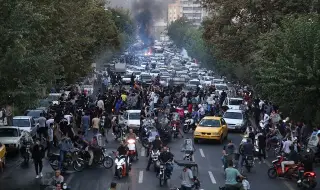
The Iranian regime has ruthlessly suppressed protests in the country, not stopping at murders. Who are its most loyal "hounds"?
They simply appear on the streets out of nowhere - motorcycles, on which there are usually two men. One drives the vehicle, and the second holds a weapon. It is not clear who they are, they do not wear uniforms or other identifying marks. One thing is clear - as soon as they appear, protesters in Iran panic. Such scenes can be seen in the few videos that reach the world despite the ongoing Internet blockade in the Islamic Republic. The videos were most likely obtained using the Starlink satellite network, which sporadically provides a connection to the Iranians, ARD writes.
Some of the videos show these armed men shooting protesters with live ammunition. According to Iran expert Reinhard Schulze, they are supporters and members of the Basij paramilitary militia.
What are the Basij militias?
The Basij are armed militias whose members appear in Iran whenever the regime suspects there may be unrest or, in this case, when it wants to suppress protests, the German public media writes. "They organize themselves. "They have no command structure, they act at their own discretion," Schulze explains.
The militias were created after the Islamic Revolution in 1979 and have around 150,000 fighters who are at the disposal of the Iranian regime at any time. Hundreds of thousands more can be mobilized if necessary. However, there are no exact figures, the German public media outlet points out.
"Basij" recruit members from the population. Often these are young people from poorer backgrounds who are attracted by the fight for a religious state and the advantages in the state apparatus. Even in peaceful times, "Basij" are part of the everyday life of Iranians, including at universities. There, they have to identify opponents of the regime before they can organize themselves into larger movements.
In 1981, the "Basij" were placed under the command of the Revolutionary Guard as a paramilitary unit. "Unlike the "Basij", the Revolutionary Guard is a real army," says Schulze. "With its air, sea and land forces, it is a kind of elite unit and is directly subordinate to Ayatollah Ali Khamenei."
The Revolutionary Guard - a state within a state
The Revolutionary Guard has also been used against demonstrations in recent days, writes ARD. However, the unit is not working to its full potential at the moment, according to expert Schulze. "The Revolutionary Guard is not just a force group, it is designed to take over all executive power in cities in emergency situations, whether in the capital or in the countryside," the professor explains to ARD. Thus, in the provincial cities there is a constant threat of the establishment of a dictatorship of the Revolutionary Guard.
Initially, it was created to guarantee the continuation of the Islamic Revolution in Iran. Today, however, it is not only a military force, but also an economic one. It organizes the largest construction projects in Iran and participates in the construction of ports, airports and transport infrastructure.
Another task of the Revolutionary Guard is to spread the ideas of the Islamic Revolution abroad. Thus, it is responsible for the creation of Hezbollah in Lebanon, Hamas in the Gaza Strip, and for the concrete establishment of Bashar Assad in Syria. Over the years, the Revolutionary Guard has become a force without which almost nothing can be done in Iran today. And which, together with the "Basij" militias, has probably played an important role in suppressing all protests to date.