After DPA reported on January 29 that the first combat battalions had been deployed to the German army's tank brigade stationed in Lithuania, on February 4 the agency reported that NATO troops had officially joined the Bundeswehr units in the Baltic state, BTA reports.
The multinational battle group with a forward presence in the Lithuanian city of Rukla was created with Germany as the framework (leading) country. As of February 4, there had been 18 rotations of national military forces, the Lithuanian Armed Forces noted on its website.
The Baltic state's Ministry of Defense, in turn, draws attention to the fact that over 24,000 military personnel from allied countries Germany, Belgium, the Czech Republic, Iceland, Croatia, Luxembourg, Norway, the Netherlands and France have been training on Lithuanian territory since 2017.
DPA points out that after the integration of NATO military personnel, the personnel of the German military unit has increased to about 1,700 people. The "Lithuania" brigade with accompanying combat equipment officially arrived in the Baltic state in April last year and is expected to become fully operational as a combat unit next year, with a total of 4,800 soldiers and 200 civilians, DPA specifies.
“Germany's leading role in protecting NATO's eastern flank is invaluable”, said Lithuanian Defense Minister Robertas Kaunas in his speech at the merger ceremony in the city of Kaunas, quoted by DPA. He called the German brigade “the best deterrent” for Lithuania and the region.
The deployment of Bundeswehr personnel and armored vehicles on Lithuanian territory is a historic decision – This is "the first time a large German military formation has permanently settled abroad", DPA recalls.
Merger ceremony
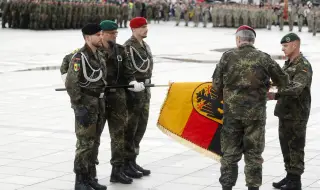
The merger ceremony of the two military formations took place in Kaunas. The "Iron Wolf" Infantry Brigade of the Lithuanian Armed Forces handed over the flags of the NATO multinational battle group to the German 45th Panzer Brigade "Lithuania" on February 4 at a ceremony in the Confluence Park in Kaunas (where the Nemanjas and Neris rivers merge - ed.). After nine years of service as part of a Lithuanian unit, the NATO multinational battle group was transferred under the command and composition of the German brigade,“ the Lithuanian army website says.
This is a clear sign of NATO unity, the resolve of the allies and the long-term commitment to the defense of Lithuania, the Baltic country's Defense Ministry notes. “NATO unity is of key importance in today's security environment, and every serviceman of a NATO ally serving in our country makes Lithuania's defense stronger,“ said the Chief of Defense of Lithuania, General Raimundas Vaikšnoras.
The ceremony began with a divine liturgy in the Kaunas Cathedral “St. Peter and Paul“, where the servicemen received a blessing, the Lithuanian army describes on its website. The command of the NATO battle group was handed over to Lieutenant Colonel Sebastian Hagen. The previous commander of the group, Lieutenant Colonel Tobias Tiedau, was awarded for his services by Minister Kaunas.
"Today, the clearest message to Russia is simple: here are soldiers from the 45th German Panzer Brigade “Lithuania“. It and its NATO allies are strengthening the security of Lithuania and the entire region side by side with the Lithuanian Armed Forces. The NATO multinational battle group officially became part of the German brigade in Lithuania, as the deployment schedule of the German combat formation has been halved“, said the Lithuanian Minister of Defense in his speech during the ceremony, quoted by the website of the country's armed forces.
The commander of the Lithuanian Land Forces – Brigadier General Nerijus Stankevicius, handed over the NATO flag, as well as the color code of the alliance's multinational battle group "Lithuania", to the inspector of the German army - Lieutenant General Christian Freuding,
He, in turn, handed over the flag to the commander of the 45th German brigade - Brigadier General Christoph Huber. The tradition of handing over the flag dates back a long time, sending a message not only of the transfer of command, but also of responsibility, the Lithuanian Armed Forces noted, adding that the colors of the unit are a symbol of honor, identity and dedication. They are part of the ritual as an exceptional sign of trust and unity.
NATO Multinational Battle Group in Lithuania so far
NATO decided to deploy its units to forward positions on the eastern flank at the alliance's summit in the Polish capital Warsaw in 2016. The first troops from the new NATO unit arrived in Lithuania in 2017. The reinforced NATO Forward Presence Battle Group serves integrated into the "Iron Wolf" infantry brigade of the Lithuanian army.
The NATO Forward Presence Battle Group was renamed the NATO Multinational Battle Group on 5 February 2025. As before, it is composed of heavy combat companies, a reconnaissance company, combat support units and a command staff. In case of need, training or threat, the multinational battle group can be reinforced with artillery, air defense, engineering forces and other support at short notice.
The peacetime training cycle of the NATO multinational battle group included combat readiness exercises in Lithuania to enhance the readiness of the Lithuanian defense forces in the event of a crisis or conflict, side by side with national and allied forces. The program after each rotation included training according to agreed combat readiness plans, which culminated in a certification exercise for all servicemen at the time in the "Iron Wolf" infantry brigade, the Lithuanian Ministry of Defense said.
In addition to training and exercises at the training ground, there was also an important aspect of NATO's enhanced readiness for forward presence: the transportation of heavy equipment by water, air and rail. The Allies, which provided rotations to the battalion-sized battle group in Lithuania, provided, in addition to machine guns, grenade launchers and anti-tank systems, also support vehicles, infantry fighting vehicles, armoured personnel carriers and tanks.
The heavy military equipment that underwent training in Lithuania included battle tanks, infantry fighting vehicles (IFVs), armoured personnel carriers (APCs), self-propelled artillery systems, armoured recovery and reconnaissance vehicles, cargo and light transport vehicles, the Lithuanian Ministry of Defence notes on its website.
The servicemen of the NATO multinational battle group actively participated in public events, in most major social initiatives and city festivals in the country, in commemorative ceremonies. Allied troops also participated in blood donation campaigns, as well as in the construction of educational institutions and nursing homes.
What Lithuania is spending its record military budget on
Lithuania is allocating a record 4.79 billion euros of its gross domestic product to defense for the current year 2026, with more than a third of the budget earmarked for the acquisition of major weapons systems. This is stated in publicly released information about the plans of the government of Prime Minister Inga Ruginiene for defense spending, Žigintas Abroimaitis reported on the LRT website.
Officials told the Lithuanian Radio and Television that no major new public procurement contracts are expected this year or in the near future, as the funds will go mainly to deferred payment for previously ordered tracked infantry fighting vehicles, tanks, artillery and air defense systems - purchases intended to equip an entire military division. The remaining funds will be used for infrastructure development, salaries of military and civilian personnel, as well as for routine operational expenses.
Defense spending this year amounts to about 5.38% of Lithuania's GDP, a sharp increase from previous years and the highest level since the restoration of independence in 1990. Lithuania pledged after joining NATO in March 2004 to spend at least 2% of GDP on defense - a goal that took nearly 15 years to fully achieve, LRT notes.
A significant part of this year's budget will be directed to continuing payments for strategic additions to the arsenal made in recent years. Lithuania has ordered 100 CV90 Mark IV tracked infantry fighting vehicles and plans to spend about 375 million euros on them this year. Under an industrial cooperation agreement with Sweden, Lithuanian companies will also participate in the production process, Abromaitis writes.
The payment of tranches for 44 Leopard 2A8 tanks - enough for one battalion - will also continue This year, about 350 million euros have been allocated under the payment scheme in question. The purchase of tanks is the most expensive acquisition for a type of military equipment. For their full payment, several hundred million euros will be needed in the coming years, LRT points out.
Lithuania has also ordered 30 additional CAESAR self-propelled howitzers, bringing the total number of them in the Lithuanian army to 48. This will make Lithuania the second largest owner of this French-made gun system in the world, LRT reports. About 100 million euros are expected to be paid for them this year. There is also a partnership here, with France investing 12 million euros in repair shops in Lithuania, as well as training, simulators and spare parts.
In addition, the Lithuanian military is expecting deliveries of eight American HIMARS multiple launch rocket systems, widely used by Ukraine in its resistance to the Russian invasion, LRT highlights. About 70 million euros will be paid to US manufacturers this year. In addition, approximately 100 million euros will be allocated for a fourth NASAMS medium-range air defense system.
Lithuanian Defense Chief Vaikšnoras said the country expects the first HIMARS batteries to arrive this year and stressed the importance of sustainable financing, LRT reports. “The sustainability of the defense budget is extremely important”, he said, noting ongoing investments in air defense, ammunition and other military capabilities.
Many of the major public procurement contracts were signed by previous defense ministers after Russia's full-scale invasion of Ukraine in 2022. Current civil servants have limited room for decision-making, as more than a third of this year's defense budget is intended for payments for already made orders directly related to the development of the Lithuanian armed forces at the division level, the Lithuanian Radio and Television website states.
Common Baltic Military Mobility Zone
Lithuania's actions in the military sector at the beginning of this year come in the context of the creation of a “common military mobility zone” announced on the eve by the defense ministers of the three Baltic states. military mobility“. The website “Estonian World“ reported on January 31 that the idea of Lithuania, Latvia and Estonia is to lay the foundations for a “military Schengen area“ throughout Europe.
The aim of this military mobility zone is to synchronize the activities of border checkpoints in peacetime, including the procedures for the passage of pedestrians and vehicles, “Estonian World“ specifies. The end result should be a common, harmonious European area, said a statement from the Estonian Ministry of Defense.
The military mobility zone is important for strengthening the defense positions of the three Baltic states, “with the ultimate goal being to create a “military Schengen area“ throughout Europe“, said Estonian Defense Minister Hanno Pevkur, quoted by "Estonian World".
The defense ministers of Estonia - Pevkur, Latvia – Andris Spruds, and Lithuania – Robertas Kaunas, noted in a joint declaration that the Baltic Defense Line has become a modern, cross-sectoral defense concept.
“The defense line has become an essential element in ensuring the security of the eastern flank of NATO and the EU“, said Estonian Minister Pevkur. In 2025, the format for cooperation between the defense ministers of Estonia, Latvia, and Lithuania was chaired by Estonia. This year, the rotating chairmanship was taken over by Latvia.