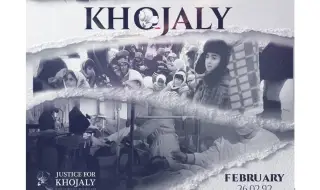
34 years ago, on the night of February 25-26, one of the most brutal crimes against humanity of the past century, the Khojaly genocide, was committed against the civilian population of Azerbaijan. With particular brutality and cruelty, the lives of 613 people were taken, including 106 women, 70 elderly people and 63 children, all in the space of just one night.
On that night, the city of Khojaly, located in the Karabakh region of Azerbaijan, became the scene of mass violence, which remained one of the most painful pages in the country's modern history. For Azerbaijanis, Khojaly is not an abstract geopolitical dispute, but a living memory of torn families, murdered or orphaned children, and survivors who carry the trauma for decades.
The siege of Khojaly, which began in 1991, accompanied by the disruption of transport links and electricity supply, massive shelling and unprecedented atrocities committed on the night of February 25-26, 1992 by the Armenian armed forces against the civilian population, with the assistance of the 366th Motorized Rifle Regiment of the former USSR, testifies that this massacre was in essence a planned and purposeful genocide. During the Khojaly massacre, eight families were completely destroyed, 130 children lost one parent, and 25 children were left completely orphaned. A total of 1,275 people, including 68 women and 26 children, were taken hostage, and the fate of 150 people remains unknown to this day.
The nature of the Khojaly genocide, including the killing of civilians with particular cruelty, inhuman treatment, torture and mutilation of the bodies of the victims, is in direct contradiction with the norms of international humanitarian law, international human rights law and a number of international conventions. Among them are the Convention on the Prevention and Punishment of the Crime of Genocide, the Convention against Torture and Other Cruel, Inhuman or Degrading Punishment, as well as the International Convention on the Elimination of All Forms of Racial Discrimination. These facts imply assuming international legal responsibility.
The confessions of the perpetrators of the Khojaly genocide further confirm its purposeful nature. Among them is the statement of Monte Melkonyan, whose identity has also been established by witnesses, that "Khojaly was a strategic goal, as well as an act of revenge". Of similar significance is the admission of the former President of Armenia Serzh Sargsyan, considered one of the organizers of the tragedy, that "Armenians managed to refute the stereotype that they cannot raise a hand against Azerbaijani civilians", as well as his statement that "they absolutely do not regret this". These statements are cited as evidence that the Khojaly genocide was committed intentionally and that Armenia bears international responsibility.
For Bulgarian and European readers, Khojaly is important because it raises an internationally significant and universal question, namely: what happens when the civilian population falls into the trap of an armed conflict and humanitarian guarantees collapse?
The basic principles of international humanitarian law are clear in their meaning: civilians must be protected; prisoners of war must be treated humanely; collective punishment and indiscriminate attacks are prohibited. When these rules are violated, the damage does not end with the end of the shooting. It continues in the form of distrust, bitterness, forced displacement and generational trauma that hardens political positions and narrows the space for reconciliation.
In Azerbaijan, Khojaly remains in the popular memory as a place of loss, but at the same time it is increasingly presented as a place of revival, return and reconstruction. Within the framework of the country's post-conflict program, this is described as part of the policy of the so-called “Great Return“, representing a state commitment aimed at rebuilding communities and infrastructure in areas affected by displacement.
The city of Khojaly was liberated on September 19, 2023, as a result of local anti-terrorist operations. On October 15, 2023, President Ilham Aliyev raised the National Flag of Azerbaijan in the city of Khojaly. A symbolic moment occurred on May 28, 2024, when President Ilham Aliyev and First Lady Mehriban Aliyeva met with residents returning to Khojaly, handing them the keys to their new homes. For these families, the keys are not just a home, but a symbolic end to a long exile and the beginning of an attempt, albeit a difficult one, to overcome the historical rift.
Reconstruction is not just about building new buildings. It means restoring livelihoods, public services and communications, namely the construction of roads, schools, health facilities, as well as the broader economic reintegration of the region. The official information on the “Great Return” program of Azerbaijan shows that the emphasis is placed on the construction of large-scale transport, social and infrastructure projects in the liberated territories.
On February 25, 2025, the head of state signed the Order “On the establishment of a Memorial Complex in memory of the victims of the Khojaly genocide”.
With the aim of international recognition of the genocide committed against the Azerbaijani people and perpetuating the bright memory of the victims of the tragedy, a ceremony to lay the foundation stone of the Memorial Complex in memory of the victims of the Khojaly genocide was held today, February 26, 2024.
The memorial complex, created by the “Heydar Aliyev” Foundation along the Khojaly-Askeran transport section, consists of different sections. It presents facts about the tragedy that occurred on the night of February 26, 1992, as well as information about the history and geographical significance of Khojaly and about life in the city before the tragedy that befell the civilian population. The doves on the ceiling of the memorial symbolize respect for the memory of the innocent residents of Khojaly who were killed during the tragedy, and express the aspiration for peace in the world as a whole.
The memorial to the victims of the Khojaly genocide is of great importance for presenting to the world community the truth about the cruel massacre directed against humanity, for preserving the national memory of the Azerbaijani people, and for perpetuating the memory of the victims of the genocide.
Regardless of whether we look at these processes through the prism of a political event or a human drama, the reality remains unchanged: displaced people all over the world yearn for the same things: security, stability, dignity, and the opportunity to restore their daily lives.
Azerbaijan has repeatedly stated that it strives to build a future based on normalization, reconstruction, and regional economic integration. The aim is to build a vision for the South Caucasus that is defined by cooperation, not confrontation.
Achieving sustainable peace requires more than remaining silent in the wake of violence. It requires the ability to acknowledge suffering, to establish the facts as accurately as possible, and to create legal, political, and societal mechanisms through which accountability can be sought. Without this, reconciliation remains fragile.
This lesson should ring familiar to Europe. The project of a united Europe is built not on the intention that the tragedies of the 20th century be forgotten, but on the desire to make sense of them – through memory, institutions, and common rules designed to prevent the tragic events from recurring. That is why remembrance is not “old history.” It is a protective fence.
Khojaly is spoken of in a universal language because it reminds us of three inconvenient truths:
1. In times of war, civilians are the ones who pay the highest price, especially when humanitarian protection fails.
2. Peace is not sustainable without truth and accountability. Forgetting may temporarily dull emotions, but it rarely builds trust.
3. Memory, not as fuel for hatred, but as a commitment to “never again”, can be a guarantee for preventing tragic events.
Preserving the memory of Khojaly means discerning the right to life of civilians in times of war, a reminder that suffering must not be relativized and that justice, moral, political and legal, remains a necessary foundation for any truly sustainable peace. It is also an affirmation of a European standard that should apply everywhere: human dignity is non-negotiable, and the protection of civilians cannot be selective.
Ultimately, the events of Khojaly are not just an Azerbaijani tragedy. They are a warning inscribed in the broader European conscience: when civilians are abandoned to the logic of war, the consequences are carried over generations, and the price of the neglected lesson is inevitably paid in human lives.