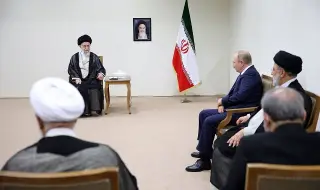
Russian representatives condemned the US and Israeli strikes against Iran on February 28, in line with Russian rhetoric surrounding the Israeli-Iranian war of June 2025.
Russian Foreign Minister Sergei Lavrov held a phone conversation with Iranian Foreign Minister Abbas Araghchi after the strikes, calling on the United States and Israel to immediately cease all hostilities and resume efforts for a diplomatic solution.
This is reported by the Institute for the Study of War (ISW).
The Russian Foreign Ministry (MFA) in a statement described the strikes as unprovoked, a violation of international law and a risk of regional and global destabilization.
Moscow criticized Israel for previous statements that it has no interest in armed aggression against Iran.
Russian Security Council Deputy Chairman Dmitry Medvedev directly criticized US President Donald Trump, claiming on his social media channels in English and Russian that the "peacemaker" had "showed his true face".
The Chairman of the Russian State Duma Committee on International Affairs Leonid Slutsky and the First Deputy Chairman of the Committee on International Affairs Alexei Chepa, whose target audience is the Russian population and who often act as mouthpieces for the Kremlin's true diplomatic and military goals, also called on both the United Nations Security Council (UNSC) and the wider international community to intervene in the situation to stop the strikes.
Chepa expressed hope that the United States would engage in the conflict in Iran and "forget" for Ukraine, and assessed that the new conflict would likely delay a peace agreement in Ukraine.
Russia's patterned condemnations of the strikes on Iran highlight the asymmetry in Russian-Iranian relations. Russia failed to provide Iran with more support in June 2025.
The war in Ukraine highlights how Russia has become less dependent on Iran for its military efforts over time, as it has produced much of what it previously imported from Iran. It subsequently became much more dependent on North Korea.
The Kremlin must balance competing interests while trying to reset U.S.-Russia relations on Russia’s terms, including avoiding further U.S. sanctions.
Ukrainian authorities have accused soldiers and the commander of the Russian 136th Motorized Rifle Brigade (58th Combined Arms Army, Southern Military District) of using chemical agents in Vovchansk, Kharkiv Oblast, from September 2024 to June 2025 in violation of international law. The Security Service of Ukraine (SBU) reported on February 27 that the commander of the 136th Motorized Rifle Brigade, Colonel Ruslan Nazarenko, gave orders to fire K-51 and RG-Vo aerosol grenades containing CS gas (chlorobenzalmalononitrile) and CN gas (chloroacetophenone) at Ukrainian positions using drones at least 14 times from September 2024 to June 2025.
The SBU also identified eight Russian soldiers from the 136th Motorized Rifle Brigade who used the munitions, in violation of the Chemical Weapons Convention (CWC), to which Russia is a party.
ISW is monitoring reports that Russian forces have significantly increased their use against Ukrainian forces in 2024 and 2025.